Welcome back to our Florida’s Hidden Invaders Blog Series where we focus on spreading awareness of invasive species and their impacts. In this section we will focus on houseplants that become invasive if planted in the landscape.
For much of the world, tropical plants are grown strictly as indoor houseplants because they need warm temperatures to thrive. But here in sunny Florida, many of these “houseplants” can survive year-round outdoors—and that can become a serious problem for our environment.
Some common houseplants are invasive in Florida and should only be grown indoors. When planted in the landscape they can escape cultivation, spread aggressively, and harm native ecosystems. All of the plants listed below are also toxic to pets, so they may not be the best choice if you have animals in your home.
 Snake Plant (Sansevieria trifasciata)
 Snake Plant (
- Recognizable for its upright, sword-shaped leaves with green and yellow variegation, Snake Plant is a low-maintenance favorite for low-light spaces. Indoors, it’s nearly indestructible. Outdoors, however, it can become a serious nuisance.
- Any part of the plant—including leaves, seeds, or underground tubers—can regenerate new growth. These tubers can persist for years, making control extremely difficult. There are currently no herbicides labeled for Snake Plant control, so once it spreads, removal becomes a long-term maintenance battle. Best to keep this plant in a pot indoors.
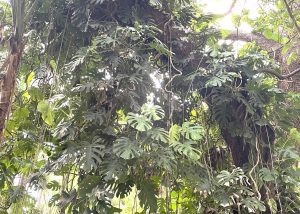
Swiss Cheese Plant (Monstera Deliciosa)
- This showstopper plant is a favorite for its large, glossy leaves with natural holes. Indoors, it’s a gorgeous statement piece. Outdoors in Florida, it can become invasive by climbing trees and spreading rapidly via aerial roots. Once established, it uses tree trunks for support and can damage the host tree by smothering it. Keep this beauty inside and out of the garden.
- Photo: Clarissa Chairez, University of Florida
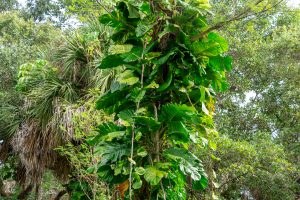
Golden Pothos (Epipremnum aureum)
- Pothos is a classic trailing plant for hanging baskets, but outdoors it behaves much like Swiss Cheese Plant—climbing and overtaking trees, fences, and other plants. While it may look charming climbing up a trunk, it can severely harm native vegetation. For Florida gardens, this is one plant that’s best kept trailing indoors.
- Photo: Clarissa Chairez, University of Florida

Wandering Dude/Inch Plant (Tradescantia zebrina)
- Valued for its vibrant purple-and-green striped foliage, Inch Plant grows quickly and roots easily from cuttings. Outdoors, it can spread rapidly, even from a tiny piece tossed into a compost pile. While not currently listed as invasive in north or central Florida, its growth rate and ability to propagate make it a species to watch closely. Be cautious when using it as groundcover.
Dumb Cane (Diffenbachia seguine)
- With its bold, variegated leaves, Dumb Cane is a popular indoor ornamental. However, the UF/IFAS Assessment of Non-Native Plants predicts it could become invasive. If you propagate or gift Dumb Cane, ensure it stays in a container indoors to prevent outdoor escape.

Spider Plant (Chlorophytum comosum)
- Spider Plant is famous for its arching leaves and long “runners” tipped with baby plants. Those runners root easily in soil, allowing the plant to multiply rapidly outdoors. Recently categorized as invasive by the UF/IFAS Assessment, Spider Plant can outcompete native species if planted in the landscape. Keep it indoors to avoid unwanted spread.
If you like the appearance of these plants, keep them in a pot growing indoors! If you are looking for alternative plants for your landscape, check out the Florida Friendly Landscaping TM Plant Selection Guide to find a plant that fits your needs.
Don’t forget to check out the other blogs in our Florida’s Hidden Invaders Blog Series!
- Introduction to Invasive Species
- Common Invasive Plants in Our Yards Part 1
- Common Invasive Plants in Our Yards Part 2
- Teaching Youth About Invasive Species
 1
1