The Quinceys:
Established in 1965, Quincey Farms II is an 800-acre operation outside of Trenton, Florida that has been passed from father to sons. The Quincey brothers, Zane and Kelly, have recently taken over for their father but have continued in his footsteps when it comes to tillage of the soil, with a dense crop rotation of corn, peanuts, watermelons, hay, Bahia grass, oats, sesame and even some cattle. The brothers are no strangers when it comes to farming.
Some of the Best at Better Management:

The Quincey brothers have implemented Best Management Practices (BMPs) for more than ten years and have worked closely with UF/IFAS and Extension to gain knowledge in certain aspects of better management. Whether it be grid soil sampling, soil moisture probes, and an overall practice of water conservation, Quincey Farms II serves as a strong example of BMP implementation in action.
Their commitment to better management earned the brothers’ recognition by the Florida Farm Bureau CARES program back in 2024. This program recognizes Florida farmers who demonstrate great efforts in protecting Florida’s natural resources by using BMPs. In addition, the Quincey brothers also earned a first-place award through the UF/IFAS Florida Stakeholder Engagement Program (STEPS) Florida Stakeholder Engagement Program (STEP) – University of Florida, Institute of Food and Agricultural Sciences – UF/IFAS in 2025 for growing corn. This program gives farmers a way to test various management strategies, new technologies, nutrients, and water efficiency practices while maximizing profitability. It also allows for peer-to-peer interaction and supports collaborations within the agriculture communities.
Sweet Blue Lupine:
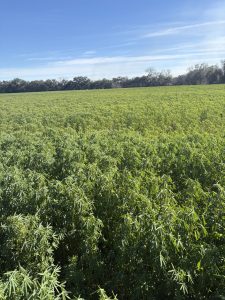
Sweet Blue Lupine is a legume known as Lupinus angustifolius and is frequently used for food plots to attract wildlife, but at Quincey Farms II it’s used as a nitrogen fixation cover crop. Cover crops are grown to help protect and improve soil quality, increase soil organic matter, prevent soil erosion, suppress weeds, and potentially improve yields by acting as an organic nitrogen source. In some cases, it can even be harvested for seeds to be sold and generate revenue. This past corn growing season Zane Quincey, who manages the agronomic row crop side of the operation, had great things to say about the Sweet Blue Lupine.
Planted in mid-October, the lupine served both as a cover crop and seed crop. By May, Quincey harvested the Blue Lupine after reaching maturity and planted corn directly behind it. Between the nitrogen contribution from Blue Lupine and the use of best management practices, the Quinceys were able to get a 6-bushel-per-acre yield increase in their corn crop compared to other corn fields that did not have blue lupine as a cover crop all while reducing their nitrogen inputs and actually being under the recommended nitrogen rate from UF/IFAS.
Keeping the Blues Around:
Although Sweet Blue Lupine has not yet gained widespread popularity in the Suwannee Valley; the Quincey brothers plan to keep it within their rotation if it continues to deliver results. Through cover cropping, reduced nitrogen inputs, and consistent BMP use, Quincey Farms II is paving the way toward a more sustainable future. Zane expressed his philosophy on farming by saying “Sometimes we need to rotate our thinking just as much as we rotate our fields.” With the knowledge, experience, and commitment to conservation, the Quincey brothers are well positioned and will embrace working with modern agricultural technologies and how it all evolves to add to their family farming legacy.
Authors: Kelsey Crain, Sydney Williams, Mark Warren, and Beth Cannon
University of Florida, Institute of Food and Agricultural Sciences; North Florida Research and Education Center – Suwannee Valley
 0
0