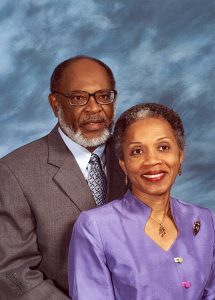
Celebrating a lifetime dedicated to agricultural research progress, a $1 million gift launches an endowment that will empower doctoral students to continue the legacy and mission of a pioneering agricultural economist at the University of Florida Institute of Food and Agricultural Sciences (UF/IFAS).
The pledge establishes the Dr. Carlton G. Davis Scholarship Endowment for Ph.D. Research in Tropical Agriculture and delivers a powerful response to Challenge 180, a fundraising effort by the UF/IFAS Tropical Research and Education Center (TREC) for $180,000 to provide scholarships for doctoral students whose work would bolster food security measures in Florida and across the Caribbean Basin.
The endowment will fund the work of doctoral students whose research at TREC focuses on agricultural sciences of significance to the Caribbean, Florida and Latin America.
Announced by his wife of 47 years, Pauline Lawrence, professor emerita in the UF/IFAS Department of Entomology and Nematology, at the recently held 11th One‑Night in the Tropics fundraising event, the gift honors the life and legacy of Carlton George Davis, a Distinguished Professor Emeritus in the UF/IFAS food and resource economics department. His research, mentorship and service promoted learning, fostered interdisciplinary collaboration and influenced institutional policy decisions in the United States, throughout the Caribbean and in various African countries.
“From his days at Mannings High School in Jamaica, Carlton understood how vital agriculture was to a country’s
economy,” said Lawrence. “He was mentored by one of the island’s first agricultural economics graduates, and subsequently by Abram Epp of the University of Nebraska, and Glenn Johnson of Michigan State University. These mentorships sparked his passion for, and shaped his lifelong commitment to, the study of agricultural economics in developing economies across the Caribbean and other tropical countries.”
For Davis and Lawrence, Florida’s juxtaposition to the Caribbean makes TREC an ideal hub for advancing tropical agriculture research and the perfect place for the Carlton G. Davis Endowment.
“The gift represents more than philanthropy. It is an investment in people, discovery and the future resilience of Caribbean and South Florida agriculture,” said Edward “Gilly” Evans, director of UF/IFAS TREC.
Evans explained that TREC is the only state university research center working on a wide variety of tropical and subtropical crops and on myriads of issues that are also pertinent to other areas of the tropics and subtropics. That statement resonates personally with Lawrence, whose career was deeply influenced by the opportunities TREC provided.
“My breakthrough research on the Caribbean fruit fly, a pest found in Jamaica for instance, was initiated at TREC with support from the center,” she said. “Moreover, my husband, who had mentored several students, knew all too well the role long-term funding could have in attracting top-quality graduate students whose research could advance tropical agricultural sciences and further strengthen TREC’s role as a global leader.”
A legacy rooted in equity and global agricultural progress
Born in Black River, St. Elizabeth, Jamaica, Davis became the first Black tenured faculty member at UF/IFAS and one of the first three at UF when he joined in 1970. As a leading authority on international agricultural trade and development, rural poverty and food security in the Southern United States, the Caribbean Islands and various African countries, he left an indelible mark on the field of agricultural economics over decades of impactful research, teaching and public service.
He earned numerous national and international recognitions, including:
- Outstanding Black Agricultural Economist Award from the American Agricultural Economics Association (1984),
- UF Distinguished Black Faculty Award (1993),
- Lifetime Achievement Award from the Southern Agricultural Economics Association (1996),
- George Washington Carver Public Service Hall of Fame Inductee from Tuskegee University (2005),
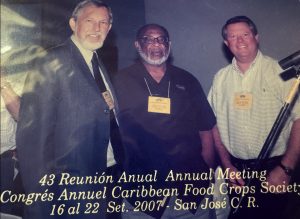
- Outstanding Contribution Award from the Caribbean Food Crops Society (2008).
Davis, a prior Ford Foundation International Research Fellow, was also a visiting professor at the University of West Indies in Trinidad and Tobago. He was a leader in several professional associations, including the Caribbean Food Crops Society that fostered collaboration among Caribbean and Latin American agricultural scientists and their students and their UF/IFAS counterparts. Davis frequently translated research into policy improvements. One of the most notable influenced a change in the U.S. Department of Agriculture Food Assistance Program guidelines for low-income households.
He, with Evans and others, was instrumental in formulating the Caribbean Region Invasive Species Intervention Strategy (CRISIS) document to help safeguard the wider Caribbean Region, including Florida, from the introduction and spread of harmful pests and diseases.
“Davis devoted his career to cultivating future leaders in agricultural economics, mentoring students from diverse backgrounds in the U.S. and from around the world,” said Lawrence.
From Rockefeller Foundation minority fellows to students from the Caribbean, Latin America and Africa, he helped launch careers that would go on to influence agricultural policy and food systems globally. Many of his graduates returned to serving their home countries in distinguished leadership roles in academia, industry and government while fostering international collaborations with UF and other institutions.
His first doctoral student, Jean Ongla from Cameroon, became professor and vice chancellor of the University of Dschang in Cameroon.
“The excellent academic training and mentorship he received under Carlton at UF likely had a favorable impact on subsequent international collaborations between the two institutions that resulted in their signing of a memorandum of understanding,” said Lawrence.
Adama Bakayoko, another of Davis’ doctoral students from the Côte d’Ivoire, became a dean at the University of Abidjan and was later appointed as general director of the national oil company, Petroci Holding, of the Ivory Coast. As an investment economist, he formulated energy policy and sometimes sought Davis’ advice on economic matters.
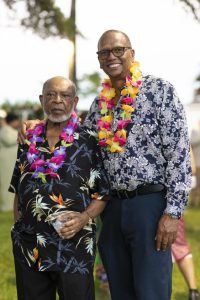
Evans was another of Davis’ outstanding doctoral students. Now a TREC professor and center director, he continues Davis’ legacy through his own leadership, innovation and mentorship of numerous students from various backgrounds.
“It is fitting that the Davis endowment, coupled with Challenge 180, will fund students who will carry their legacy of research excellence in areas critical to the agricultural sciences,” said Lawrence.
She further noted that Davis believed true progress in science comes from unity, not isolation.
“If he were here to speak to the first recipient of the Davis scholarship, I think he would emphasize the need for research collaboration across disciplines because success comes not only from working hard but from working together, sharing ideas, building partnerships and lifting others as you climb,” she said.
Together, Lawrence and Davis believed that agriculture is an essential component of developing economies, such as in the Caribbean, Latin America and in subtropical Florida. Despite this, agriculture has not received the depth of study it urgently needs to address burgeoning issues such as climate change, invasive species and unanticipated challenges, said Lawrence.
“We must invest in students and scientists who will advance these fields. Agriculture is essential to many tropical economies and without more research, these regions cannot thrive,” said Lawrence. “Carrying this work forward is vital for our future. I hope that this endowment and Challenge 180 will have some impact on TREC’s ability to identify and train the best students who themselves are committed to addressing challenges, existing and unexpected, that these tropical regions and Florida may face.”
###
ABOUT UF/IFAS
The mission of the University of Florida Institute of Food and Agricultural Sciences (UF/IFAS) is to develop knowledge relevant to agricultural, human and natural resources and to make that knowledge available to sustain and enhance the quality of human life. With more than a dozen research facilities, 67 county Extension offices, and award-winning students and faculty in the UF College of Agricultural and Life Sciences, UF/IFAS brings science-based solutions to the state’s agricultural and natural resources industries, and all Florida residents.
WHY FOOD IS OUR MIDDLE NAME
Feeding a hungry world takes effort. Nearly everything we do comes back to food: from growing it and getting it to consumers, to conserving natural resources and supporting agricultural efforts. Explore all the reasons why at ifas.ufl.edu/food or follow #FoodIsOurMiddleName.
 1
1

