Imagine 19th century Florida: sweltering heat with no air conditioning, swarms of mosquitoes, nights lit only by campfires and the harsh reality that any meat on your plate had to be hunted and killed by you.
These gritty details aren’t just history – they’re lessons coming to life for 15,000 fourth graders, statewide, as they read A Land Remembered, a best-selling historical novel by Patrick Smith. The book focuses on three generations of the MacIvey family, from the frontier days of the 1800s to the era of modern Florida development.
A Land Remembered is central to a curriculum developed by Bridget Stice, a Polk County livestock Extension agent. She has two major goals with the program.
“We’re offering a fun and easy-to-use curriculum for fourth-grade teachers, to use in their classrooms, that matches the learning goals for their students,” said Stice, interim director of University of Florida Institute of Food and Agricultural Sciences (UF/IFAS) Extension Polk County.
The curriculum associated with A Land Remembered has been developed to align with Florida’s fourth-grade English & Language Arts, Social Studies and Science Learning Standards.
“The second goal is to increase awareness and understanding of agriculture’s role in Florida’s history and culture, environment and food systems,” Stice said. “As students become more aware and understanding, they will have a greater appreciation of working lands and the people that care for them.”
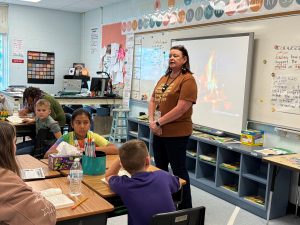
On Nov. 21, students at Spook Hill Elementary School in Lake Wales listened as Kristin Chandley read a few chapters aloud from the book.
As she took a brief break from reading, Chandley, an agriculture and gifted teacher at the school, said: “The next time you roll through a fast-food place, think how easy it is to get food now, and how hard it was back then.”
Language arts teacher Ashley Smith then reminded students about the challenging conditions pioneers faced.
“Florida is very hot and has lots of mosquitoes,” Smith said. “It was hard to grow a crop. They wondered if they were even going to get any rain.”

Some things – hot weather and bugs — haven’t changed.
While they were only on Chapter 3 out of 23 chapters in the student edition, pupils at Spook Hill are noticing the differences between roughing it in the wilderness and living and attending school in climate-controlled comfort.
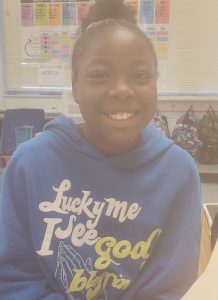
“It was very hard for them. They had to live in the woods. It was hot, and they had to find animals to kill and eat,” said student T’Shaonne Irving.
Classmate Zachary Ashcroft noticed that pioneers had to retrieve water – unlike now, when water fountains are just outside the classrooms. Picturing himself back in 19th century Florida, Zachary said: “It would be hot and sweaty. You couldn’t get cooler, because there’s no air conditioning, and if it’s cold, you have no blankets.”
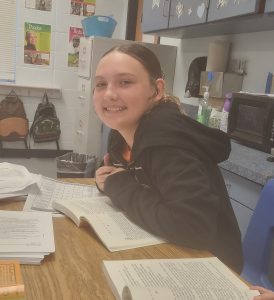
Codi McKay noted that people living in 19th century Florida couldn’t freeze their meat, like we do now. You had to either eat meat right away, or you could smoke the meat to preserve it, she said.
Language arts instructors teaching the curriculum are giving students an overview of the curriculum.
“For instance, we’ve told them this is what it was like way back when and how things are different now,” said Lavinia Parido. “I hope they learn to appreciate the things we have now, and the struggles that they went through (in history).”
In January, after students have finished the curriculum, Stice and Kendall Gill, the livestock agent for UF/IFAS Extension DeSoto County, will live stream events from the Great Florida Cattle Drive. If students can’t tune into the livestream, it will be recorded and shown later on YouTube.
Want to follow along? You can find A Land Remembered at your local library.
 6
6

