Across the Sunshine State, some Floridians are eyeing roadsides as potential havens for pollinators. But there’s a catch – while many residents are fond of bees, butterflies and other beneficial bugs, a new University of Florida study shows that enthusiasm doesn’t always translate to action.
Researchers with the UF Institute of Food and Agricultural Sciences (UF/IFAS) conducted an online survey of 1,051 Floridians and found four categories of respondents.
The two extreme categories were those labeled “positive pollinator passerbys,” who have favorable attitudes but lack interest in supporting roadside habitats, and “pollinator patrons,” who have very positive attitudes and are actively supporting these spaces. One of the moderate groups, the “pollinator advocates in waiting,” has strong positive attitudes and is ready to take action.
“It is clear there is a large subset of the population not even thinking about these spaces and how they can support pollinators,” said Laura Warner, a UF/IFAS professor of agricultural education and communication and lead author of the study. “I think we have a big opportunity to make the benefits of these spaces, when managed appropriately, much more public.”
Messaging for the pollinator advocates in waiting – who are eager to help — needs to focus on benefits to the environment and local food, Warner said.
“Since this group values pollinator-friendly roadsides and is ready to act, we don’t need to sell them on this concept but would communicate about clear steps they could take to support these spaces,” she said. “This group is well positioned to volunteer for maintenance or planting projects, support specific programs, adopt a pollinator-friendly roadside, purchase a license plate, etc.”
To learn about pollinator-friendly roadsides, people prefer small signs, and they pay attention to roadside vegetation, so they would likely respond well to messaging embedded along their driving routes, Warner said.
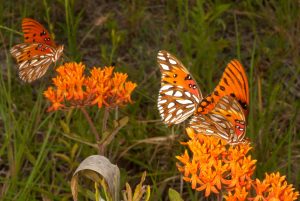
Pollinators — such as wasps, bees and butterflies — play an essential role in ecosystem health and food security. They love to live along the sides of roads, and Florida has 124,000 miles of roads, according to the state Department of Transportation.
Blooming plants and foraging pollinators help Florida’s two largest industries – tourism and agriculture. With all the roadsides, “we have plenty of opportunities to help pollinators,” said Jaret Daniels, curator of lepidoptera at the Florida Museum of Natural History.
“Instead of taking farmland out of production to plant blooming flowers that support pollinators, roadsides are available and nearby,” said Daniels, a UF/IFAS professor of entomology and study co-author. “But how do we manage these lands and how do we generate buy-in from the public and decision makers about the importance of pollinator-friendly roadsides?”
With results from the study, researchers think they’re starting to get answers, including pollinator gardens at rest areas.
Despite the critical nature of pollinators, evidence continues to point to significant declines in their populations.
“To reverse this, we can no longer simply focus on lands set aside for conservation. We must develop strategies that allow other, managed landscapes in the built environment to help support pollinators,” Daniels said.
The new study follows a recent Ask IFAS document that also focused on Florida residents’ knowledge and perceptions toward roadside pollinators. The Ask IFAS document pointed to some key conclusions:
- Floridians know a lot about environmental and ecological aspects of roadsides, but less about actual management of pollinator-friendly roadsides.
- Respondents ranked environmental and ecological elements as more important than aesthetics when it comes to pollinator-friendly roadsides.
- Survey participants preferred educational communication — mainly in the form of a demonstration garden, for example at a rest stop or welcome center – to inform them of the benefits of roadside pollinators.
###
ABOUT UF/IFAS
The mission of the University of Florida Institute of Food and Agricultural Sciences (UF/IFAS) is to develop knowledge relevant to agricultural, human and natural resources and to make that knowledge available to sustain and enhance the quality of human life. With more than a dozen research facilities, 67 county Extension offices, and award-winning students and faculty in the UF College of Agricultural and Life Sciences, UF/IFAS brings science-based solutions to the state’s agricultural and natural resources industries, and all Florida residents.
 6
6

