New University of Florida research suggests native plants may be able to produce more flowers for pollinators under both full and partial irrigation. That means more pollinators, such as bees, may be attracted to them.
For the study, scientists selected 20 plants – 10 native and 10 non-native — based on several criteria:
- Their anticipated value to pollinators (particularly bees).
- Diversity in bloom times.
- A mix of flower colors and shapes to attract different pollinators.
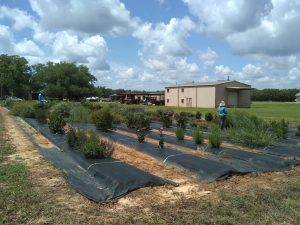
Scientists planted the species at the UF/IFAS North Florida Research and Education Center in Quincy and at the Plant Science Research and Education Unit in Citra. They used different irrigation levels to see how well the plants would grow under limited water.
While full irrigation enhanced plant survival during the first year of the two-year project, native plants generally outperformed non-native ones in both overall plant size and flower density, regardless of water levels, in this study.
“This suggests that native plants may be a good choice for attracting native pollinators, who like to visit dense floral displays,” said Joanna Silva, a doctoral student who conducted the research — with funding from USDA-NIFA — under the supervision of principal investigator Rachel Mallinger, an assistant professor of entomology. “Native plant species can support pollinator populations, which is a key strategy for addressing global pollinator decline.”
That makes these findings worth noting for landscapers, gardeners and nurseries, she said.
“Many commercially available plant mixes include native and non-native plants, but sometimes, some of these plants do not provide sufficient resources for pollinators – such as abundant flowers containing nectar and pollen,” Silva said. “By planting native plants, they can create more sustainable landscapes that support local pollinators and wildlife.”
UF/IFAS is constantly evaluating the efficacy of native vs. non-native plants and regularly updates its Assessment of Non-Native Plants in Florida Natural Areas, which you can access here. This list identifies native, non-native/non-invasive and invasive plants to assist gardeners and landscapers in plant selection.
###
ABOUT UF/IFAS
The mission of the University of Florida Institute of Food and Agricultural Sciences (UF/IFAS) is to develop knowledge relevant to agricultural, human and natural resources and to make that knowledge available to sustain and enhance the quality of human life. With more than a dozen research facilities, 67 county Extension offices, and award-winning students and faculty in the UF College of Agricultural and Life Sciences, UF/IFAS brings science-based solutions to the state’s agricultural and natural resources industries, and all Florida residents.
 3
3

