About this series
- As residential and commercial development continues to expand across Florida, wildlife is adapting to live closer to people.
- The University of Florida Institute of Food and Agricultural Sciences (UF/IFAS) shares tips through Ask IFAS publications, available in English and Spanish, to help residents and visitors understand and coexist with these species.
- Building on this mission, Wildlife Watch is a new monthly series highlighting seasonal wildlife and Ask IFAS resources to help Floridians learn, appreciate and share their neighborhoods with nature.
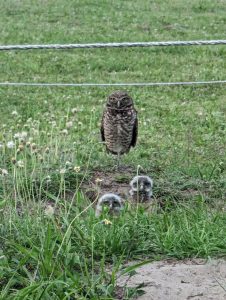
They’re small, quirky and curious, and they live underground. Florida’s burrowing owls are starting their nesting season, surprising residents as they fly into their neighborhoods. This makes it easy to spot them as they build a home in backyards, nearby parks and even golf courses.
As the national population is projected to grow to nearly 370 million by 2080, according to the United States Census Bureau, pressures on land use and wildlife habitat are increasing across the states, including Florida. These trends show sustained growth and the expanding footprint of urban sprawl, making thoughtful coexistence with wildlife more important than ever.
As more people move into Florida, wildlife is adapting to live closer to people than ever. Florida’s burrowing owls are small but mighty birds that play a big role in our ecosystem and are a prime example of wildlife living with humans.
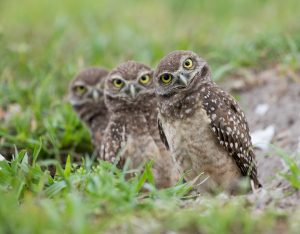
These charismatic native birds are the focus of a recently released Ask IFAS publication, Wildlife of Florida Factsheet: Burrowing Owl, now available in Spanish. The publication sheds light on what to expect and how to co-exist with these protected birds.
UF/IFAS wildlife experts say these are the key things to keep on your radar:
Basics on protecting the species:
- Burrowing owls are a protected species.
- Protect nesting owls by maintaining vegetation under 5 inches around burrow entrances and use light equipment like weed trimmers. Also, avoid heavy machinery.
What makes them unique:
- Florida burrowing owls are a geographically distinct, nonmigratory subspecies, unlike their western counterparts, meaning they stay in-state year-round.
- They are active both day and night and can even hover in mid-air, a rare behavior for an owl.
Nesting and breeding timelines to watch out for:
- Nesting season runs from January through March. To entice them to stay, avoid disturbing burrows or mowing nearby areas.
- The breeding season spans February through July, with eggs incubating for 21–28 days and chicks fledge around 12 weeks later.
- Young owls emerge from their burrows at just two weeks old and stay with their parents for about 12 weeks before becoming self-sufficient.
See how they dress up their digs:
- Though they commonly dig their own burrows, the owls also opportunistically occupy abandoned burrows made by gopher tortoises or armadillos, and even use man-made structures like manholes, sewer drains and PVC pipes.
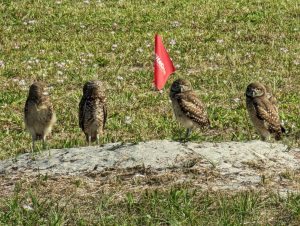
- They often decorate their burrow entrances with eclectic items such as feathers, insect parts, grass clippings, branches, debris and more to deter predators.
Ways we can help:
- Help these owls by installing T-perches near their burrow sites, giving them better vantage points to watch for predators and prey.
- Restrict the use of pesticides that may affect owl food sources.
- Keep pets away from the burrow site and observe from a distance.
Para accesar a este contenido en español, por favor utilice este enlace.
###
By Lourdes Mederos, rodriguezl@ufl.edu
ABOUT UF/IFAS
The mission of the University of Florida Institute of Food and Agricultural Sciences (UF/IFAS) is to develop knowledge relevant to agricultural, human and natural resources and to make that knowledge available to sustain and enhance the quality of human life. With more than a dozen research facilities, 67 county Extension offices, and award-winning students and faculty in the UF College of Agricultural and Life Sciences, UF/IFAS brings science-based solutions to the state’s agricultural and natural resources industries, and all Florida residents.
 0
0

