It’s one thing to listen to a farmer describe the challenges of battling pests, unpredictable weather or dwindling resources — and quite another to hand them a tool that can tackle those problems head‑on.
Imagine technology that manages issues in real time. Increasingly, that means putting artificial intelligence (AI) directly into the hands of farmers, transforming centuries‑old practices with cutting‑edge innovation.
That’s the vision driving scientists at the new Center for Applied Artificial Intelligence in Agriculture.

“We’re not just studying problems — we’re equipping farmers with solutions,” said Nathan Boyd.
The mission of AI center faculty is to turn AI from a concept into a practical partner in the field, one capable of reshaping the future of farming by solving problems in real time.
Boyd spoke before the Nov. 7 groundbreaking of the AI hub at the Gulf Coast Research and Education Center, part of the University of Florida Institute of Food and Agricultural Sciences (UF/IFAS).
The day also marked the centennial celebration of GCREC. While faculty at the center have been helping farmers manage their issues for 100 years, scientists at the AI facility will expedite the process of getting technology to growers.

“From the very beginning, the thing that was very clear was that we want to play an integral part of not just coming up with a prototype, but we want to begin defining what is the pathway to commercialization,” said Boyd, associate director of GCREC, who’s also in charge of the AI center. “We want to get useful tools into the hands of the people that need them.”
That’s not just a matter of getting technology in growers’ hands. You need grower buy-in.
“We want to get that tool in a form that they can use and in a form that they want,” Boyd said. “It’s that close relationship between the researcher and with our stakeholders.”
Sometimes, farmers resist new technological advancements. It can feel risky. But in gathering data before breaking ground on the AI center, Boyd and others reached out to farmers to learn their priorities – a process that will continue.
“Our approach to this is going to be farm-focused research priorities,” he said. “We’ve already started working on it. We meet with farmers and say, ‘What is that you need the most?’ And from that, we can take a synergistic approach to development, where we take the best scientists at the University of Florida and other institutions, bring them together and say, ‘This is the problem. How do we address it?’”
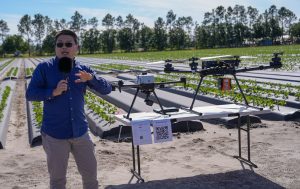
Then, scientists will work with stakeholders to make sure they can help the farmer manage his or her problem.
“It’s all about grower adoption,” Boyd said. “How are they going to adopt what we recommend. Well, if growers are involved in the process, to create something that they’ve identified that they need, as well as designed it in a way that they want it, adoption is not an issue.”
People often ask Boyd why he and the faculty at the AI center don’t appear to be working on solving growers’ issues beyond Florida.
His answer is simple: They are.
“Our faculty here already do that,” Boyd said. “When it comes to global work, I realized something: Sometimes we worry too much about whether something will have a global impact. If you design something that addresses the needs of the local grower, it will be excellent and it will be adopted globally.”
Construction on the 40,000-square-foot facility is scheduled to begin in January and is expected to be completed in 2027, he said.
###
ABOUT UF/IFAS
The mission of the University of Florida Institute of Food and Agricultural Sciences (UF/IFAS) is to develop knowledge relevant to agricultural, human and natural resources and to make that knowledge available to sustain and enhance the quality of human life. With more than a dozen research facilities, 67 county Extension offices, and award-winning students and faculty in the UF College of Agricultural and Life Sciences, UF/IFAS brings science-based solutions to the state’s agricultural and natural resources industries, and all Florida residents.
 0
0

