In the heart of Florida’s agri-tech renaissance, students at the University of Florida are not just studying the future of farming – they’re inventing it.
With artificial intelligence becoming central to everything from crop management to heat resilience, UF’s Institute of Food and Agricultural Sciences (UF/IFAS) is training the next generation of technological innovators who will redefine how we grow food and feed the world.
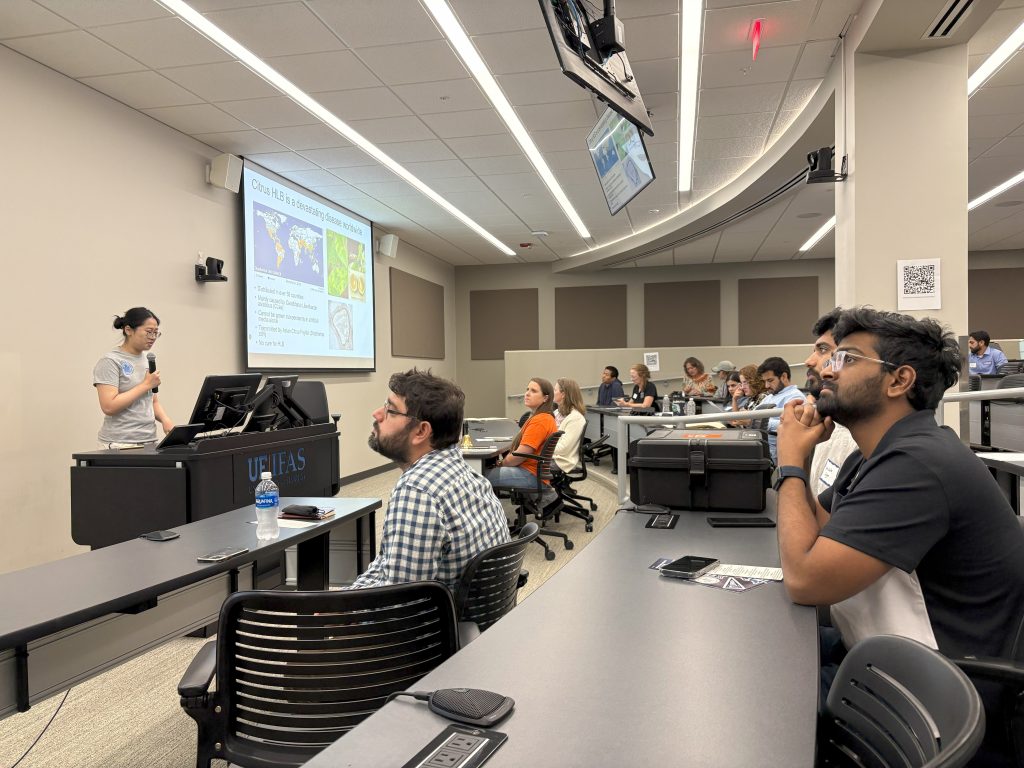
“AI is transforming almost every industry,” said Kati Migliaccio, UF/IFAS College of Agricultural and Life Sciences dean. “We have leading experts in UF/IFAS that are applying AI to issues in agriculture, water and biology, and our students are learning and working directly with them to help solve our greatest challenges.”
This commitment to student-driven, practical AI research was most apparent in the recent College of Agricultural and Life Sciences (CALS) AI Day, where students like Daniel Petti and Salvador Cuadros Cerpa presented their use of AI in their fields – literally. Petti’s research uses robots to count crops of flowers and Cuadros Cerpa is making advanced AI algorithms that use knowledge from physics and biology to improve how AI makes predictions.
The event was part of UF’s AI Days, hosted by the UF AI2 Center, highlighting AI research and education across the university.
“With precision farming, technology is improving processes to produce more food with less land,” said Petti, a graduate research assistant in the Department of Agricultural and Biological Engineering. “You have to be able to respond to situations that you can’t control, and AI is very good with that. I think this is going to be a very significant research area, and I’m glad that I’m getting that sort of background.”
While his first experience with AI was in high school, he gained an interest in agriculture after working on a hydroponics project as an undergraduate, while also studying to become a computer engineer. Now, he hopes to either continue research or go into the precision agriculture industry.
“Small scale robotics is having a moment,” he said. “That’s where a lot of innovation is happening.”
Cuadros Cerpa, a Ph.D. student in the Department of Horticultural Sciences, said being able to have a deep understanding of AI will be a huge advantage to companies, which are always looking for new tools to improve efficiency.
“When we leave UF and go to the private sector, there will be a demand for this kind of knowledge,” he said.
His path started with a background in chemical engineering but soon homed in on AI in agriculture.
“When I realized how important AI is to the real world, how fast AI tools are advancing everything and how the market is demanding its application in different fields, I decided to focus my energy on learning as much as I could about it,” he said.
Professors and advisors at UF/IFAS encourage their students, even in more traditionally hands-on degrees, to have a fundamental understanding of AI to prepare themselves for the workforce. Having that AI literacy is critical, said Raquel Dias, an assistant professor in the Department of Microbiology and Cell Science and a member of the university’s AI initiative, who also teaches an Introduction to Artificial Intelligence course.
“As they say: AI is not going to replace you, but people who know how to use AI will replace other people who don’t know how to use AI,” she said. “The power of AI goes far beyond what the general public sees, offering tools that can revolutionize precision agriculture, genetic engineering, computer vision and more.”
Additional AI-focused resources that UF offers include the UF/IFAS Faculty AI Working Group and the AI2 Summit in the spring.

###
ABOUT UF/IFAS
The mission of the University of Florida Institute of Food and Agricultural Sciences (UF/IFAS) is to develop knowledge relevant to agricultural, human and natural resources and to make that knowledge available to sustain and enhance the quality of human life. With more than a dozen research facilities, 67 county Extension offices, and award-winning students and faculty in the UF College of Agricultural and Life Sciences, UF/IFAS brings science-based solutions to the state’s agricultural and natural resources industries, and all Florida residents.
 0
0

