As much as Norman Hall’s red bricks and gothic arches, the massive live oak tree in the courtyard was a defining feature of the University of Florida College of Education. Hurricane Helene toppled the tree in September, but it will live on through its sprouts, some of which may be planted at the site. Others will possibly go home with donors of the Finding Touchstones campaign, a fundraiser supporting the courtyard’s revival.
“These sprouts are an early indicator of the courtyard’s next chapter,” said Glenn Good, College of Education dean. “The Norman oak can never be replaced, but its loss has given us the opportunity to reimagine the space and ensure that future generations are able to enjoy it as Gators from across the university have for decades.”
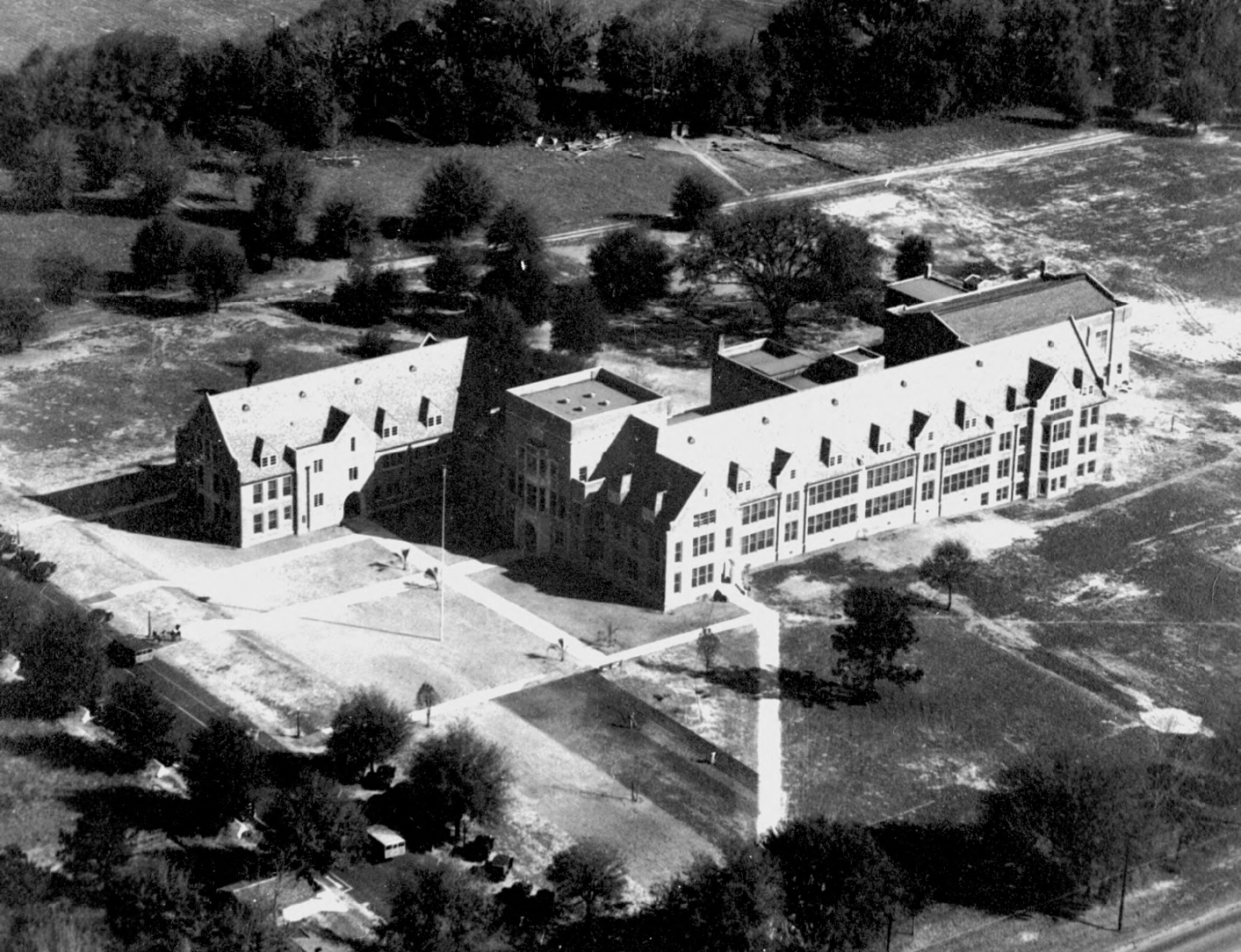
There is no known record of the tree’s planting, but it existed well before 1932, when the P.K. Yonge Laboratory School – later known as Norman Hall — was built. A black-and-white aerial photograph from the time appears to show the tree’s canopy rising above parts of the roofline.
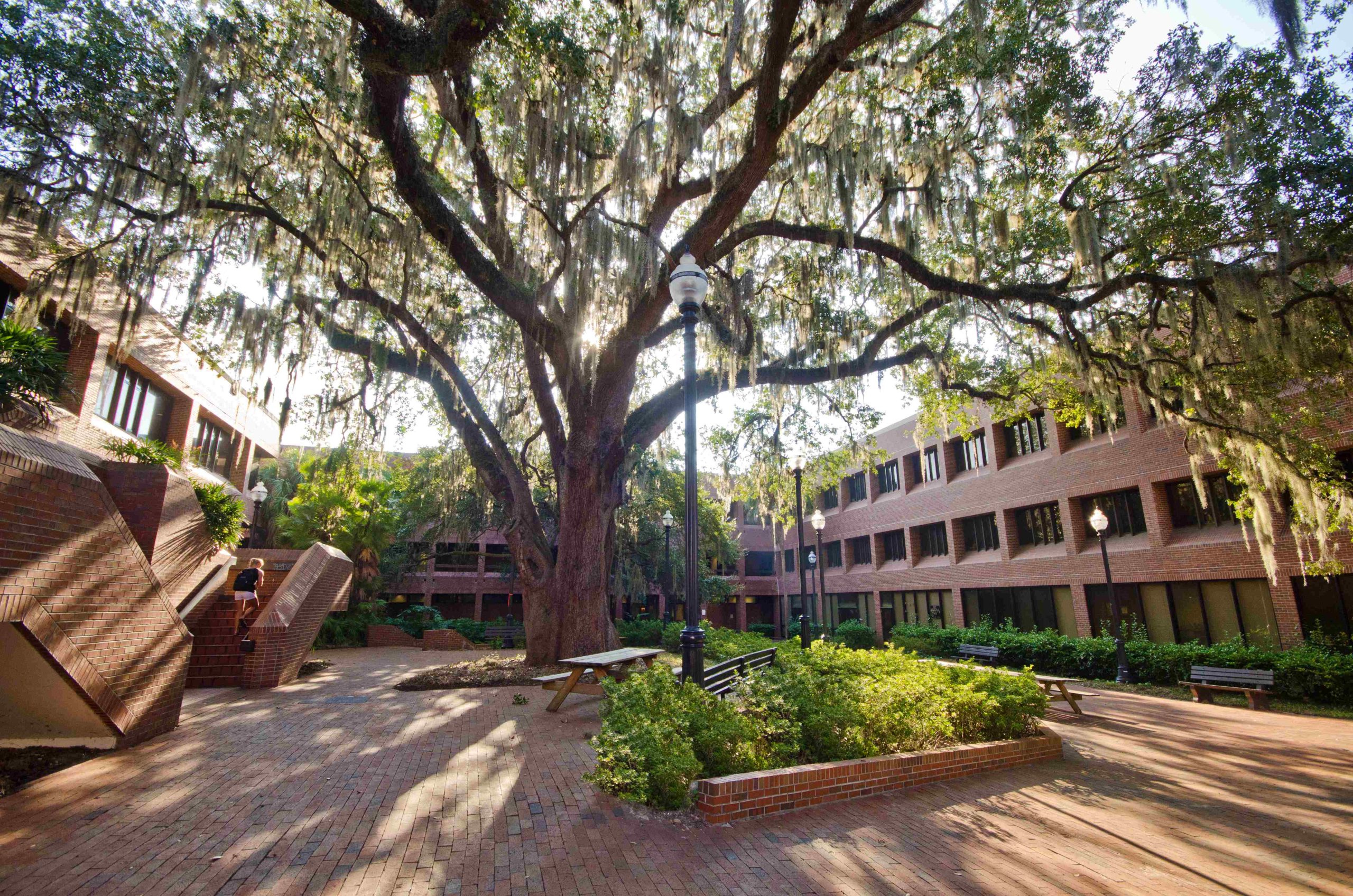
As the College of Education expanded, it did so in deference to the tree. Wings of Norman Hall were constructed around the oak, and its branches nearly brushed the building walls that enclosed it. Generations of students gravitated toward the shade it offered to study, eat lunch and admire the wildlife around them. Professors conducted lessons and hosted back-to-school socials at the tree’s base. On at least one occasion, it bore silent witness to a wedding.
Michael Andreu, UF/IFAS associate professor of forest systems, first became acquainted with the oak when he profiled iconic campus trees for a social media video filmed a few years ago. Afterward, he encouraged his students to pay homage.
Based on Andreu’s knowledge of the tree’s history and its size (“hugging the trunk would have required several people holding hands”), he estimated it was approaching 200 years when it fell.
The trunk’s unique growth likely contributed to its collapse, Andreu said. It was formed by three separate stems, and the weight of the boughs caused the main forks to weaken over the years. Although support cables had been suspended between the branches, they were no match for Helene, which barreled through Gainesville during the early morning hours of Sept. 27.
“When the wind gusted during the hurricane, the three stems split, and the tree opened up like a flower,” Andreu said.
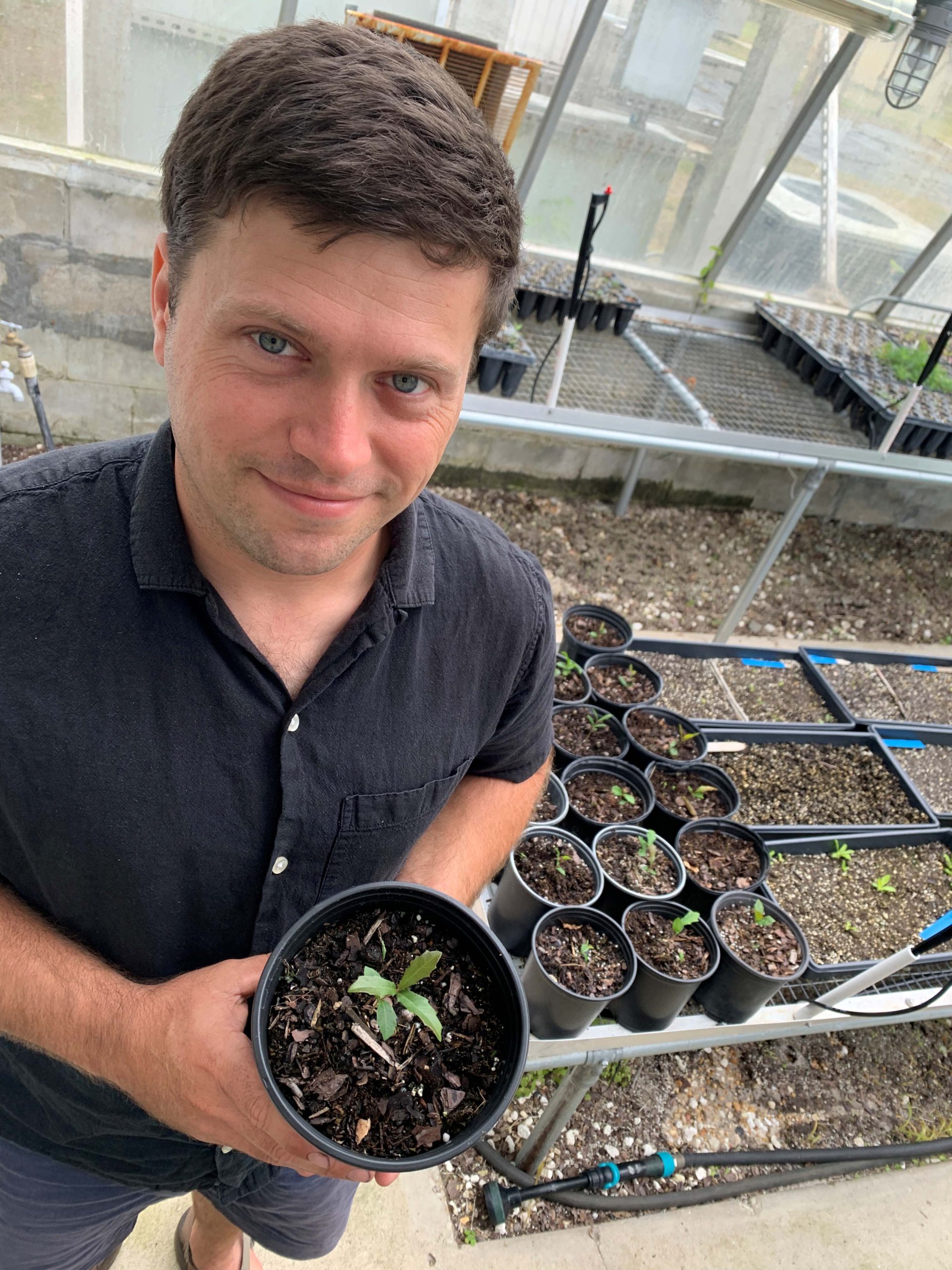
UF faculty, staff members and students scrambled to collect hundreds – if not thousands – of acorns from the tree in the days following its collapse. Gage LaPierre, manager of the UF/IFAS native plant nursery, became custodian of the haul.
“Acorns go through a process of ripening on the tree, and these were still green,” he said. “I didn’t think any of them would sprout.”
In October, however, LaPierre sowed several hundred acorns. He exposed them to cool temperatures to encourage germination and stored them in a greenhouse to thwart meddlesome squirrels. In March, tiny leaves began to unfurl from the soil. As of this week, more than two dozen acorns have sprouted.

A preliminary courtyard design reveals where some of the sprouts might end up: three small trees are each encircled by concrete bench seating. Nearby, an elevated gazebo contains a picnic table.
Regardless of configuration, the absence of the once-dominating oak will likely take some getting used to.
“When you lose a big tree like that, you’re losing something that has become part of your family and a part of you,” Andreu said. “It has real impact. Knowing that, it felt great for IFAS to give back and maybe provide a little solace to those who had a long-term relationship with that tree and felt its loss.”
Learn more about the Norman Hall oak and donate to the Finding Touchstones campaign by visiting education.ufl.edu/norman-courtyard-revival.
###
Featured image by Alexander Johnson, UF/IFAS
ABOUT UF/IFAS
The mission of the University of Florida Institute of Food and Agricultural Sciences (UF/IFAS) is to develop knowledge relevant to agricultural, human and natural resources and to make that knowledge available to sustain and enhance the quality of human life. With more than a dozen research facilities, 67 county Extension offices, and award-winning students and faculty in the UF College of Agricultural and Life Sciences, UF/IFAS brings science-based solutions to the state’s agricultural and natural resources industries, and all Florida residents.
 8
8

