Written by Lily Fierson, 2025 undergraduate summer intern hosted by Caleb Purtlebaugh and Taj Knapp of the FWC Fisheries Independent Monitoring (FIM) Program

This summer, I had the privilege of participating in the NCBS Fisheries Independent Monitoring Internship, hosted by the Florida Fish and Wildlife Conservation Commission. As a part of the Fisheries Independent Monitoring team, I was able to spend the summer expanding my practical knowledge, learning critical field and lab skills.
What is FIM?
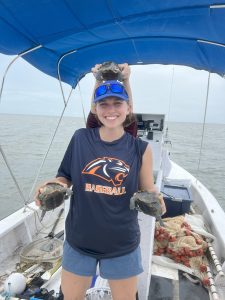
Aside from fisheries-dependent data, collected directly from recreational and commercial fisheries, fisheries-independent data is collected via scientific surveys. The work of the Fisheries Independent Monitoring Program provides essential data used to monitor fish population dynamics and abundance trends, seasonality and spatial distribution of species, and ecosystem health. This data is used not only by FIM staff, but also by other researchers, policymakers, and fisheries managers for use in the conservation and management of Florida’s fishery resources.
How does this happen?
To sample, FIM utilizes three net types. 70-foot seines are set on beaches, shallow offshore water, and tidal creeks to catch juvenile and small adult fish and crustaceans. 600-foot haul seines are set along shorelines and catch subadult and adult fish and crustaceans. 20-foot otter trawls sample benthic species, set in deeper water.
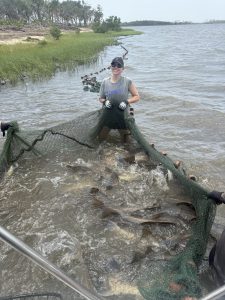
On a daily basis, crews of 4-5 FIM staff members pull both 600’ and 70’ foot nets at numerous sites and identify, measure, and release individuals. Certain individuals are culled, meaning they are brought back to the lab for processing. For these individuals, sex is determined, tissue samples are taken for mercury analysis, and otoliths are extracted for life history assessment. Physical data, such as temperature, salinity, dissolved oxygen, pH, and habitat parameters are also taken at each site.
In the Lab

When monthly sampling is finished, a number of tasks must be completed back in the lab to accomplish FIM’s objectives and keep things running smoothly. These tasks range from data entry to vessel and vehicle maintenance to the infamous task of net mending, with many more in between. One of the most important lab tasks is completing representative and identification samples. When sampling, a quantity of fish from 70’ and trawl nets are brought back to the lab to ensure that fish are properly identified in the field. To do so, we use a set of diagnostic morphological characters, such as fin ray and spine counts, to identify fish. ID samples utilize the same process, but for fish that can’t be identified in the field, be that identification of species requires a microscope, internal anatomy, or otherwise.

Thank you
With the goal of pursuing my PhD in marine biology, this internship has provided me with critical skills that will greatly facilitate my success in the future as a researcher. I’d like to say a huge thanks to NCBS for providing this opportunity, and to Caleb Purtlebaugh and Taj Knapp of FWC for hosting me. Special thanks go out to the field staff: Hunter Barrand, Will Ray, Susan Hogan, Alexis Stovall, Liam MacLean, Trey Holland, Nich Sucher, Jennie Miller, and Brian Klimek. I’m immensely grateful for the knowledge they shared, and the patience they had while sharing it. There’s no one I’d rather untangle nets, sort through 39 gallons of algae, or walk through sawgrass with.
| Follow the link to learn more about the UF/IFAS NCBS Undergraduate Summer Internship program. Read more intern blogs here. |
Featured image credit: UF/IFAS Photo by Cat Wofford
 2
2