Written by Holden Harris, Researcher at UF/IFAS Nature Coast Biological Station
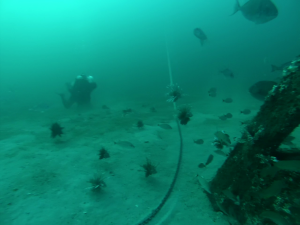
Indo-Pacific red lionfish (Pterois volitans/miles complex) in the Western Atlantic Ocean have been the most successful marine fish invasion on record and caused region-wide negative effects on reef fish communities and ecosystem processes. Mitigating their impacts is a top priority for marine resource managers. Developing lionfish fisheries has been proposed as a market-based solution to control their densities and augment commercial fishermen livelihoods. However, a commercial fishery for an invasive marine fish has never before been tried. We’ve thus used an interdisciplinary approach to improve our understanding of population dynamics, reef fish community ecology, and resource economics to help guide strategic development of lionfish fisheries.
Specific projects include:
- Using ecosystem-based approaches to evaluate lionfish management strategies and understand the concurrent impacts of the Deepwater Horizon Oil spill
- Examining changes in lionfish populations following the emergences of a novel pathogen
- Improving lionfish control efforts by understanding their detection and removal efficiency
- Developing lionfish traps for controlling deepwater populations
- Forecasting the commercial fisheries for invasive species using bioeconomic modeling
Several of these studies received national media attention, including articles by the Associated Press on research of the lionfish disease and lionfish traps that were distributed in numerous news outlets (including New York Times, Washington Post, MSN, and Phys.org); other articles by the The Nature Conservancy, TCPalm, United International Press and Dive Magazine; a video by the Associated Press; and a spotlight on National Public Radio’s All Things Considered. Recently, we’ve also conducted collaborations with European researchers to better understand the lionfish invasion of the Mediterranean Sea via the Suez Canal and harnessing citizen science efforts to help study and control lionfish.
Featured image credit: UF/IFAS Photo by Cat Wofford
 0
0