Written by Dr. Dave Chagaris, Faculty Researcher at UF/IFAS Nature Coast Biological Station
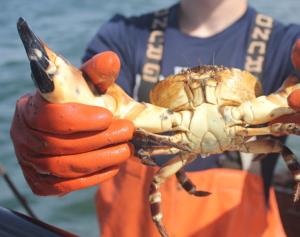
The Florida stone crab fishery operates primarily along the Gulf Coast, from the Panhandle to the Florida Keys. The fishery is one of the most valuable in Florida, with over $30 million in revenue generated annually. This fishery is unique in that crabbers remove the claws and release the crabs back into the water, where the majority have been presumed to survive, potentially facilitating a very sustainable fishery.
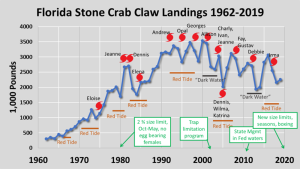
However, the Florida stone crab fishery currently is in critical condition. Three decades of high exploitation combined with ineffective management, red tides, and hypoxic ‘dark water’ events have resulted in a depleted stone crab population and lower landings. However, due to the high value of stone crab claws, revenues have increased even though landings have declined. The NCBS is currently conducting a variety of research on stone crab biology, population dynamics, and fisheries management. In 2020 a project titled “Improving management and harvest practices in the Florida Stone Crab fishery” was funded by Florida Sea Grant.
This project is a collaborative effort between the University of Florida (UF), The Florida Fish and Wildlife Conservation Commission (FWC), and Florida Sea Grant (FSG). The project aims to a) develop new population models for assessing stock status and management options; b) provide a basic understanding of economic patterns in the fishery; and c) conduct stakeholder outreach to improve understanding and promote best practices (read the June 2021 workshop report). In addition, collaborators at the UF School of Forestry, Fisheries, and Geomatics Sciences have utilized the NCBS wetlab facilities for experiments designed to understand the effects of trap soak time, starvation, and environmental conditions on stone crab growth and condition.
Learn more: Stone Crabs – FWC
Featured image credit: UF/IFAS Photo by Tyler Jones
 0
0