June 2026
Potential New Invader: Pulse Corals
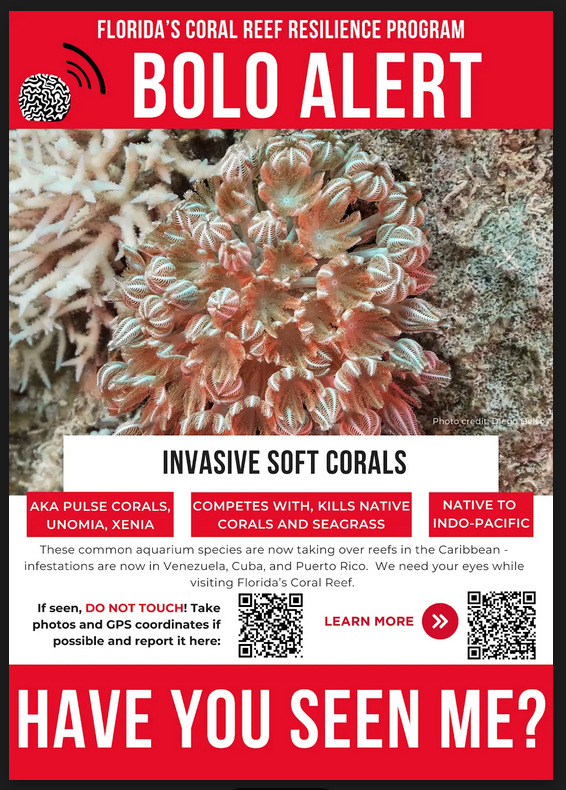
There is the potential for a new aquatic invader in South Florida. Pulse Corals are bright-colored soft corals that are very popular in the saltwater aquarium trade. These soft corals are a type of octocoral in the family Xeniidae. Common native octocorals in the U.S. are sea fans, sea whips and sea pens.
The Pulse Corals can be identified apart from our native soft corals because the polyps are much larger and the polyps are constantly opening and closing to feed in a pulsing rhythm. Like the invasive lionfish, Pulse Corals are also native to the Red Sea and the Indo-Pacific Ocean. Since the temperatures in South Florida are like their native range, there is good reason to believe if they arrive they could be very successful at spreading rapidly if not controlled immediately.
Two New Aquatic Invaders in Puerto Rico
Since 2025, there are two different species that have been found in Puerto Rico (Xenia umbellata and Latissimia ningalooensis) and northern Cuba (X. umbellata). Pulse Corals were introduced illegally in Venezuela 20 years ago and the invasion there has devastated thousands of acres of coral reef and seagrass habitats. Pulse Corals can smother coral reefs and seagrasses because they grow rapidly and have no known native predators. They are easily fragmented and travel away to rapidly colonize new areas.
Since the early 2000s, there have been numerous outbreaks of Pulse Corals in both the Pacific Ocean and Caribbean. The suspected causes of these outbreaks include intentional releases by marine aquarists, illegal aquaculture activities where they were likely grown in the wild to be sold in the aquarium trade, fragments of soft corals attaching to boats, ships, and fishing nets, and possibly spread via ship ballast water. Due to their asexual reproduction, removal is difficult without fragmenting and accidentally spreading these octocorals to colonize new areas. As of 2024, invasive soft corals have been identified in Venezuela, Pearl Harbor, Hawaii (2020), Cuba (2022), and Puerto Rico (2023). These soft corals are very popular in the saltwater aquarium trade where they are known by the common names “Pulsing Xenia” and “Pom-Pom Xenia.” One of the reasons this is such a popular saltwater aquarium soft coral is because it grows rapidly, can handle a wide range of poor water quality conditions, and is easily fragmented and sold to other aquarists with a high price range for colorful specimens.
Soft corals are soft and flexible compared to the hard stony corals that build coral reefs. Soft corals may also be called gorgonians from Greek mythology and the Gorgon Medusa, who had a head of writhing snakes. They are also called octo-corals because each individual polyp has 8 symmetrical feathery tentacles. Hard corals like brain corals, star corals, and pillar coral are distinguished by having 6 tentacles and secrete a hard calcium carbonate skeleton that creates the 3-dimensional structure of a coral reef.

As we have seen with the invasive lionfish, aquatic invaders are very difficult to eradicate if they are allowed to become established. This is why we are looking for SCUBA divers and snorkelers to keep an eye out and report it if found. If you see it – please do not touch since small fragments easily break off and float away to regrow in new areas. There are numerous places to send reports, and photos are encouraged. In the United States, please send all reports to the Florida Department of Environmental Protection FDEP SEAFAN.net or the US Geological Society Nonindigenous Aquatic Species “report a sighting” tool. In the Caribbean, report to the Atlantic and Gulf Rapid Reef Assessment (AGRRA) Invasive Xeniid Soft Coral Exchange portal. All of these sites have maps to drop a pin with latitude and longitude information and a place to upload photos. All of these sites have maps to drop a pin with latitude and longitude information and a place to upload photos. The Monroe County Extension is working closely with all of these partners and you can also call our office at 305-292-4501 with reports or for more information.
 2
2