Quick Facts
What it is: Sargassum is a free-floating brown seaweed that drifts across the open ocean.
Where it comes from: The Great Atlantic Sargassum Belt, a massive accumulation of floating algae stretching from West Africa to the Gulf of Mexico.
Why 2026 is different: Satellite tracking from the University of South Florida shows record-high sargassum totals for the year, with beaching events increasing across Florida, the Caribbean and the Gulf.
Main health concern: Hydrogen sulfide gas released as sargassum decomposes, along with low but measurable arsenic exposure risks associated with decomposing seaweed and contaminated sand.
Why microbiologists care: The smell, the gas and the contamination are all driven by microbial activity happening inside the pile.
If you have walked a Florida beach this summer, you already know the smell before you see the seaweed. It shows up first as a whiff on the breeze, something between low tide and rotten eggs, a reminder that one of Florida’s biggest coastal challenges is being driven by some of the planet’s smallest organisms.
This is sargassum season, and 2026 is shaping up to be one of the most extreme on record. But the story unfolding on Florida’s beaches is not just about a plant piling up on shore. It is about the microscopic communities that transform that seaweed after it arrives.
The Great Atlantic Sargassum Belt Bringing Seaweed to Florida’s Shores
Sargassum is not new to Florida. What is new is the scale. Scientists across Florida are tracking how these massive floating mats move, grow and reach coastal communities.
University of Florida researchers and extension experts have been studying sargassum from multiple angles, including its role in marine ecosystems, challenges associated with beach accumulation and strategies for managing harvested biomass.
UF scientists have also worked with USF researchers to develop real-time forecasting tools that could help communities prepare for sargassum landings. Satellite monitoring from the University of South Florida’s Optical Oceanography Lab has helped researchers track record or near-record sargassum totals across the Atlantic, Caribbean and Gulf of Mexico through 2026.
 The seaweed originates far offshore, in a floating mass known as the Great Atlantic Sargassum Belt, which can stretch thousands of miles from the west coast of Africa across the Atlantic and into the Caribbean Sea.
From there, wind and current do the rest. The same belt that buries beaches in the Yucatan and along Caribbean coastlines eventually rides the Gulf Stream and local currents into Miami-Dade, Broward, Palm Beach and the ocean side of the Florida Keys. Ocean conditions, including nutrient availability, have helped fuel the algae’s growth, researchers say, turning what used to be a seasonal nuisance into a recurring and increasingly costly coastal problem. Cleanup and mitigation across Florida, Mexico and the Caribbean now runs into the hundreds of millions of dollars some years.
So this is both a global and a local story. What forms far out in the Atlantic becomes a very real, very smelly problem on the sand outside your hotel or your favorite fishing spot.
What Sargassum Is Supposed to Be Doing
Before it becomes a beach problem, sargassum is doing important work. Out in the open ocean, floating mats of the algae create habitat for crabs, shrimp, juvenile fish and threatened sea turtles that use the mats for shelter and food. Commercially important species like tuna and swordfish feed on the smaller marine life that gathers around it. In healthy amounts, sargassum even helps build and stabilize beaches by trapping sand.
The trouble starts when the amount arriving on shore outpaces the beach’s ability to absorb it. When mats pile several feet deep and sit in the sun for days, sargassum stops being a habitat and becomes decomposing biomass, and that is where the science gets interesting.
The Chemistry Hiding Inside Sargassum
Sargassum has a habit that most beachgoers never think about: it naturally accumulates arsenic from seawater as it grows. Under normal ocean conditions, that arsenic stays locked inside the plant tissue. Once the seaweed washes ashore and begins to break down, that is no longer guaranteed.
 Research on decomposing sargassum has raised new questions about how compounds naturally stored in the algae, including arsenic, may move into surrounding sand and water as the biomass breaks down. Studies simulating beach conditions have found that arsenic can be released from decomposing sargassum, while overall health risks from typical beach exposure remain low. However, researchers have identified potential concerns in specific scenarios involving prolonged contact or accidental ingestion, particularly for young children.
Understanding what happens to sargassum after it reaches shore is also an important part of managing these large-scale beaching events. UF/IFAS researchers have studied ways to safely repurpose harvested sargassum, including the costs of processing harvested seaweed and the need to account for contaminants such as arsenic.
The same research also found that how beaches handle sargassum can affect what remains behind after cleanup. When sargassum is mixed into sand rather than removed, arsenic levels in that sand can increase.
Why Does Sargassum Smell So Bad?
 Arsenic is only part of the story. The smell that gives sargassum its reputation comes from a different process entirely: microbial decomposition. Once the seaweed reaches shore, bacteria and other microorganisms move in, breaking down the biomass and changing the chemistry around it.
As sargassum piles sit and rot, sulfur-containing gases, mainly hydrogen sulfide, are released, and research shows these emissions can increase during the early stages of decomposition. That rotten-egg odor is not just unpleasant. At high enough concentrations, hydrogen sulfide can irritate the eyes, nose and throat, and people with existing respiratory conditions may notice breathing difficulty near large accumulations.
If you are at the beach and start to feel that irritation, or the smell suddenly gets sharp instead of just unpleasant, that is a reasonable signal to move away from the pile rather than push through it.
The Microbes Driving Florida’s Sargassum Decomposition
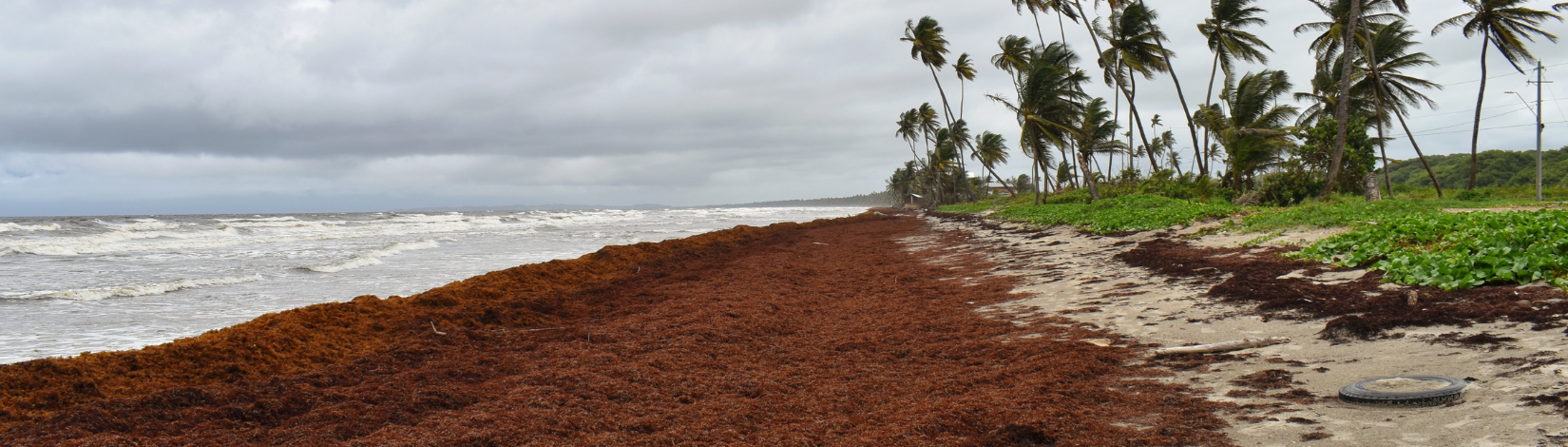
Here is the part that rarely makes the headlines: none of this happens without microbes.
Sargassum does not decompose on its own. Bacteria and other microorganisms colonize the seaweed almost as soon as it hits the sand, breaking down its tissue and, in the process, driving the chemical shifts that release hydrogen sulfide and mobilize arsenic into the surrounding sand, water and air. The rate of decomposition, the specific gases produced and how far contaminants travel all depend on which microbial communities take hold in a given pile, on a given beach, in a given amount of heat and moisture.
That is the kind of question environmental microbiologists are built to answer. Understanding which organisms break down organic matter, how they interact with contaminants like arsenic and how environmental conditions such as temperature and salinity change that process is central to predicting and managing events like a sargassum bloom, not just describing them after the fact.
At the University of Florida Department of Microbiology and Cell Science, researchers study these same connections between microbial communities, environmental change and human health, helping explain how microorganisms influence some of Florida’s biggest ecological challenges.
This is also why sargassum keeps showing up in the same conversations as red tide, blue-green algae blooms and other harmful algal events that Florida deals with regularly. Different organisms, different toxins, but the same underlying question: what happens when microbial life interacts with a changing coastal environment at massive scale?
Reducing the Risk Without Avoiding the Beach
 The good news is that the overall risk to beachgoers remains low, and none of this means avoiding the coast altogether. It means being a little more deliberate.
Basic precautions go a long way. Washing hands before eating at the beach, showering after returning home and keeping young children from putting sand, water or seaweed in their mouths all reduce exposure. Young children deserve particular attention because they are more likely to put sand or other material in their mouths while playing on the beach. The Florida Department of Health has also recommended avoiding direct contact with sargassum where possible and using gloves if handling it becomes necessary.
On the management side, the research is fairly clear: removing sargassum rather than mixing it into the sand keeps contaminant levels lower in the beach itself. That has real implications for how coastal cities and counties plan cleanup, especially in a year when the volume arriving on shore is breaking records.
Sargassum: A Lesson in Microbiology
 It is easy to file sargassum under tourism or coastal management and move on. But underneath the smell, the sand mixing, the arsenic and the gas emissions is a living system shaped by microbial activity.
That overlap between environmental change, microbial activity and human health is exactly what draws students to environmental microbiology in the first place. At UF’s Department of Microbiology and Cell Science, students study how microbial communities shape ecosystems, food systems and public health, and how that knowledge can be applied to real problems unfolding along Florida’s coastline.
For students interested in studying the connection between microorganisms, environmental change and human health, UF offers pathways including the Environmental Microbiology Certificate, a graduate pathway built around understanding how microorganisms interact with pollutants, ecosystems and changing environmental conditions. It pairs well with UF’s broader online Master of Science in Microbiology and Cell Science, which allows students to build advanced expertise while working around professional and personal commitments.
Careers built on this kind of research extend well beyond the classroom. Environmental microbiologists work with public health departments, coastal management agencies, water quality labs and research institutions tracking harmful algal blooms, contamination events and the microbial systems behind them.
Explore more career paths in microbiology →
The Future of Florida’s Sargassum Summers
Sargassum is not going away. As long as ocean conditions continue to support growth and nutrient availability remains high in the Atlantic, scientists expect the Great Atlantic Sargassum Belt to keep producing large accumulations, and Florida’s beaches will keep absorbing the overflow. What changes year to year is how much arrives, how it is managed once it lands and how well researchers understand the microbial engine driving its transformation from floating habitat to rotting hazard.
For now, the smell on the wind is a reminder that even something as small as a microorganism can shape a very large, very visible problem stretching from the middle of the Atlantic to the sand under your feet.
FAQ
Is sargassum a harmful algal bloom?
No. Sargassum is a type of brown macroalgae that forms large floating mats in the ocean. While large accumulations can create environmental and management challenges when they wash ashore, it is different from microscopic harmful algal blooms such as red tide.
Is it safe to go to the beach if sargassum is present?
Generally yes. Research shows overall health risks from typical beach exposure are low. Simple precautions such as washing hands before eating and avoiding direct contact or ingestion reduce risk further, particularly for young children.
Why does sargassum smell so bad?
As sargassum decomposes, microbial activity releases sulfur-containing gases, mainly hydrogen sulfide, which produces the characteristic rotten-egg odor. Emissions tend to spike within the first couple of days after the seaweed washes ashore.
Does sargassum contain arsenic?
Yes. Sargassum naturally accumulates arsenic from seawater as it grows. When it decomposes on the beach, that arsenic can move into sand, water and air, though overall exposure risk for most beachgoers remains low.
Why is 2026 such a bad sargassum year?
Satellite monitoring from the University of South Florida has tracked record-high sargassum totals across the Atlantic, Caribbean and Gulf of Mexico throughout 2026, associated with ocean conditions and nutrient availability that support its growth.
What does microbiology have to do with sargassum?
Microorganisms are responsible for breaking down sargassum once it reaches shore. That microbial decomposition process drives the release of hydrogen sulfide gas and the mobilization of arsenic, making environmental microbiology central to understanding what happens to sargassum after it reaches shore.
 5
5