The inaugural Study America trip included 13 graduate students from both UF’s Department of Microbiology and Cell Science along with participants from the College of Pharmacy. The experience was open to master’s and doctoral students.
Microbiology and Cell Science graduate students from the University of Florida recently traveled to Washington, D.C. for the department’s first Study America experience, an experiential learning program designed to connect graduate students with the real-world systems, environments and organizations shaping the life sciences.
This inaugural trip focused on science policy, research funding and national scientific infrastructure, giving students a closer look at how scientific discovery is supported, communicated and advanced beyond the laboratory.
 Across several days, students met with scientific organizations, federal agencies and policy leaders working across public health, biomedical research and science advocacy. The experience offered students a perspective rarely seen in traditional coursework by showing how scientific discovery moves beyond the laboratory and into the organizations, funding structures and decision-making spaces that support research at a national level.
“Our Study America course provided many examples of non-traditional roles for scientists,” said Dr. Eric Triplett, Microbiology and Cell Science Department Chair. “The students were exposed to a wide variety of professions that they never dreamed were available for STEMM graduates [Science, Technology, Engineering, Math and Medicine].”
 Beyond professional exposure, the experience also created valuable opportunities for connection among students in UF’s graduate programs, many of whom complete coursework online and asynchronously throughout the year.
“All of the students in this course were online M.S. or Ph.D. students,” Triplett said. “This was a rare in-person event that allowed them to talk informally to their peers, instructors and representatives of the organizations we visited over the course of four days.”
At a time when scientific funding and federal research priorities remain central topics across the country, students also saw how scientific research is supported through collaboration between universities, professional societies, federal agencies and congressional leadership.
“If the massive cuts to scientific funding hasn’t affected you, it has affected someone you know,” said Hannah Durham, an online M.S. student in Microbiology and Cell Science who attended the trip. “When I was sent information about the first ever ‘Study America’ trip to Washington, D.C., I knew I had to go.”
Throughout the trip, students visited organizations connected to microbiology, public health, research funding and science communication. Meetings included conversations with scientific societies, federal research agencies and professionals working in science advocacy and administration.

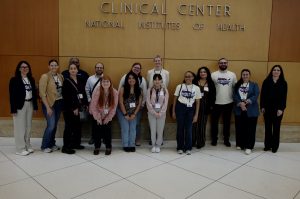
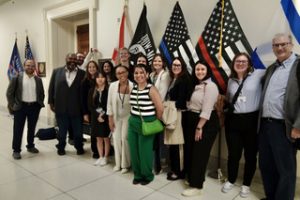
One of the most memorable parts of the experience was a visit to a mystery federal agency that remained undisclosed until students arrived, adding an element of anticipation to an already packed schedule. Spoiler: it was the CIA.
The program also highlighted how broad scientific careers can become beyond traditional research roles. Students heard directly from professionals using science backgrounds in policy, federal relations, advocacy and leadership positions that influence national research priorities.
“This experience gave students a broader view of science by exploring how research is funded, the many careers that shape innovation and how science translates to societal impact,” said Amanda Ojeda, Ph.D. candidate and co-instructor for Study America alongside Dr. Eric Triplett and Dr. Jennifer Drew.
For students interested in microbiology and the life sciences, the trip reinforced that scientific impact is not limited to the laboratory. Research funding, public policy and science communication all play a role in determining how discoveries move forward and how communities benefit from them.
“Before this trip, I truly did not know the depth of what science advocacy is and how important it is,” said Hannah Durham, an online M.S. student in Microbiology and Cell Science who attended the trip. “Every single agency we met with was a privilege and just the coolest experience.”
Durham said several visits stood out during the experience, including meetings with the American Association for the Advancement of Science, the American Society for Microbiology, the National Science Foundation and biotechnology company Novonesis.
“I would absolutely recommend this opportunity to other students,” Durham said.


As scientific research continues to shape conversations around health, biotechnology, agriculture and national preparedness, experiences like Study America are helping students better understand not only how science is conducted, but also how it’s supported, communicated and sustained at the national level. Learn more about Study America and future experiential learning opportunities within UF’s Department of Microbiology and Cell Science.
 0
0