Mites are one of the major pests attacking ornamental plants in Miami-Dade County, particularly when it is warm and dry during the spring. One female mite can produce 13,000 mites in a month at an average temperature of 70°F!
Mites are not insects, but more closely related to spiders: they have two body regions, and can have two, three, or four pairs of legs depending on their growth stages and the types of mites. Mites are very small in size, which makes it difficult to detect, identify, and monitor them in the nursery.
There are four major groups of mites that feed on ornamental plants, including spider mites (Tetranychidae), flat mites (Tenuipalpidae), broad mites (Tarsonemidae), and gall/bud mites (Eriophyidae). The life cycle for spider mites and flat mites has 4 stages, including egg, larva, nymph, and adult, while 3 stages for broad mites (egg, larva, and adult) and gall mites (egg, nymph, and adult). Mites can crawl within individual plants, but they can only be passively dispersed for long distances by air or other insects such as whiteflies.
The major characteristics of the 4 groups of mites:
Spider mites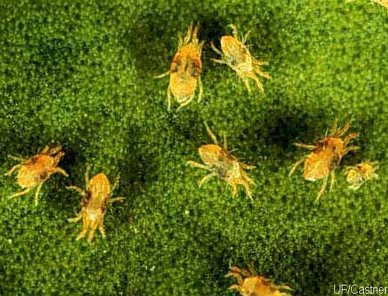
• The most common mites.
• Live underside of older leaves in general.
• Prefer hot and dry conditions.
• Most species produce webbing.
• Common ornamental hosts include hibiscus, palms, viburnum, orchids, marigold, dracaena, roses, juniper, and podocarpus.
Flat mites
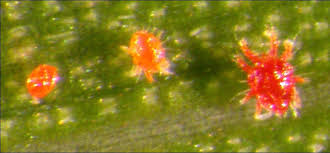
• Most flat mites live on the underside of leaves, along the main vein.
• Some species can transmit viruses, including the orchid feck virus (OFV) and hibiscus infecting Cilevirus (HiCV).
• Commonly affected ornamental hosts include hibiscus, ferns, palms (red palm mite), jasmine, privet, orchids, liriope, dracaena, and viburnum.
Broad mites
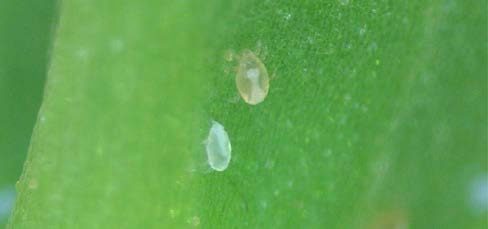
• Small mites.
• Prefer high relative humidity.
• Often found on new leaves, buds, and growing tips.
• Causes distorted and curled leaves.
• Commonly affected ornamental plants include African violet, azalea, begonia, chrysanthemum, dahlia, ivy, impatiens, zinnia, and jasmine.
Gall mites 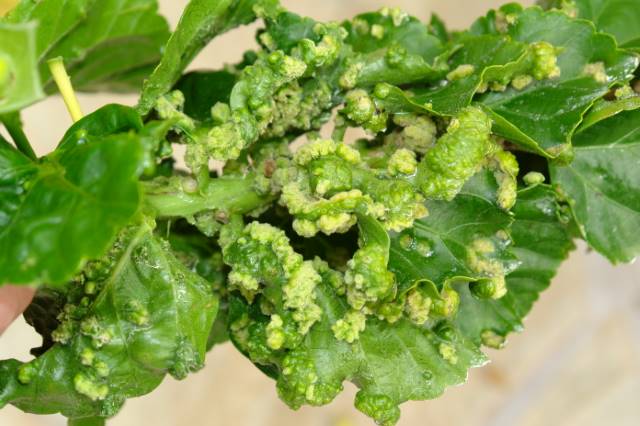
• Extremely small in size.
• Live on the underside of new leaves, new buds.
• Usually host-specific.
• Can transmit viruses.
• Commonly affected ornamental hosts include hibiscus, privet, camellia, roses, lantana, ruellia, and podocarpus (witches’ broom).
Mites management
Integrated mite management (IMM) is recommended in the control of mites in ornamental plants, including monitoring, cultural practices, biological control, and chemical control.
Scouting is essential in decision making regarding what to proceed with, by looking for mite damage/symptoms in the bottom leaves (spider mites) or top new growths (broad mites), particularly on the underside of the leaves. Plants with live mites found should be tagged for later revisit to assess the effectiveness of control measures.
Cultural practices include removing weeds surrounding ornamental plants, avoiding over-fertilizing plants or drought conditions, using overhead irrigation that may be helpful in suppressing the growth of the mite population, particularly for spider mites.
Biocontrol is the foundation of IMM, such as introducing predatory mites and fungal pathogens that are commercially available. Relative humidity plays a key role in affecting the effectiveness of predatory mites. Though there are many options available on the market, Phytoseiulus persimilis and Neosiulus californicus are both good choices for Florida growers (Osborne et al.,), and they could work in combination to cope with different environmental conditions.
Chemical control is the most effective way in reducing the mite population and damage, but has a negative impact on the environment. There are many active ingredients available for mites control, particularly against spider mites, acaricides like avermectins (abamectin), pyrroles (chlorfenapyr), METI (fenpyroximate), tetronic and tetramic acid derivatives, sulfur, and horticultural oils can be effective against multiple groups of mites. It is important to have good coverage of the plants, particularly the underside, and rotate chemicals of different modes of action to avoid resistance development.
The contents of this publication are adopted from a recent workshop on mites organized by Dr. Revynthi at UF TREC.
 2
2