Introduction
Florida-Friendly LandscapingTM (FFL) promotes nine principles to protect water resources in designing and maintaining landscapes. The practices can be applied at scales ranging from individual yards to parks to communities. Landscapes designed around the FFL principles can satisfy a range of aesthetics, work well across sites inland and coastal, and suit properties large and small. The more examples we have of FFL, the better we can picture the possibilities it offers.
What do homeowners say about FFL recognition?
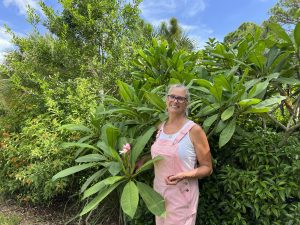
In this article, I interviewed Mary Calo, a homeowner whose residential yard we recognized as FFL Gold in 2024.
YG: Tell us a little about yourself!
MC: I’m originally from a small rural town in Illinois. I grew up surrounded by agriculture- primarily fields of corn and beans. My Grandpa had a “Back Forty” where he grew a large garden with potatoes, strawberries, rhubarb, apricots and apples to name a few… My Nan grew the flowers. She had the most beautiful violets, peonies, crocus and daffodils every spring. I believe my love of gardening stems from helping them.
YG: You hosted our FFL Certified Professional (FFLCP) class on a visit to your yard for the field portion of their certification training. In reviewing the FFL recognition checklist with you, the class was able to get experience with the recognition process. We agreed your yard would qualify for FFL Gold recognition. Congratulations, and thank you for welcoming our class to your property! What was it like to have a team walk your yard and review the FFL checklist with you?
MC: Initially I was a little intimidated to have a group of professionals come to my yard to evaluate it. Once the team arrived, I saw how curious and eager they were to evaluate – not judge – my yard. They first walked the yard without me and went through the FFL checklist. Afterwards, I walked with them to answer any questions they had and to explain “why I did this or that” to them. It was very relaxed and any inhibition I previously had, I soon realized was unwarranted. They appreciated all my hard work and explained the certification process clearly.
YG: What do you most value about having an FFL-recognized landscape?
MC: I love knowing I did the right thing for the environment. “Walking the walk… not just talking the talk”…LOL
YG: Is there a particular FFL principle that is most important to you? If so, what is it?
MC: There are two principles that are most important to me.
1st – Attract wildlife…
2nd – Protect the Waterfront…
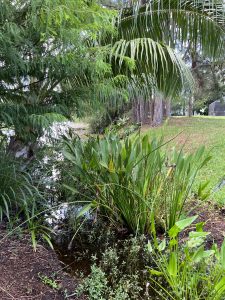
YG: How have you chosen to apply these principles in your landscape?
MC: Every tree or plant has to abide by this rule…”If you don’t feed the Birds, Butterflies, Bees or Me…or provide Food, Shelter or Places to Raise Baby Critters…you have no place here.” We have found that planting primarily Natives does that and makes maintenance much easier once they are established. Everyone that visits our yard is amazed to learn we don’t have an irrigation system.
Any and all wildlife is welcome in this yard. It is a Certified Wildlife Habitat with the National Wildlife Federation, as well as a Certified Butterfly Sanctuary with The Florida Federation of Garden Clubs.
We planted the entire shoreline of our lakefront with Native Aquatic Plants. Not only do those plants stabilize our shoreline from erosion, they also filter the water and again, provide habitat for birds and fish.
YG: Have you spoken with your landscaper or arborist about FFL? If so, how has their work contributed to your FFL recognition?
MC: We do our own yard maintenance. We did take the initiative to meet the technician from Tigris (the aquatic lake maintenance company contracted with our HOA) that sprays our lake. We gave him a tour of our yard so he would understand how important our shoreline and yard are to us. Not only did he appreciate it greatly…he has eagerly agreed to take extra care to not harm our shoreline when he sprays the lake.
He knows it’s a “No Spray Zone.”
YG: What do you most enjoy about your yard?
MC: Walking around our yard is like taking a hike through a park. We have “Trails” through “Rooms” with benches to sit and enjoy different views.
Mornings are our favorite because we get to experience “The World Waking Up.” We have so many varieties of birds singing their morning songs and butterflies visiting the Native Wildflowers. It’s very peaceful.
Be Recognized!
Contact your local UF/IFAS Extension office to learn more about the FFL principles and apply them in your yard or community. If you’re in Martin County, reach out to our UF/IFAS Extension Martin County FFL Yard Advisors at (772) 288-5654 or MCMasterGardenerFFL@yahoo.com, led by County Extension Director Jennifer Pelham. Our knowledgeable Master Gardener Volunteers will review the FFL recognition checklist with you on your property. Together, you will identify practices that would qualify for Gold or Silver status!
Seek or Become a FFL Certified Professional
Property owners seeking to incorporate FFL can find certified professionals in the FFL Certified Professional (FFLCP) Directory. FFLCPs earn their qualification by completing six hours of instruction, participating in a field module, and passing the certification exam.
Landscape professionals, if you are seeking FFL certification, contact your local Extension office. In Martin County, contact Yvette Goodiel, 772-419-6962 or goodiel@ufl.edu. We are offering the FFLCP Field Module on January 28, 2026 at the Port Salerno Civic Center. Register or learn more at: https://tinyurl.com/FFLCPJan26MC. You can also learn more in the blog, “Landscape professionals: Add Florida-Friendly to your resume.”
 0
0