Global seaweed production is currently at an all time high (World Bank, 2023; FAO, 2024). Almost all of that production occurs in Asia. The small amount that does occur in the US is restricted to cold water species, like the kelps of New England or the Pacific Northwest. In Florida, seaweed is often thought of as a nusiance to be removed from the beaches (or it is just not thought of at all). Recently, researchers at the University of Florida have begun exploring what commercial opportunities our local macroalgae may have to offer.
At a first glance, Florida seems like an obvious location for seaweed aquaculture. There are existing working waterfronts, a skilled workforce of watermen and seafood professionals, an expansive coastline and an extraordinary selection of potential seaweed species. But there are definite obstacles as well. Not unsubstantially, the lack of an existing market and the paucity of data regardng the utility of local native species are significant hurdles to the development of seaweed aquaculture.
I recently had the opportunity to sit down and chat with my friend Dr. Aaron Welch, who is the owner of Two Docks Shellfish Company and is one of the only producers of seaweed in the state of Florida. He is currently involved in multiple research collaborations that are investigating some of these questions. I wanted to get his industry perspective on the potential future of this market – his tempered enthusiasm is cautously optimistic and offers a realistic viewpoint of what might be possible. Our conversation is below.
Please state your name and the name of your business.
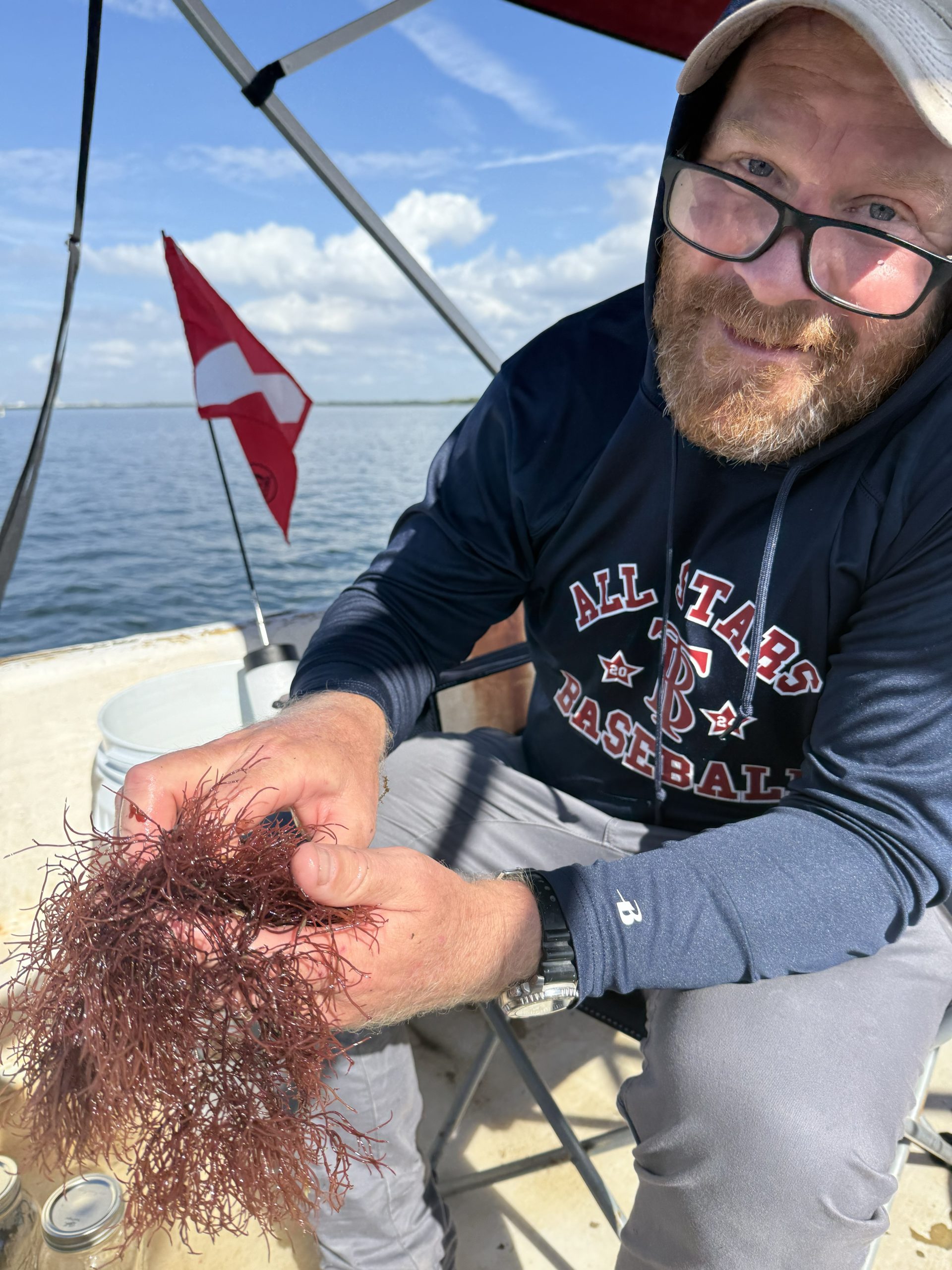
My name is Aaron W. Welch, and I am the president of Two Dock Shellfish, LLC, here in the Tampa Bay area.
Where do you currently have active aquaculture operations right now in Florida?
We have shellfish grow-out leases in Tampa Bay and Cedar Key. We have a small nursery in Pinellas County, and we have a hatchery in northern Manatee County.
And you’ve been doing this for quite some time, right? How long have you guys had Two Docks open? Well, it’s been sort of one of those things that’s progressed. The company’s existed for 12 or 13 years. It was sort of a part-time thing for the first 5 or 6 years of our existence, and now it’s a full-time thing.
And it’s a family operation?
It is a family operation, yes. We have me and my father, and then we have some employees who have become equity partners in the business as well… it’s a family company, with some help from some great investors and some great partner employees.
What species are you currently growing for commercial sale?
For commercial sale, most of our inventory on the farm is Mercenaria mercenaria, the northern hard clam. We have a small number of oysters, Crassostrea virginica, the eastern oyster. For restoration work, we are also working with Mercenaria campechiensis, which we’ve planted about a million of down in Charlotte Harbor as part of the ABC program [A Billion Clams for Charlotte Harbor restoration initiative].
What is your favorite part about being a shellfish farmer?
I mean, I’m not in a cubicle.…
I grew up on the water, I’ve worked on the water my whole life. I think that, sort of the combination of being able to be a farmer and produce something from the beginning, from a seed, is a really an amazing act…and we get to do it on the water. We work in one of the most beautiful places in the world, and we’re out there every day. I mean, sometimes in February, when it’s blowing 30, and it’s 45 degrees, it’s not super fun, but, you know, most of the time, we get to do an amazing thing in an amazing environment, and …
And provide a really delicious product to boot.
Yes! And genuinely, we provide that product to people who are genuinely appreciative of it.
So, we’re going to talk a little bit about the seaweed aquaculture exploration here in Florida, but, I wanted to ask first, how do shellfish farmers feel about normally occurring wild seaweed in general – specifically, when it is out on the leases?
Right, so generally, seaweed on the leases is a nuisance. It sticks on the bags, and it accumulates. And over a period of weeks, it can accumulate to the point where it reduces water flow over the shellfish, and it can make it challenging for clams to grow. As that seaweed accumulates, if it’s not removed, all that biomass will eventually die, and it will rot, and it will lay on the bags and form sort of an anoxic layer of goop, which will not just stunt the clam’s growth, but it can choke them out and kill them.
So you spend a fair amount of time as a farmer, at least in our part of the world, simply removing this stuff from your leases, and it’s a nuisance. So I think most farmers around here think of rolling seaweed… It’s just a hassle. It’s just something that has to be dealt with.
We started wondering years ago if there was some use for this product we were pushing off the leases every other week. We knew seaweed was used in other applications in other places, like kelp in the Pacific Northwest or New England where it’s grown for food or other things. Asian cuisine uses a variety of different seaweeds. Some seaweed that’s grown here in Florida have cousin species grown in Southeast Asia, like Gracilaria, that are used for agar. Carrageenan is used in all sorts of things. So we knew there were some uses for it, and we just started to get interested in instead of just pushing off the lease, could we harvest it, or somehow capitalize on this potential product that was causing us to do a ton of labor anyways.
So that… that’s sort of more than you asked for, but that’s how our interest in seaweed initially began.
No, that was perfect, because my next question was actually what made you take the next step in exploring seaweed as a potential market?
I mean we fooled around with it initially early on, almost in an unserious way. Like, we looked at it to see if it could be used as a fertilizer or nutrient supplement for plants. We had some of the seaweed tested on our own dime for its mineral composition, any trace nutrients, etc., but nothing really serious. We kind of started getting serious about it when a colleague of mine through the University of Miami introduced me to a researcher at Wood’s Hole named Loretta Roberson, who is a seaweed expert. We got to know Loretta, we did a little work for her on a contract basis, then we started collaborating with her on some grants focused on growing Euchema here in the Gulf. She also has research sites down in Puerto Rico and Belize. One thing led to another until we had a couple grants going with Loretta and Woods Hole. None of them panned out exactly the way we hoped, but it sort of started getting us interested in it, especially since there was federal research money to explore it. That made it worthwhile to go out and do some more focused research and start to learn. Even though those grants didn’t necessarily turn out the way we’d hoped, we still learned a lot. We sort of learned what doesn’t work, for sure. That’s a start.
Well, this is perfect background, because my next question was to briefly describe your past and current projects.
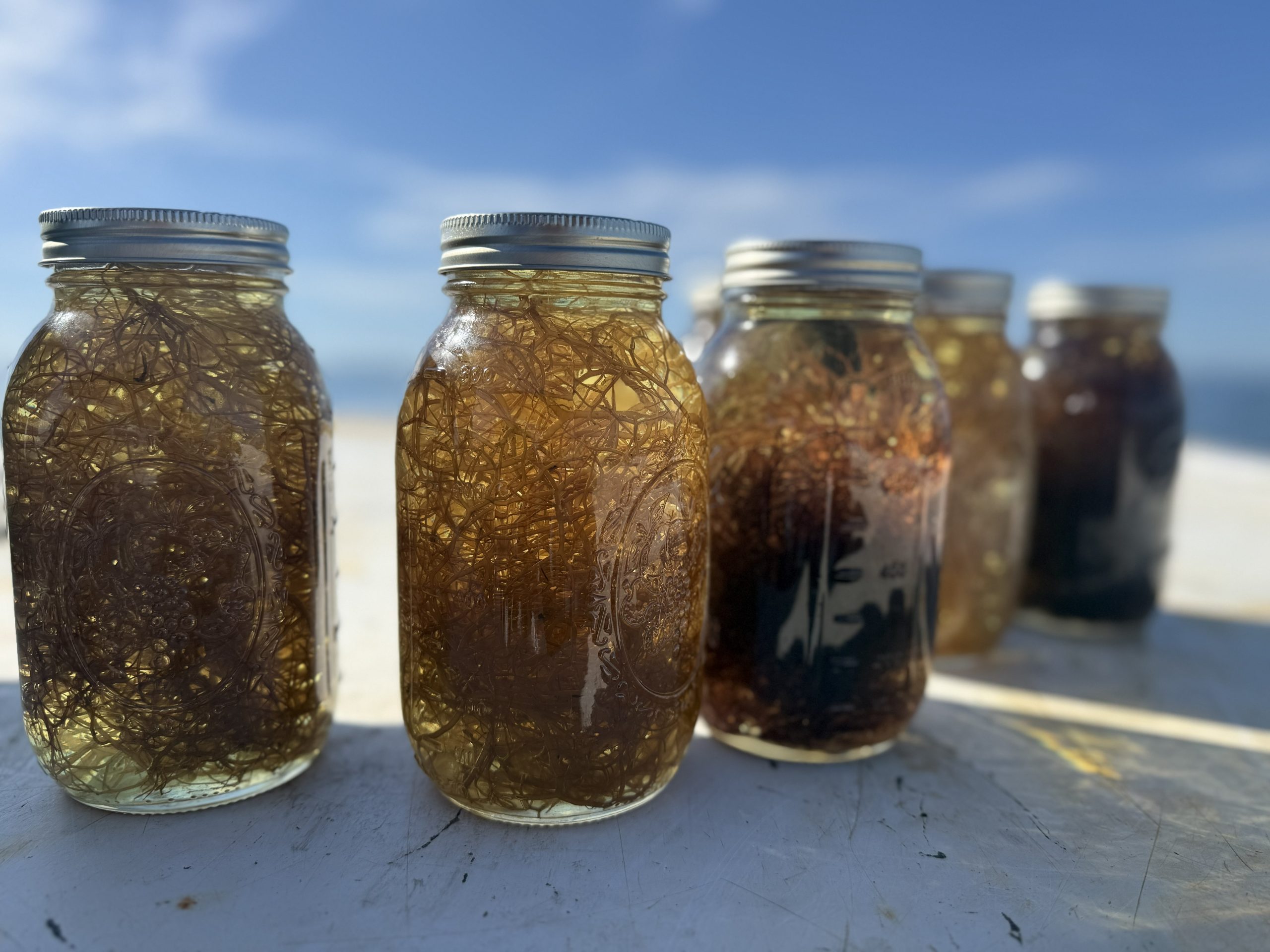
So, our first major project with Woods Hole was a project trying to grow Euchema. We had permitted a small offshore lease, about 2 miles off Anna Maria Island. We grew seaweed on a long line array. We had a lot of trouble with that site. The site had too much boat traffic, there were a lot of people around, and the Euchema just didn’t grow there.
The second major project we were involved in was another collaborative grant with Woods Hole, and I was actually the PI on that one. We were trying to grow seaweed in a multi-species array with Sunray Venus clams, and we had some challenges with that one, too. A couple of those challenges were out of our control, like hurricanes that beat us up pretty bad. We did the best we could, though, and again, we learned a lot.
And then of course, the [UF and Sea Grant] projects that we’re involved with now. We’re assisting in one project identifying the primary species that occur on our shellfish leases [to look for economically valuable product potential and ecosystem services], as well as another project focused on growing Gracilaria for bromoform production. [To learn more about these UF research initiatives, click here, here, and here].
Tell me more about that. Our readers might not know what bromoform is. So… bromoform is a compound that has been shown to cut methane emissions from cattle. It’s been shown that bromoform fed to cows in the right amounts will cut methane emissions by 95%. So we’re really excited. We found a particular species that has really high bromoform content, if it’s handled right, and we’ve learned some tricks to grow it in tanks. In Australia, I think it’s mandated that cattle producers feed their cows methane reducers, and bromoform is one of them. That doesn’t exist here in the U.S, now, but maybe it would in the future, and, we’re certainly excited about it.
The volumes you would have to produce to make it work are pretty large, and it’s not the kind of thing that we could do at scale [right now]. But we can produce enough to help them do some of the science they would need to do to prove this out.
So we couldn’t do it at scale yet, but it’s something that potentially, if there was a market, infrastructure could be developed to support that need?
If there was an actual market, somebody could say, “if you produce X, there’ll be a buyer. You know, Buyer Y will buy X tons,” we could put pencil to paper and see if there’s a real business there. There isn’t now, but like you said, maybe down the road there will be.
What do you think are the biggest challenges to an actual viable seaweed production market for Florida?
I mean….
I realize there are many.
There are many, but the biggest one is there is no market for anything we can produce right now. I mean, there is a market for things like agar, but that business is a volume business. If you look at the numbers from the Asian producers, it’s millions of tons. We’re never going to be able to produce millions of tons with our existing lease setup. I actually don’t think, even if we had the leases, we could produce that much because of some of our other environmental challenges. It doesn’t grow in the summer very well, there are some predation issues, et cetera, et cetera. Maybe it would work on land, but I have a hard time seeing a facility that’s suitably scaled. I mean, you’re talking tons [of product] and thousands of tons of tank space.
So, one, there’s no market. Some of the markets that could potentially be tapped, I think operate at a scale that we’ll never be able to compete in. So I think you’re looking at whether it’s going to be produced here in Florida, there’s got to be a market for something where you can produce at a smaller scale for a profit.
Maybe the methane thing is one, but I don’t know. I mean, the fundamental overarching problem is there simply is no market right now for a grower for Gracilaria, unless you’re producing millions of tons of it.
And this is where these Sea Grant projects might be informative, because they aim to identify other Florida species that might have high-value compounds and not require such a large volume, right? I think that’s exactly right. I know there are potential pharmaceutical applications among others, and that’s on the research community. Our research grants are allowing us to explore things like looking at the potential for our seaweed to be a protein supplement or provide some other compound. If the research community can tell us what the market is, you know, our aquaculture community could then start to turn the screws on producing the stuff at profit and building a sustainable product – both environmentally and financially sustainable.
You are currently one of the only (if not the only) industry members in Florida working on seaweed. What are you most excited about when you think of seaweed as a potential commercial product for Florida?
Yes, I think we’re the only aquaculture business actively involved in funded projects for seaweed.
What I like about seaweed, at least theoretically, is I think we could do it mostly with the infrastructure we have. We don’t need to buy a bunch of new stuff …there are working watermen already… you know, [this product] will need to have a team that can handle boats, or can handle tanks and pumps. We’ve got all that.
So…when you’re thinking about it from a business perspective, if there’s some application, if there’s some market for the product, I don’t think it would require a huge amount of capital investment up front to start to build a business around it. I mean, there will always be some cost, but it’s not like building a new hatchery from scratch.
I think it is important to note that your perspective ranges beyond bivalve shellfish farming in Florida. Can you tell me a little bit about your aquaculture background?
I did my graduate work in aquaculture at the University of Miami, and I was trained in finfish, and I worked almost full-time in the fish world from 2006 to 2015, and then even after 2015, when we started to build Two Docs, I continued working as a consultant in the finfish business, mostly at farms in Central America. So I’ve seen some larger-scale aquaculture, up close and personal.
I’ve never worked personally on a land-based fin fish production farm. It’s always been offshore farms that I’ve worked on, or traditional net farms and I’ve worked in big hatcheries.
So you’re well-versed on a global scale, not just here in the U.S, but also in other parts of the world’s subtropical/tropical regions. What’s your gut feeling about the future of seaweed as a product in Florida?
I mean, look, my gut feeling about seaweed is more or less the same gut feeling I have about aquaculture in the United States in general. The developing world is developing. Consumers in the developing world are acquiring more and more purchasing power. Right now, the U.S. seafood economy is essentially an import-based economy, because we have the most buying power right now. We can buy anything we want from anywhere in the world, because our consumers will pay more than anybody else’s consumers. That’s a very rough 30,000-foot generalization, but it’s basically true. But that dynamic is changing. The GDP per person is rising almost everywhere in the world, and at some point, we’re gonna have, like, a $5 per gallon moment for seafood. And at that point, we’re going to have to build more fish farms, more shellfish farms, more seaweed farms, more everything farms, because at some point, if the rest of the world keeps developing and getting wealthier, we’re not going to have the buying power that we have today, so I think over the long haul the business is going to continue to grow. I couldn’t predict exactly what it looks like, but that’s my overall view of the seafood business globally. There’s a lot of stuff that we use as Americans right now that comes from seaweed produced in Southeast Asia. If 20 years from now the Southeast Asians don’t need to ship it to us because they are buying it all themselves, we’re gonna have to produce it.

What do you think is the most exciting thing about seaweed as an aquaculture product for Florida? Personally, I love the fact that if there were markets for it, I don’t think we would have to invest in huge amounts of new infrastructure or equipment. I love that it isn’t a build-it-from-scratch business if you’re already in the business of producing stuff on leases or in tanks.
I’m talking about this from the perspective of a shellfish farmer, but I think there’s a lot of businesses in the U.S. that could do it. Maybe you can do it as a secondary product, because you’ve already got a lot of the things you’d need.
The other thing I wanted to touch on real quick was the potential of seaweed as an environmental mitigation tool, right? So it sucks up nitrogen…
Yeah, it does, and I think that’s something we haven’t touched on today. I mean, if there were a nutrient credit market out there it would be real interesting to see how much you could get for producing. I know those markets exist for other commodities like trees, or whatever…
If state or federal governments could somehow find a way to incentivize [seaweed production] through those sort of mitigation credits, or nutrient credits, yeah, for sure it could become an environmental tool.
Is there anything that you would like to add? I would certainly say to anybody that reads this, it’s not easy! Like, it sort of seems easy from the surface, but it’s not easy. We have failed way more than we have succeeded. When I got into the shellfish business, being trained in finfish, I thought “oh, how hard could clams be? How hard could oysters be? They just sit there.” Yeah, well, I learned shellfish is not easy. And it’s the same with seaweed.
References and additional online resources:
The State of World Fisheries and Aquaculture. FAO, 2024.
Global Seaweed New and Emerging Markets Report. The World Bank, 2023.
Restoration Aquaculture Playlist. Florida Sea Grant, 2025.
 1
1