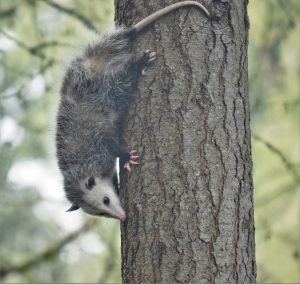
Opossums in the Americas are among the most ancient and enigmatic mammals on earth. Belonging to the order Didelphimorphia, they are marsupials, a lineage that diverged from placental mammals more than 100 million years ago. The Virginia opossum (Didelphis virginiana) is the only marsupial native to North America north of Mexico (Fitzwilliam and Boughton,2020). The opossum has unique adaptations that provide many contributions to natural ecosystems and have allowed it to thrive in our human environments.
So, what is marsupial? Unlike placental mammals that nourish their young in the womb until birth, marsupials give birth to tiny, underdeveloped offspring that continue to grow within a pouch on the mother. A newborn opossum is as big as a bee. Dozens of offspring may be born, but only those that secure a teat inside the pouch survive. This reproductive strategy has persisted for millions of years and reflects the opossums’ evolutionary resilience.
One of the most striking features of opossums is their adaptability. They possess opposable thumbs on their hind feet and prehensile tails, giving them exceptional climbing abilities. Their dietary flexibility is equally impressive also. They are omnivores and scavengers, and feed on everything including fruits, insects, small animals, and carrion. This varied diet allows them to thrive in diverse habitats and human landscapes.
Opossums have several unique physiological traits that support their survival. Most famously, they can “play dead” or enter a catatonic state when threatened, a behavior known as thanatosis. When they are in this state their eye glazed and tongues loll, and the opossum emits the foul scent of death from its anal glands that discourages predators. It is important to note that this is not a conscious act, but rather thanatosis is an involuntary response to extreme fear and an evolutionary strategy that has saved many a possum life. In short, the possum does not fight or flight but rather fools an attacker.
However, it is important to recognize that this ability is combined with other unique adaptations. Opossums also have a remarkable trait of partial resistance to venom (Jansa and Voss, 2011). Opossums have shown immunity to the venom of snakes like rattlesnakes and cottonmouths (Oliveira and Santori, 1999). This resistance allows them to prey on these dangerous creatures. There is ongoing research to study and understand their serum proteins to explore potential medical applications, including anti-venoms for humans (Komives et. Al., 2017).
Ecologically, because of their adaptability and uniqueness, opossums play a vital role in maintaining balance. As scavengers, they help clean up dead animals which reduces the potential spread of disease. They are also prolific consumers of ticks, eating thousands each season making them unlikely allies in the fight against tick-borne illnesses. They also consume vast amounts of fallen fruit, which helps seed dispersal.

Despite their fascinating adaptations and many benefits that opossums provide ecosystems, they are often misunderstood. They can be viewed as pests when their nocturnal foraging habits and appearance interact with human environments. Yet these animals pose little or no risk to humans as they are shy, non-aggressive, and rarely carry rabies (thanks in part to their low body temperature). These might marsupials are far more beneficial to the ecological health of our environments than we realize.
Our ecosystems are challenged, and many species are in decline, but the opossum endures. Their evolutionary heritage, adaptability, and quiet contributions to ecological health make them worth our admiration. They remind us that not all heroes are charismatic or cuddly but rather some have naked tails, hiss, and show an adaptability and resistance that is incredible. Opossums are peaceful stewards of the natural world and represent an endearing testament to the beauty and riddle of evolution.
References:
Oliveira M, Santori R, 1999. Predatory behavior of the opossum Didelphis albiventris on the pitviper Bothrops jararaca (translated). Stud. Neotrop. Fauna Environ 34, 72–75.
Jansa SA, Voss RS, 2011. Adaptive evolution of the venom-targeted vWF protein in opossums that eat pitvipers. PloS One 6, 1–9.
Komives CF, Sanchez EE, Rathore AS, White B, Balderrama M, Suntravat M, Cifelli A, Joshi V. Opossum peptide that can neutralize rattlesnake venom is expressed in Escherichia coli. Biotechnol Prog. 2017 Jan;33(1):81-86. doi: 10.1002/btpr.2386. Epub 2016 Dec 1. PMID: 27718338; PMCID: PMC5315628.
Fitzwilliam, Simon, and Raoul K. Boughton. “Wildlife of Florida Factsheet: Virginia Opossum: WEC426/UW471, 06/2020.” EDIS 2020.3 (2020): 2-2.
 1
1