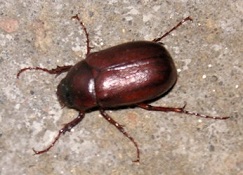
This May I noticed numerous half-inch brown beetles congregating around my porch light every evening at around 10:00 PM. Most householders in Florida deal with June Bugs. Their dried-out bodies can congregate under outdoor lights, in shallow plant saucers, or in the rain barrel from May through July. If you see Ibis feeding in your lawn, the larvae from these insects and other soil-dwellers are what they’re after.
Where do they come from?
But from where do these brown beetles come? We don’t see any all year and then in May, “Wham”, here they are in great numbers. June Bugs, Phyllophaga spp., spends most of their life under the soil as a white grub. White grubs munch on tree roots, sod roots, and decaying vegetation. You may never see these grubs unless you dig a hole in your yard to plant a tree or do irrigation work. Some dogs can smell them and will dig up a few every year when they get closer to the soil surface. These are great bait if you know a fisherman. Backyard chickens also enjoy eating them.
Adults June bugs are nocturnal ungainly flyers, which is why they congregate around the porch light.
There are How Many?
Insects outnumber humans 200 million to one on the earth. Of all those insects, beetles are the most numerous, with 350,000 species worldwide, making up 40% of all insects. There are between 100 and 300 different species of May Beetles, of the Scarabaeidea family of insects.
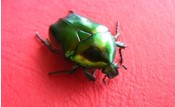
The second most common June beetle I encounter in my Florida neighborhood is the green June beetle, Cotinis nitida. These don’t show up in such great numbers as the brown May Beetle, but their iridescent green color is strikingly beautiful. This beetle is a bit larger, 3/4-of-an-inch to 1-inch long with a psychedelic metallic shine. Again, he spends his whole life underground from egg to root-munching grub, to pupae waiting to emerge as an adult. When they emerge from their pupae at the soil surface, the adult lives for only a short time. The goal of the adult May beetle or June bug is to mate and lay eggs.
Another related beetle is the yellow June beetle. This is a still larger, brown-mustard-colored beetle. It measures about one-inch long. It even has yellow eyes. This yellow species is a little more rare to find in Indian River County, and it also lives most of its life in the soil as a grub.
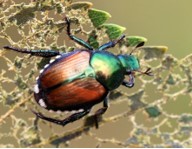
One of the June Bug’s most common relatives is the Japanese beetle, Popillia japonica. Though beautiful, invasive Japanese beetles are a major pest problem in the United States. In their adult stage, they eat living leaves of beans, roses, peonies, and numerous other plants. Treatments for getting rid of these pests range from sticky traps to pheromone traps. Pesticide sprays have little effect on Japanese Beetles.
The enemy of my enemy is my friend.
However, May beetles have natural enemies. Parasitic wasps and flies will feed on them and cut down their numbers naturally. When we spray pesticides, we also kill the good insect predators. Here are a few of the beneficial insects and other predators which feed on beetle larvae.
- Pelecinid wasp, Pelecinus polyturator
- Pyrgotid fly, Pyrgota undata
- Cordyceps, a fungus which infects the grubs so they never become adults.
- Birds such as Ibis and Sandhill cranes will eat the grubs in your lawn.
- Moles, skunks, raccoons, and armadillos also eat grubs in the lawn.
The life cycle of the June Bug
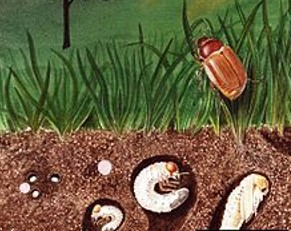
Adult female Phyllophaga spp. (May beetles) will lay 15 to 20 eggs in a cluster with some leaf litter from one to eight inches beneath the soil. Eggs are 1.5 mm to 3 mm across, pearly-white, and may darken before hatching in about 21 days. Depending upon the species of beetle, it may burrow anywhere from 1-foot to 3 1/2-feet underground after hatching. Which is why sprays often do not work to prevent them. They will generally start rising in the soil as they near pupal stage. From egg to adult may take from 1 to 3 years, depending upon the species. May beetle grubs (brown) take three years to become adults and can damage large areas of lawn and ornamental plants in that time period.
To learn more about these interesting insects and their life cycle, and crop damage they can cause, please visit the University of Florida’s EDIS (Electronic Data Information Source) publication, “White Grubs, Phyllophaga spp. (Insecta: Coleoptera: Scarabaeidae)” at https://edis.ifas.ufl.edu/in202#FIGURE%204.
 3
3