I live in a region of the world that frequently experiences hurricanes as disturbance events. Other places might endure wildfires, flooding, or ice storms. While different regions each suffer their own distinctive form of environmental smiting, some disruptions are more universal and affect urban trees across climate zones and continents. One such disturbance is construction damage. In this week’s Tree Research Journal Club, we look at a paper that investigates what happens when two disturbances overlap—specifically, root damage from sidewalk redevelopment and a straight-line wind event.
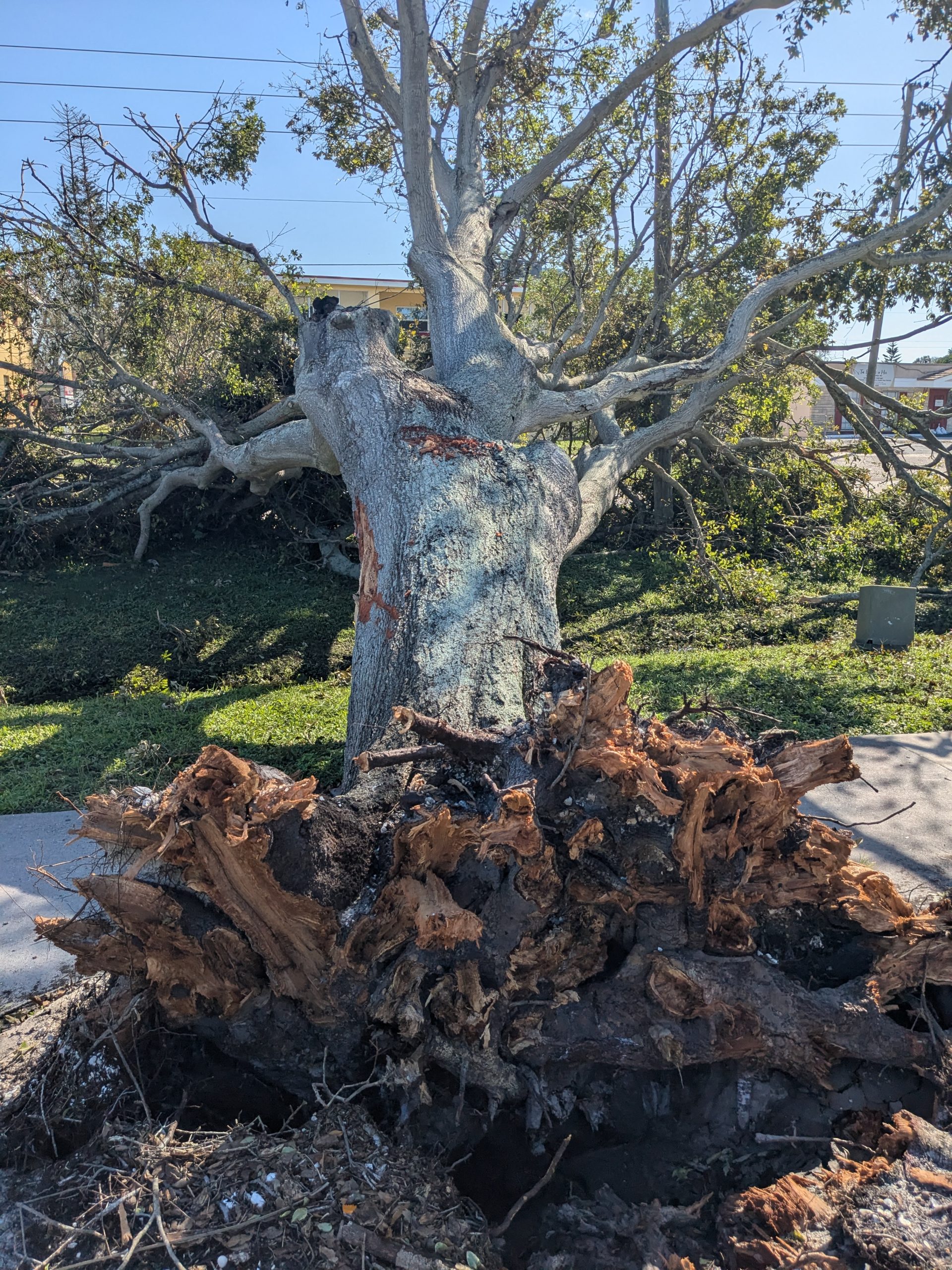
As mentioned in other posts, I worked with Dr. Allyson Salisbury on an international literature review of real-world studies examining the impacts of hurricanes, typhoons, and cyclones on urban tree failure. While there are many biomechanical studies that offer insights into tree risk assessment, I believe these real-world studies are the gold standard. In fact, I was so convinced of their value that I worked with a team to propose a data standard, supported by funding from the Florida Chapter of the International Society of Arboriculture.
One study that did not meet the inclusion criteria for our review—because it focused on northern temperate storms rather than a tropical system, but is still worth doing a deep dive into—comes from a team of researchers at the University of Minnesota and the University of Nebraska. These researchers were able to identify past construction damage to street trees and link it to loss of stability during a high-wind event. The convergence of data availability (including both tree inventory and sidewalk management records), a storm event, and a collaborative research team working closely with a municipality makes this a rare and highly valuable dataset.
Led by Dr. Gary Johnson, this paper is the focus of this week’s Tree Research Journal Club.
What was done?
The authors included two distinct studies in this paper. The first was a long-term assessment and compilation of wind-loading events across the Minneapolis–St. Paul metropolitan area (United States) over an eleven-year period. They limited their assessment of tree failures to storms associated with thunderstorms, straight-line winds, and gust fronts. After each event, a team comprised of academics, students, and citizen scientists collected detailed data from affected sites, including location, species, DBH, type and location of failure, site characteristics, rooting space, and pre-existing conditions of concern.
The second study focused on tree failures caused by two consecutive storms—winds equivalent to Beaufort scale 9 and Beaufort scale 10—that struck Minneapolis on the same day. Researchers surveyed 3,076 trees, documenting instances of partial and complete uprooting to support local urban‑forest managers. Each tree was geolocated, its species identified, and its diameter at breast height (DBH) measured. They also collected data on adjacent sidewalk and street redevelopment activities, including planting‑space width, presence or absence of hardscape repairs, distance from the tree, and other relevant site conditions.
What was discovered?
Results for the first study were somewhat limited—only one paragraph in the original paper. Upon reviewing this section, I realized (despite missing it in the methods) that this study also focused solely on tree-failure data. My thoughts on this are detailed in the “Minor Grievances” section, but for completeness, here’s what I’m comfortable reiterating: They recorded 1,584 tree failures during the eleven-year period under the specified storm conditions.
The other study in this paper is much more robust and has always been my preferred focus. Its design was developed by the university’s statistics consulting department. The researchers sampled all trees—both failed and intact—along randomly selected road segments and found that 367 (11.9%) had either partially or fully uprooted.
As with many studies, there was a significant genus-level effect. Genera like Tilia and Fraxinus had similar failure rates but were more than twice as likely to uproot compared to Acer or Ulmus.
The presence of nearby sidewalk replacement doubled a tree’s likelihood of overturning compared to trees without adjacent construction. However, the researchers noted that managers could mitigate this risk by designing planting areas with more space; making a planting-space about 1.5 times wider nearly halved the odds of tipping in their dataset.

What we like about this paper
This paper provides a robust assessment of tree failure following a notable storm event. The authors collaborated closely with the city’s urban forestry program to design the study—even going so far as to ensure the stumps of removed trees were left intact so they could identify which trees had overturned. They also partnered with their university’s statistics department to help design and analyze the experiment. This level of coordination is commendable and highlights the kind of work that’s possible when strong relationships and institutional support are in place to capture post-storm insights.
Beyond rigor, the findings from this study are practically important. It’s intuitive that trees with root damage are more likely to fail—but this study provides actual numbers that can help inform decision-makers about what’s at stake when trees are grown in confined spaces or suffer root loss from sidewalk replacement. These data support more informed choices and may ultimately help justify alternative construction techniques or expanded planting site designs.
Though not discussed in this blog post (given the general lack of significant results), the authors also conducted soil sampling at each road segment, measuring percent organic matter, sand, and silt. However, soil penetrometer readings at six inches depth did have an impact on uprooting outcomes.
Minor Grievances
I’ve tried combining multiple studies into a single paper—especially when one dataset doesn’t seem robust enough to stand alone—but this approach often sacrifices readability. My reviewers have consistently pointed this out, and I ultimately ended up decoupling the two works. As a reader, I agree: there were several instances where I got confused about the goals and measurements of the two studies while trying to summarize them. Additionally, the eleven-year citizen science effort receives much less attention in the methods and results, and this discrepancy is noticeable.
It wasn’t entirely clear to me after reading the methods section, but the eleven-year data collection effort appears to focus solely on failed trees. I’m not a fan of this type of data collection—especially when it relies on volunteer contributions—for a couple of reasons. First, it doesn’t give you the full picture. Did you record 50 failures in one species because it’s more failure-prone, or because it’s extremely abundant—perhaps numbering over five million—in your community? Without data on trees that didn’t fail, you’ll never know. Moreover, 54% of the tree failures they collected over the years were full-tree failures. I don’t believe that whole-tree failure is the dominant mode of tree failure; it’s more likely that complete failures are just more dramatic and more likely to prompt volunteers to submit reports. When you examine every tree and record less dramatic failures (e.g., broken small branches), whole-tree failures are relatively rare.
Conclusions
Cutting roots at the base of trees has measurable consequences for tree stability. For a single tree spared from extreme weather for a few years, you might get lucky—but urban foresters managing many trees exposed to sidewalk redevelopment only need to wait for the next big storm to see the effects. Giving trees more space prevents root damage, which prevents storm damage. It also prevents sidewalk lifting, which leads to sidewalk replacement that damages roots and causes failure. It’s a cycle that, unlike many others in urban tree care, has one simple solution that can break it.
That said, simple doesn’t mean easy—financial pressures associated with development and competing infrastructure demands make it difficult to give urban trees the space they need to grow to maturity.
About this blog
Rooted in Tree Research is a joint effort by Andrew Koeser and Alyssa Vinson. Andrew is a Research and Extension Professor at the University of Florida Gulf Coast Research and Education Center near Tampa, Florida. Alyssa Vinson is the Urban Forestry Extension Specialist for Hillsborough County, Florida.
The mission of this blog is to highlight new, exciting, and overlooked research findings (tagged Tree Research Journal Club) while also examining many arboricultural and horticultural “truths” that have never been empirically studied—until now (tagged Show Us the Data!).
Subscribe!
Want to be notified whenever we add a new post (about once every 1–2 weeks)? Subscribe here.
Want to see more? Visit our archive.
 0
0