Be safe and reduce your pesticide exposure. Whether you are a backyard gardener using pesticides or a professional pesticide applicator, precautions are necessary before and during the use of pesticides. The use of pesticides comes with significant risks to both human health and the environment. Pesticides kill, control or alter the life cycles of garden and agricultural pests. However, improper use can cause impacts to the applicator, or other non-target organisms. Understanding your risks, taking precautions and planning are integral to the pesticide-application process.
If you are a professional, please visit Citrus Industry CEU article https://citrusindustry.net/2025/08/01/pesticide-exposure-and-response-strategies/ to earn one General Standards Core CEU for similar information on this topic.
HISTORY
Did you know that ancient Sumerians used crushed sulfur to control insects over 4500 years ago? (Unsworth, 2010) Coincidentally, we still use sulfur today for insect control, to moderate soil pH, and in fertilizer blends. Value is placed on pesticides from the agricultural industry, commercial landscaping, to our backyards. Pesticides are used to control insects, mites, weeds, nematodes, and disease pathogens. Interestingly, according to Wang Li, (faculty of Health, Medicine and Life Sciences at the Maastricht University), if we did not use pesticides commercially “there would be 78% loss of fruit production, 54% loss of vegetable production, 32% loss of cereal production”. What is the percentage loss if home gardeners did not use pesticides in their gardens and landscapes?
Roughly in the 1940s, the synthetic generation of pesticides was on the rise. By 1950, DDT, DicholorDiphenylTrichloroethane was widely used to control mosquitoes, insects and protect our crops from beetles and bollworms. In 1962, Rachel Carson wrote a book “Silent Spring”. She discovered some synthetic pesticides were persistent pesticides (like DDT), they actively lingered in the environment for years. DDT impacted wildlife reproductive processes which included eggshell thinning. Our bird population had severely declined by the 1960s.
Pesticides can play a crucial role in the nation’s economy. However, the use of pesticides introduces significant risks to both human health and the environment.
ROUTES OF PESTICIDE EXPOSURE: WEAR PPE
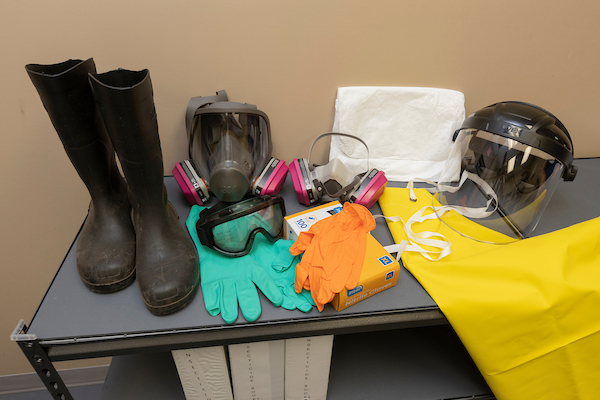
Pesticides can enter the body through four routes: dermal or skin, ocular (eye), inhalation and ingestion.
Dermal exposure is the most common route, accounting for up to 97% of exposure during spraying. It can occur through contact with dust, mist or spills during mixing, application or disposal. Prolonged skin contact can lead to irritation, blistering or more serious long-term health effects. Warm, moist skin quickly absorbs pesticides. Keep this in mind for your forehead, armpits, groin, top of feet and the back of your hands.
Ocular exposure is most common with splashes during mixing and loading or from drift of fine spray particles in the wind. Pesticide can get into eyes from sweat carrying pesticide there or from the applicator rubbing their eyes. Pesticide in the eyes has a secondary risk that it can obscure vision and make finding proper decontamination supplies difficult. Wearing the proper personal protective equipment (safety glasses) and being aware of wind direction reduces the risk of eye exposure.
Inhalation is particularly dangerous because pesticide vapors are often undetectable until symptoms appear. Symptoms may include dizziness, nausea, respiratory distress or, in severe cases, unconsciousness. Greenhouse workers are especially susceptible to inhalation issues. Workers must use proper protection.
Ingestion is less common but can occur if individuals eat, drink or smoke without washing their hands after handling pesticides. Contaminated food or drink can also lead to ingestion, resulting in symptoms such as vomiting, abdominal pain and nausea. The Florida Department of Agriculture and Consumer Services documented cases of accidental ingestion of pesticide by drinking from a soda bottle that had temporary storage of pesticide.
Absorption of pesticides by the skin differs by locality on the body. Note the absorption rates in Table 1 for parathion by bodily region. Parathion was a formerly used insecticide with systemic toxicity that has been removed from the market.
| Body Region | Percent relative absorption |
| Forearm | 8.6 |
| Palm of hand | 11.8 |
| Ball of foot | 13.5 |
| Abdomen | 18.4 |
| Scalp | 32.1 |
| Forehead | 36.3 |
| Ear Canal | 46.5 |
| Genitalia | 100 |
Table 1. Parathion absorption rate by body region.
TOXICITY LEVELS AND SIGNAL WORDS
Pesticide are not equal when it comes to toxicity level. Signal words are assigned to pesticides, and the label contains a box with the product’s level of toxicity:
- Caution – Low toxicity
- Warning – Moderate toxicity
- Danger – High toxicity
- Danger (with skull and crossbones) – Extreme toxicity
Understanding signal words is essential for selecting appropriate protective measures and responding effectively in case of accidental exposure. Toxicity can be as mild as a headache or as severe as coma or death. Seek medical advice for any level of toxicity and always indicate the pesticide you were exposed to.
REDUCE RISK
Avoid pesticide exposure with proper preparation for the application. Read the label before purchasing, mixing, applying, storing or disposing of pesticide containers. Online resources are available to understand a pesticide’s toxicity before purchasing it. Labels also list chronic toxicity warning statements, further emphasizing the importance of reading the label before you purchase or use the product.
We cannot change the toxicity of pesticides, but we can reduce our risk by reducing our exposure. This is ideal as we have full control of wearing the proper personal protection equipment (PPE), following label requirements and properly decontaminating after any exposure. Washing our hands frequently will also reduce your exposure to pesticides.

Preventive measures include:
- Read the label.
- Use PPE as required on pesticide labels.
- Follow all safety instructions and re-entry intervals.
- Ensure proper storage and disposal of pesticides.
- Clean up any spills immediately and wash hands after working with pesticides to prevent cross contamination.
PLAN AHEAD
Prior to spraying a pesticide, notify someone before your application occurs. This can be as simple as “I am going out to spray pesticides on the weeds next to the garden” or tell your boss you are about to begin application of x pesticide on x plant.
Keep Poison Control phone number posted in several locations. 800-222-1222. Be prepared to provide information on the pesticide involved, exposure details and symptoms.
FIRST AID
First aid depends on the route of exposure: inhalation, skin contact, ingestion or eye contact. Pesticide labels have a First Aid section that covers exposure solutions. Clem Cirelli Jr. wrote an excellent article about pesticide labels. Refer to the article to see what the First Aid section offers for the pesticide applicant. Meanwhile, consider these pointers:
- If possible, move to fresh air immediately if inhalation occurred.
- Remove contaminated clothing.
- Rinse skin thoroughly with water for 15 to 20 minutes (use soap if available, but do not delay rinsing).
- Rinse eyes with clean water or saline for at least 15 minutes, keeping eyelids open. Brett Bultemeier, director of the UF/IFAS Pesticide Information Office provides a blog article on this procedure.
- Watch for headache, dizziness, muscle twitching or weakness, excessive salivation, sweating, difficulty breathing, nausea, vomiting, confusion or convulsion (in severe cases).
OTHER PRECAUTIONS
Check your PPE before every use. To reduce exposure, inspect the clothing for tears or holes. Does your PPE fit adequately? Consider double gloves, particularly if the gloves are inexpensive and thin. If you wear leather boots during pesticide application, they need to be replaced occasionally. The leather absorbs the pesticides. Eventually, there will be enough product in the leather to expose the feet to harmful vapors.
Lastly, understanding the harmful effects of pesticide exposure, recognizing symptoms of poisoning and implementing effective response to exposure are essential for protecting the health and safety of humans and the environment. Be deliberate in the pesticide application process and mindful of the risks of improper application and accidental exposure. Always follow the label requirements. Following the recommendations in this article can reduce your chances of pesticide exposure.
Sources:
History of Pesticide Use. Unsworth J.;2010. International Union of Pure and Applied Chemistry, Mai. http://agrochemicals.iupac.org/index.php?option=com_sobi2&sobi2Task=sobi2Details&catid=3&sobi2Id=31.
Agriculture Development, Pesticide Application and Its Impact on the Environment. Li, Wang, Tudi, M., Ruan, H., Lyu, J., Sadler, R., Connell, D., Chu, C., and Phung DT. 2021 International Journal of Environmental Research and Public Health. https://pmc.ncbi.nlm.nih.gov/articles/PMC7908628/
Pesticides: Fact Sheet for Ethyl Parathion
Symptoms of Pesticide Poisoning
 1
1