Dr. Tara Wade has been promoted to associate professor, a well-deserved recognition of her impactful work in the field of natural resources economics since joining the University of Florida.
Wade is an agricultural economist who joined the faculty of the UF/IFAS Southwest Florida Research and Extension Center in 2017 as an assistant professor of Food and Resource Economics. She specializes largely in natural resources economics, with work focusing on understanding the economics behind the adoption of agricultural best management practices.
“Farms are businesses,” Wade explained. “We need the business to stay in business, and so we can’t just look at the benefits to the public when you are asking someone to make changes to their livelihood.”
This is where experts like Wade come in – providing cost-benefit analysis to determine the feasibility of implementing different best management practices that will benefit the planet while remaining profitable for farmers.
“What economics can help do is quantify the benefits so we can do an accurate comparison and see if it makes sense,” Wade.
Finding a Passion for Economics
 The career path leading Wade to UF was a circuitous one, beginning in the classroom as a math teacher.
While she loved math, Wade said there reached a point where she realized she was being called in a different direction. This led her to pursue her Ph.D. in Energy and Environmental Systems at North Carolina A&T State University.
“I wanted to be helpful, and I wanted to work in the natural resource space, but wanted something with more tangible impacts,” Wade said.
While in the interdisciplinary program at North Carolina A&T State University, Wade’s experience with the core economics coursework opened her eyes to new possibilities.
“My professor there had a math master’s, which made me realize I could do this,” Wade said. “I always knew the degree was flexible, but I never imagined the social sciences, and so I opened up to that.”
After completing her Ph.D. program, Wade began her career as an economist jointly employed by North Carolina A&T State University and the US Department of Agriculture, Economic Research Service (ERS). Her time writing ERS reports prepared Wade not only to ensure her work was accessible for a general Extension audience, but also that it was meticulous and methodical in nature. Wade says these experiences drove home the importance of accuracy, attention to detail, and transparency in the research process as it shapes real-world decisions.
“Something I really took away from there is what you write, people believe,” Wade said.
Supporting Florida’s Farms & Farmers
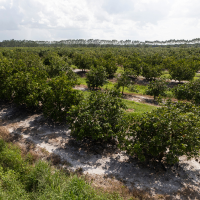
Some of Wade’s recent natural resources economics research has explored topics such as cover crop adoption in the citrus industry, Watermelon production in Florida, and the feasibility of implementing agricultural best management practices that prioritize soil water quality while maintaining profitability.
Looking forward, she is excited to continue mentoring student and post-doc team members, and to expand her Extension work to have even greater national and global impact through new ventures such as supporting areas that have previously only grown singular crops such as soybeans in efforts to introduce a wider variety of commodities.
Leading the Next Generation of Agricultural and Applied Economists
In her time so far at UF, Wade is most proud of the graduate students and postdoctoral associates she has mentored. For each student who works with her, Wade strives to expose them to the importance of Extension and reiterate the values she picked up on early in her career for careful and thorough data analysis to this new generation of agricultural and applied economists.
“In general, that’s my ethics,” Wade said. “That can slow things down, but it’s important to me and I reiterate this to my students. A part of this program is that you need to understand your data before you do the analysis. You should be able to ask and answer questions, and it’s okay to be wrong but you have to be transparent.”
 1
1