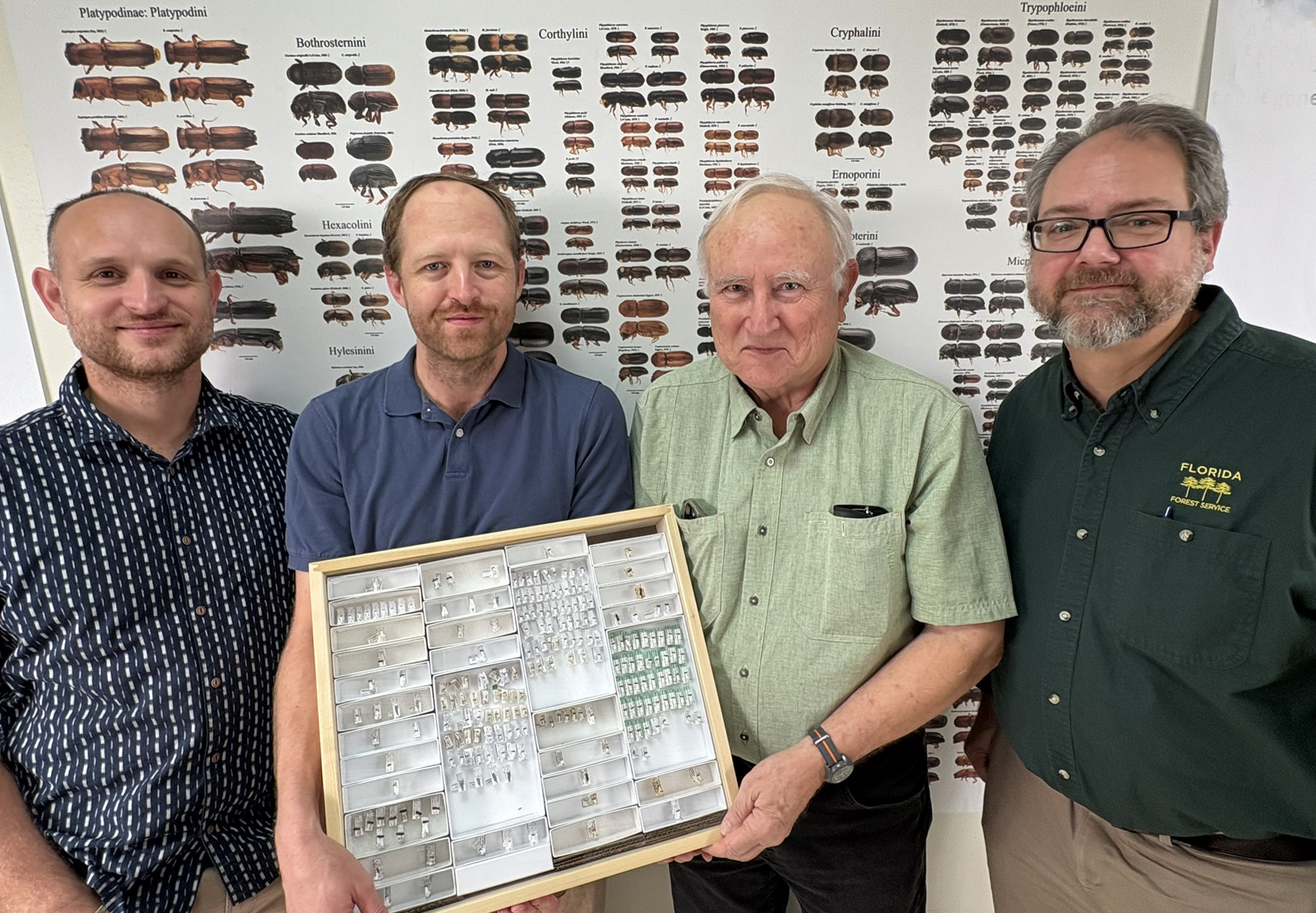
GAINESVILLE, FL — The University of Florida’s Forest Entomology Lab has launched the world’s largest database of bark and ambrosia beetles.
The site: Bark and Ambrosia Beetles of the World, contains 15,778 specimen records, 32,403 images, and 7,987 species – all of the world’s species of bark and ambrosia beetles which are one group of insects, but bark beetles live under bark of dead trees, ambrosia beetles burrow deeper in the sapwood and inoculate it with symbiotic fungi which they then eat.
The project was funded by the 2024 Bipartisan Infrastructure Legislation through a grant from the Florida Forest Service to the UF/IFAS Forest Entomology Lab (https://pitchtube.org/).
The UF Forest Entomology Lab is managed by UF Associate Professor of Forest Entomology Jiri Hulcr, Ph.D. and housed at the UF/IFAS School of Forest, Fisheries, and Geomatics Sciences.
The Forest Entomology Lab team (https://pitchtube.org/) is working with retired Associate Research Scientist at University of Texas Thomas H. Atkinson, Ph.D., who provided his massive Bark and Ambrosia Beetles database to the UF lab in 2024.
“I have been working on this database for nearly 20 years, starting very small and simple and growing in size and complexity ever since,” said Atkinson about the original site.
“In the early 2010’s it occurred to me that the information might be of interest to wider audiences,” he added. “Some early support from the U.S. Forest Service allowed me to get a web version up and running and, since then, I have kept adding to the scope and adding stacked photographs.
“Over the years the original code has become dated and creaky. Response times have slowed due to the size of the database and number of pictures.”
Atkinson said he chose to turn over his database to UF because he has been working with Hulcr and his students for over 10 years.
“I wanted to see the database survive and get some institutional support from someone younger who is still actively involved,” he said. “Jiri managed to come up with a budget to modernize the web interface, as well as speeding up response time and fixing some broken features. The combination of Jiri’s energy and institutional support from UF and IFAS were big factors. This is not a one-time event. Over the coming years we anticipate updates and upgrades. Now that I am a Gainesville resident, this is a very exciting prospect.”
Atkinson is now serving as a volunteer curator of the new site which Hulcr said has many upgrades.
“Originally, it was almost entirely from Tom’s decades of effort,” Hulcr said. “He sleuthed most the museums in the U.S. and throughout the Americas and Europe to amass this comprehensive dataset. But now, one of the upgrades we have included is a portal for other scientists and students to add their data, so we are planning on growing the database with records from around the world.”
Hulcr said he expects lots of scientists, students, government entomologists and biosecurity experts to use the site.
“These insects are not only traditional pests of timber plantations, but increasingly they are transported around the world on cargo and are becoming among the most invasive pests of all insects. Think of the laurel wilt or the Dutch elm disease.”
“Human activities – primarily trade and intensive silviculture – are allowing some species to benefit from the tree stress and become human competitors,” Hulcr said. “And that is why regulators, agencies, scientists and industries around the world need to understand the names, geography and biology of these beetles.
For example, Hulcr added, “The USDA (U.S. Department of Agriculture) needs to access to distribution data on Asian bark beetles that are arriving to our ports on cargo ships. Just as Japanese or European scientists are studying American species which are becoming invasive overseas.”
Hulcr explains how agencies will benefit from access to the improved database.
“Imagine you are working with a government agency responsible for protecting the American forests against invasive pests. Invasive bark beetles have caused tremendous damage to our forests, both planted and natural. Most people have probably heard about Laurel wilt or the Dutch elm disease – exotic beetles arrived at the US and wiped out entire tree species.
“And imagine you are working in such an agency that is protecting the U.S. from the arrival of such insects on cargo ships. There are hundreds of specialists employed with the USDA APHIS or CBP, or in state-level agencies like the Florida Department of Agriculture. Their job is to make decisions on the hundreds of shipments that come into the country daily, many of them with signs of bugs or fungi. If a wooden pallet, on which your shoes or computers from China are arriving, has holes and sawdust indicating the presence of bugs inside, that person needs to make a decision on whether to accept the shipment, or whether to turn around the whole cargo ship. If the bug infesting the wood is harmless, trade can proceed. If it turns out to be one of those dangerous invasive pests, we need to turn the ship around, and the government has the authority, and the duty, to do so.
“But there are 6000 species of bark beetles in the world. How does one know which beetle we’re looking at? That is why we need comprehensive data sources like this one. One that summarizes a century of careful taxonomic work, an authoritative resource that the government and trade representatives can rely on in their million-dollar decisions about protecting us forests or facilitating international trade.”
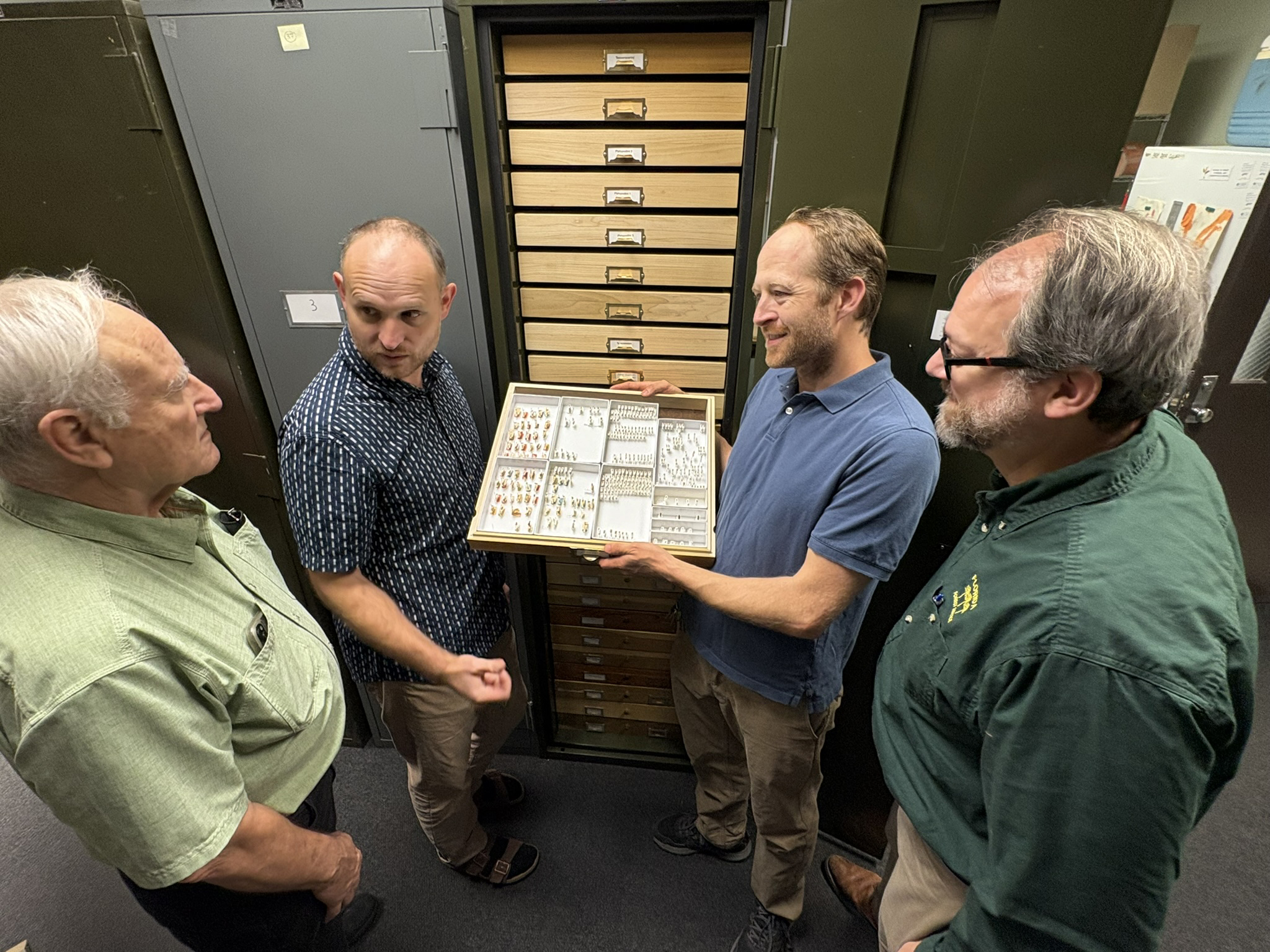
Along with Atkinson helping with curation and Hulcr managing the project, UF Research Scientist Andrew J. Johnson, Ph.D., Associate Scientist Sarah M. Smith, Ph.D., and an undergraduate student Eric Kuo will play a role in adding more data and upgrading the database code.
Florida Forest Service Entomologist Jeffrey Eickwort, is one of many intended users for the website. “As a state agency entomologist who often identifies bark and ambrosia beetles that were either collected in traps or found infesting trees in the field, having access to reliable, high-quality images for comparison can make that process much more efficient and accurate,” he said.
“It’s the next best thing to having access to a museum reference collection.”
 4
4