Not everyone can use cutting-edge technology to nimbly process millions of data points, turning them into a story full of meaning. But Jinyi Xia can, and has just published a paper in Scientific Reports that shows how she and her colleagues used terrestrial lidar to create digital replicas of Southern pine forests, while simultaneously detecting signs of damage, disease, and genetic weakness. The paper pushes the use of lidar technology forward, shedding light on how it can reveal critical indicators of forest health and inform management decisions.
Jinyi is a Ph.D. candidate in the School of Forest, Fisheries, and Geomatics Sciences at the University of Florida. Before joining Dr. Carlos Silva’s Forest Biometrics and Remote Sensing Lab in Fall 2022, she completed her bachelor’s and master’s degrees in Geographic Information Systems in China, where she became interested in how geospatial technologies like lidar can be applied to study forests in more precise and efficient ways. Jinyi is currently working on the second chapter of her dissertation, which involves both laser scanning and destructive sampling to better understand how traits like crown shape and branch distribution relate to tree growth and productivity. When she’s not crunching massive data sets in front of the computer, she enjoys camping under pine trees.
We spoke with Jinyi about her research and its implications for the forestry field.
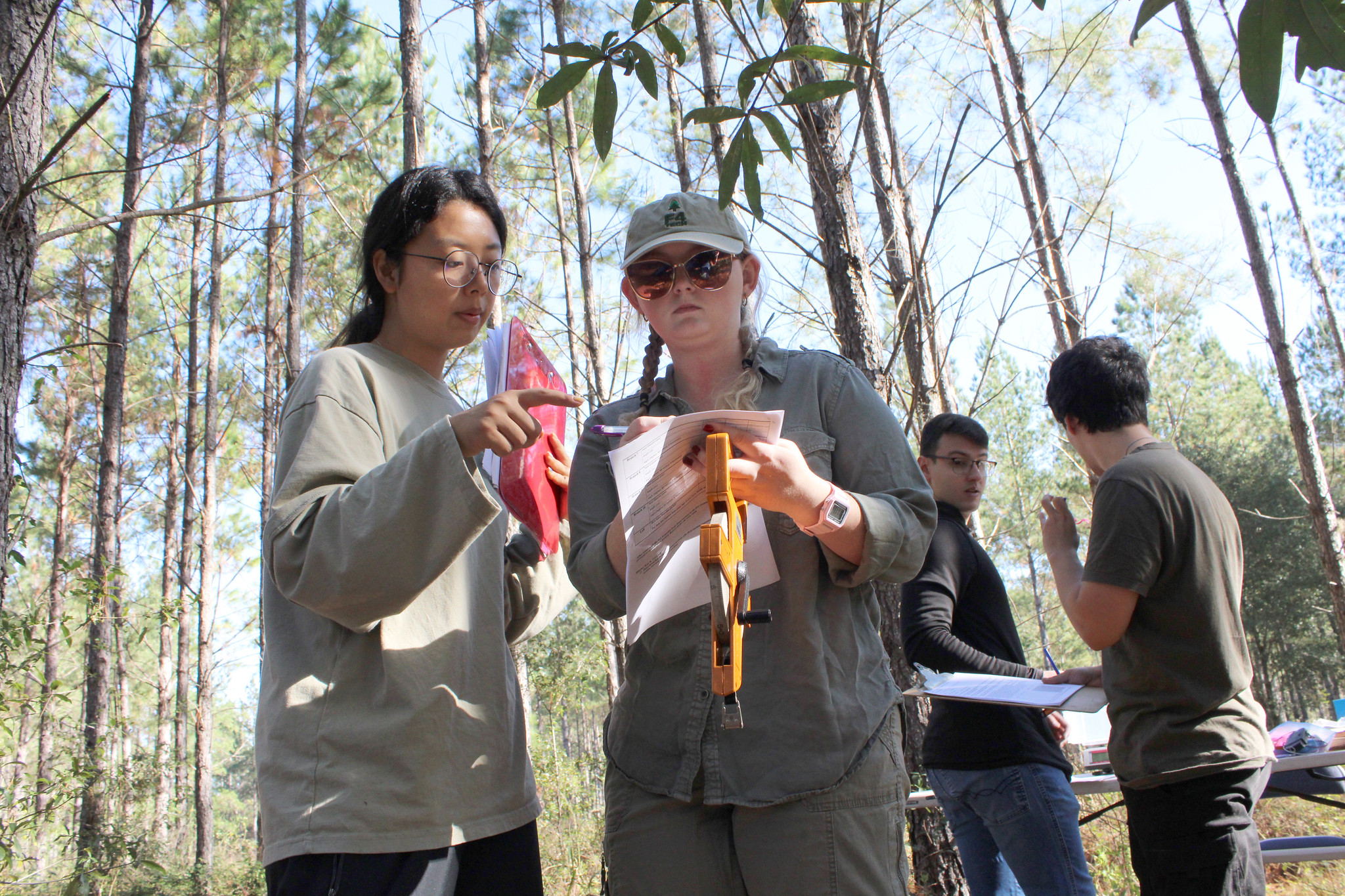
What is terrestrial lidar and how is it used to study forests?
Imagine being able to measure the height, shape, and branching pattern of a tree down to the centimeter—without ever picking up a saw. That’s the promise of terrestrial laser scanning (TLS), a ground-based technology that uses lasers to create highly detailed 3D models of trees. By setting up a scanner in the forest, we can capture millions of data points that record every branch, every curve of the trunk, even the sprays of pine needles. It’s like giving a tree a full-body scan—non-invasively, and with remarkable precision.
So we can have a fairly accurate digital replica of a forest, down to each tree, right? What can this tell us about both individual tree health and forest health?
Exactly! TLS allows us to build detailed 3D models of individual trees—capturing their height, stem shape, branch arrangement, and crown structure. From these models, we can extract precise structural traits that are closely tied to how well a tree grows, how it responds to competition, and how it allocates resources between the stem and crown.
At the individual level, these measurements can indicate whether a tree is growing efficiently or showing signs of stress, such as poor crown development or irregular branching. At the forest scale, we can aggregate this information to assess how different treatments—like thinning or genetic selection—affect stand structure and growth potential.
Several studies have shown that structural traits like crown length, branch angle, and stem taper are linked to wood quality and biomass accumulation. By capturing these traits non-destructively with TLS, we can monitor forest dynamics more accurately over time and support decisions related to carbon modeling, silviculture, and forest resilience.
How long has this technology been around?
Terrestrial laser scanning has been used in forestry research for about two decades. In the early 2000s, it was mostly used to measure tree height or diameter more accurately. Over time, as scanners became more precise and computing power increased, TLS evolved into a tool for full 3D reconstruction of tree architecture. It’s now widely used in academic research, especially in Europe, but adoption in operational forestry is still emerging—mostly because of the need for specialized equipment and data processing. However, as more open-source tools and machine learning methods become available, TLS is becoming more accessible for broader forest applications.
So the goal of your study is essentially to make sense of the massive amount of data that TLS provides? How did you do that?
In this study, we used TLS to scan individual longleaf pine and loblolly pine trees in Florida forests. These two species are ecologically vital and economically important in the Southern U.S., but their complex, needle-covered crowns pose a challenge for digital reconstruction.
Gathering the data is just the beginning. A single scan of a tree can produce millions of points, and they don’t come neatly labeled. To turn this raw data into biological meaning—like how much timber a tree has or how many branches it grows—we first needed to separate leaf points from wood points, and then build a 3D model that reflects the actual tree structure.
We evaluated four methods to “clean up” the data – classify leaf vs. wood points. Then, using four different Quantitative Structure Models (QSMs), we built virtual tree models and extracted key structural traits like trunk volume, branch volume, and number of first-order branches.
And what did you find?
Our results showed that the choice of leaf and wood classification methods has a major impact on how accurately we can measure tree structure. The deep learning model (KPConv) produced the most accurate and consistent results for both pine species. However, it required a powerful computer and a time-consuming training process. Simpler methods like DBSCAN and Graph performed well too—DBSCAN was fast and captured most wood points, though it sometimes confused leaves with branches. Algorithm selection is always a trade-off decision.

We also found that species mattered: longleaf pine, with its open crown and sparse branches, was easier to model accurately, while loblolly pine, with its dense foliage and overlapping branches, posed more challenges.
Together, these findings highlight the importance of early-stage processing decisions when using TLS to model trees. For structurally complex species like Southern pines, choosing the right combination of segmentation and modeling tools is key to producing reliable structural estimates—information that is essential for understanding growth, estimating carbon storage, and informing forest management and breeding decisions.
What kinds of decisions can forest managers make with these new technologies?
TLS provides detailed structural data that can improve decisions in many areas. For example, forest managers can use it to evaluate how different treatments—like thinning or spacing—affect tree crown development and competition. It can also help select trees for breeding programs by quantifying desirable traits, such as straight stems or efficient branch arrangements. Because TLS is non-destructive, it allows for repeated measurements over time, making it useful for monitoring growth, detecting early signs of decline, or assessing damage after storms. It bridges the gap between field observation and long-term, data-driven forest planning.
What comes next?
This work is the foundation of a broader PhD project that combines TLS with mobile laser scanning (MLS) to study how genetics and forest management practices influence pine tree crown structure and branching patterns.
Ultimately, my goal is to build an efficient, non-invasive pipeline for understanding how genetics and management shape tree architecture, helping pine forests grow stronger, more efficiently, and more sustainably.
 1
1