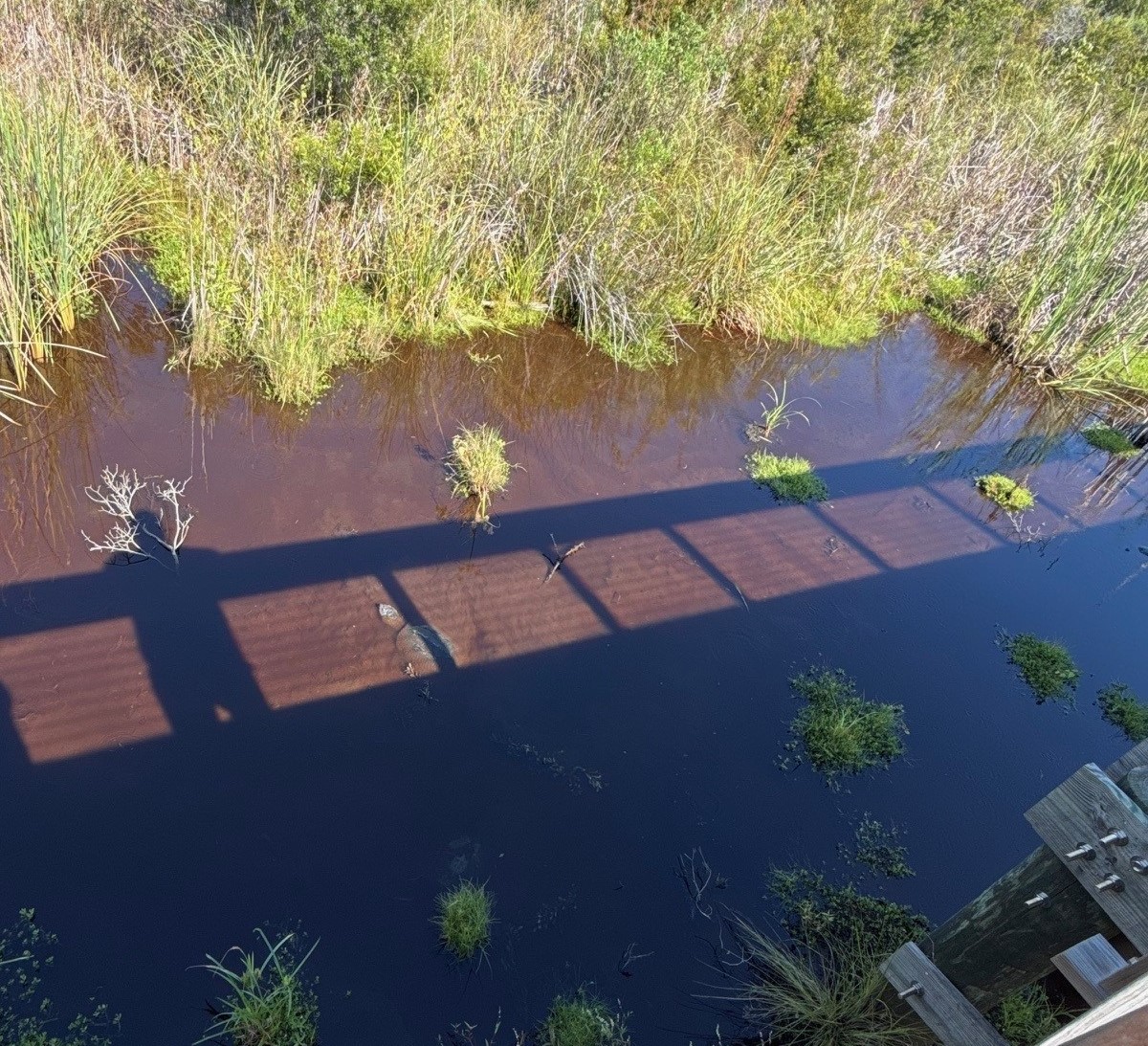
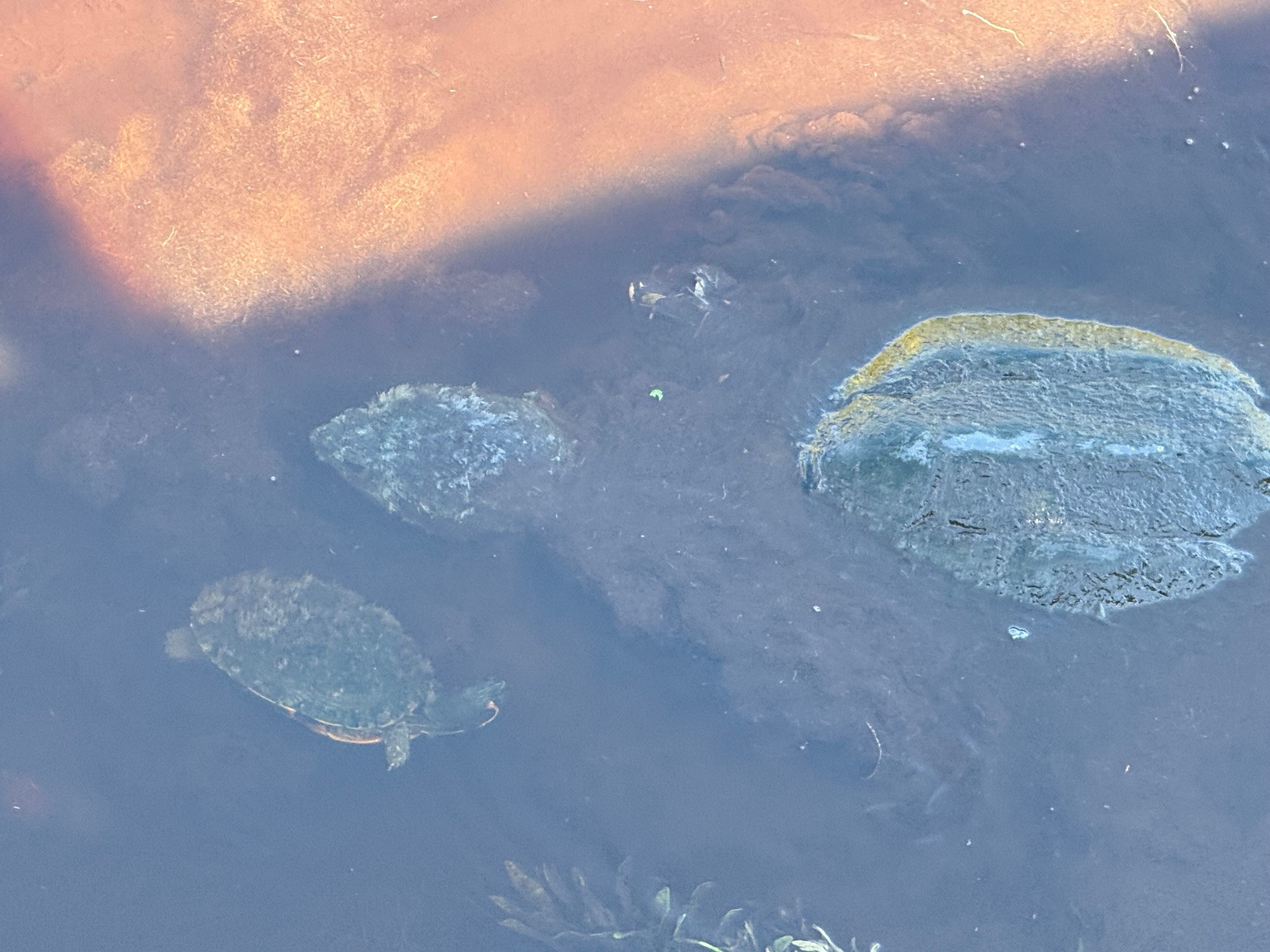
If you’re ever looking for an easy nature walk with guaranteed wildlife sightings, I highly recommend the Gulf Breeze Wetlands Trail. It’s a little over a ¼ mile long boardwalk trail at Shoreline Park South, overlooking a marsh that transitions from freshwater to saltwater. We went there over Labor Day weekend to enjoy the nice weather, and enjoyed seeing the locals—a large blue heron, an osprey diving for fish, and a handful of turtles paddling around. There’s an open pool below a bridged section of the trail where lots of turtles congregate, no doubt hoping for snacks from visitors. My favorite, though, was the algae-covered alligator snapping turtle (Macroclemys temminckii). This big fellow—at least two feet long—stood out from the crowd. His bulky head was larger than most of the surrounding turtles’ shells.
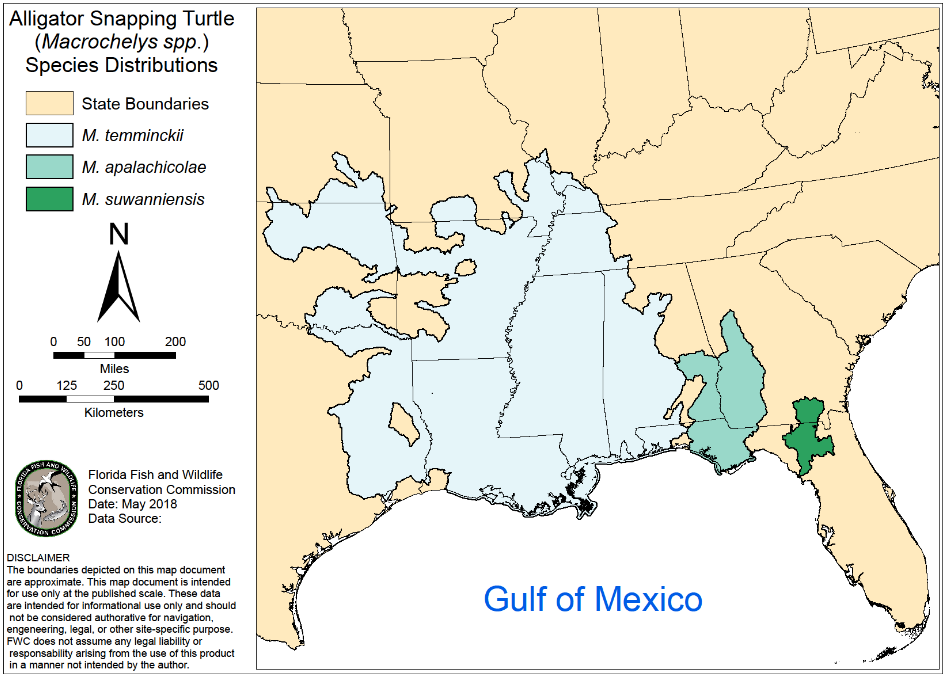
Alligator snapping turtles are native to freshwater rivers and swamps throughout northwest Florida, from Escambia County over to the Suwannee River. Two additional distinct species live to our east, the Apalachicola (M. apalachicolae), and the Suwannee alligator snapping turtles (M. suwanniensisa). Their full range is mostly in the Gulf South, although they have been found in midwestern stretches of the Mississippi River. They have extraordinarily powerful jaws with a bite force of 1,000 pounds. I’ve always heard they could break a finger bone in half if you made the poor decision of getting your hand that close.
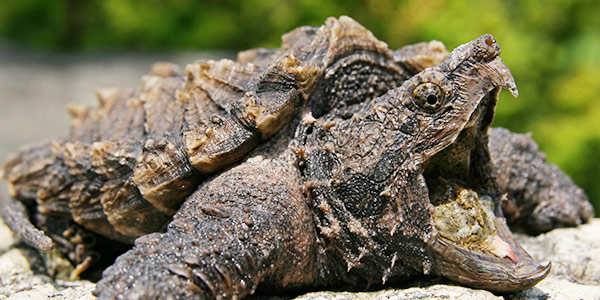
Like many large turtle species, they can grow quite old, with captivity records reaching 80 years and suspicion of longer lifespans in the wild. They are also rather large, with adult males reaching up to nearly 250 pounds and a carapace (shell) length 2.5 feet long. Females are considerably smaller, maxing out at 60 pounds. The algae growth I observed on the turtle in Gulf Breeze is not unusual for this species—it serves as an effective camouflage. In fact, it was hard to see the full form of the snapper underwater due to the muddy water and blurred edges of its carapace.
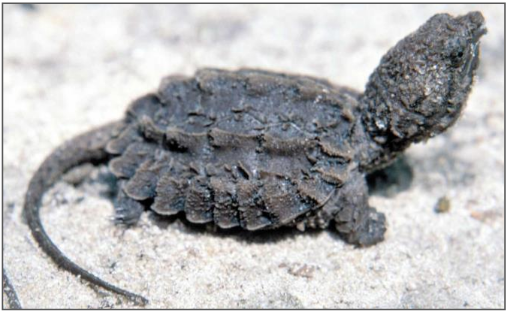
They are primarily carnivores, feeding on a wide variety of aquatic foods ranging from crawfish and fish to snakes, birds, and smaller turtles. Like anglerfish, they have a fleshy “vermiform” appendage on their tongues that they wiggle underwater to lure unsuspecting prey. They spend the majority of their time underwater, and are capable of holding their breath for 45-50 minutes at a time.
Due to their thick armored plates, adult alligator snapping turtles have very few predators (besides humans). The species is much more vulnerable when young, with eggs and juveniles predated by mammals and some insects, including fire ants and phorid flies.
Alligator snapping turtles were hunted and trapped to the point that they are now considered a Species of Special Concern in Florida. The Suwanee turtle is listed as threatened, which gives it an additional level of protection. In addition to hunting, their populations declined due to habitat loss, water quality issues, and injuries from boat strikes and fish hooks. In Florida, it has been illegal to “take, possess, or sell” the alligator snapping turtle or its parts since 2009. The US Fish and Wildlife Service is currently conducting a federal review of its protection status.
 8
8