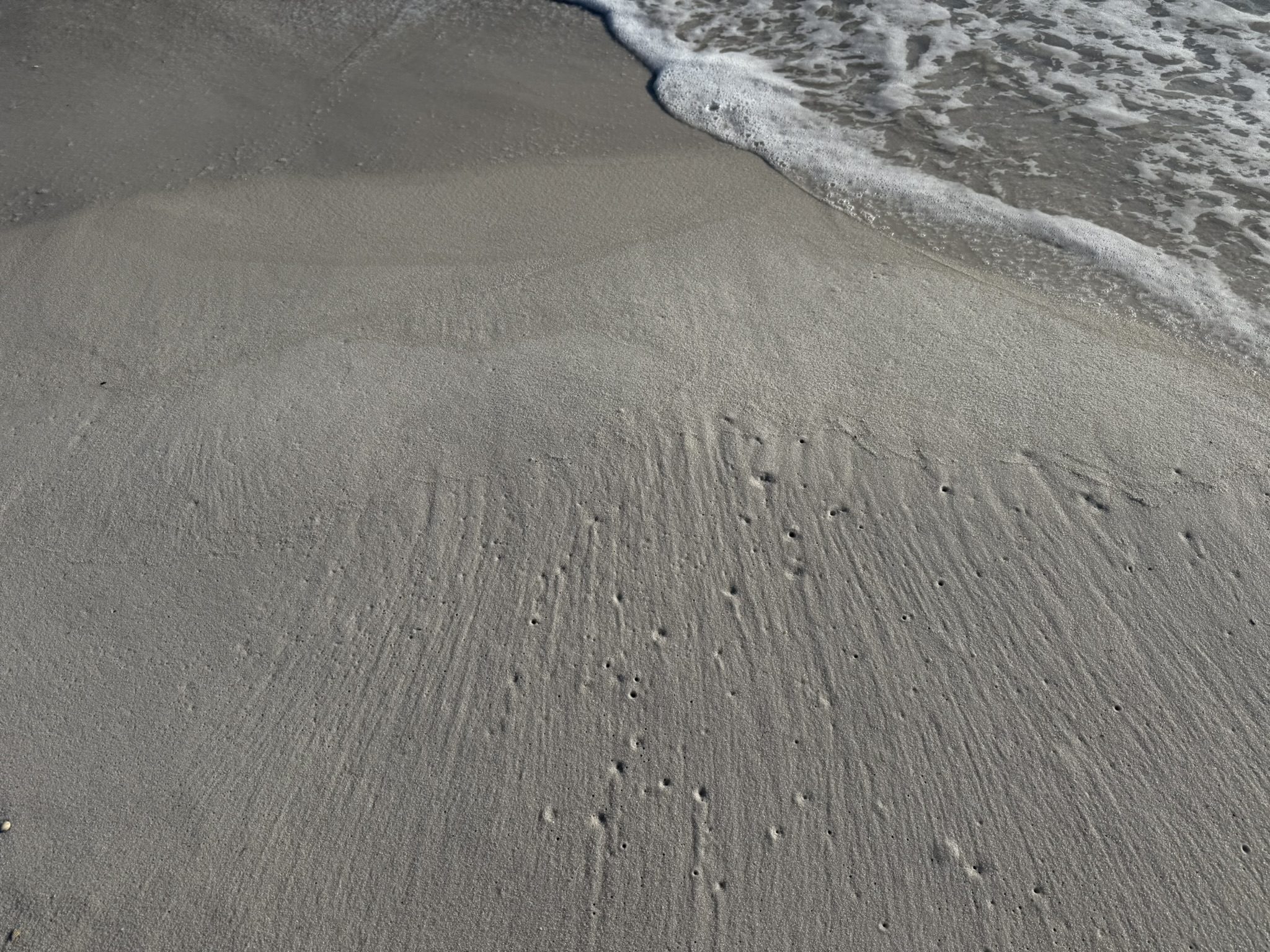
Ever notice the little air bubbles that form in the wet sand after a wave retreats? These are created by thousands of coquina clams buried just under the sand. When covered by an incoming wave, they open their shells to feed and clap closed when the water is gone. Of all the shells you come across on a northwest Florida beach, the coquina may be the most common. It’s certainly the one I see most frequently fully intact, and often alive, on our shores. They vary widely in color, often jewel-toned and shiny with repeated bands of color.
Because they’re small and abundant, these clams are a common prey item for crabs and shorebirds. Coquinas have adapted and survived for so long because they can bury into the sand, using their muscular foot to dig vertically several inches under the surface. They can even “surf” waves to move down the beach.
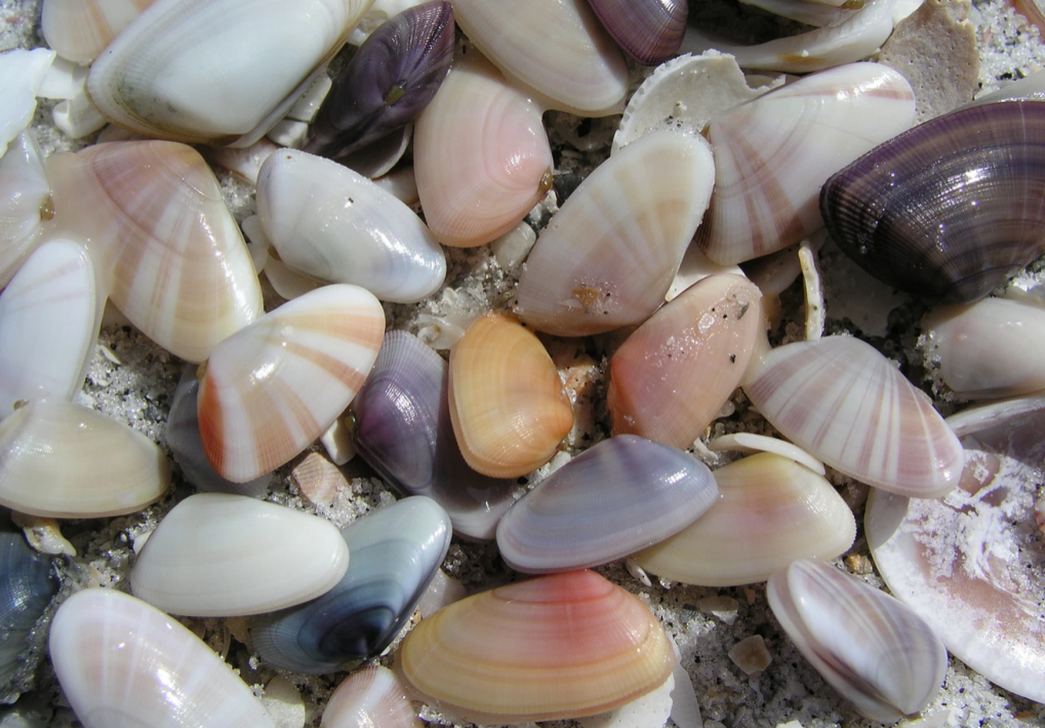
Coquina clams (Donax variabilis) are tiny—about the size of a fingernail—and inhabit the swash zone of the beach. The swash zone is the easiest to walk on, forming the packed edge between the squishy waterlogged strand and the loose sand further inland. However, this stretch of intermittently exposed or flooded sand is possibly the most difficult living condition on the beach. Almost nothing else (besides sand fleas/mole crabs) can live there permanently. The endless wave energy would quickly uproot any plant trying grow, and the constant flux of water is not deep enough for fish or anything that swims.
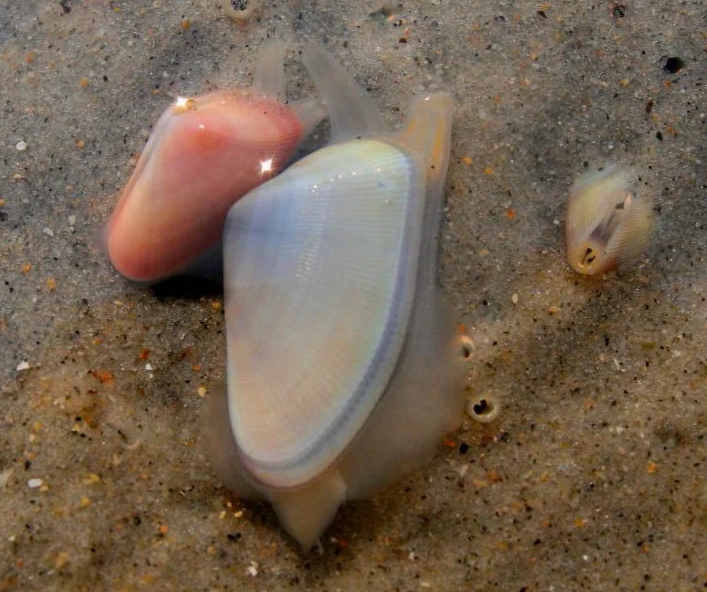
Like other bivalves—oysters, scallops, mussels—coquinas are filter feeders. They use tiny incurrent siphons to suck in water, which moves over little basket filters or gills that pick out detritus, plankton, and other tiny food particles suspended in the water. Cilia—tiny hairlike projections—move the food into the organisms’ stomachs. Water then leaves through an excurrent siphon, and the process starts all over again. This causes those little air pockets you see as you walk.
These hardy clams have played many useful roles for humans. Besides the coquina rock building material I wrote about earlier this year, I have also heard of people making coquina broth or chowder. To open the shells, you boil the clams until the shells open. Vegetables can be added to make a thicker chowder. About a hundred years ago, a factory operated in Ft. Myers to process coquina clams for a tasty broth. It was canned and sold for cooking–and also marketed as a hangover cure–which I found hilariously ironic during Prohibition.

After the Deepwater Horizon oil spill in 2010, University of West Florida biologists looked to coquina clams as a bellwether for the ecological health of beachfront life. Dr. Richard Snyder (who happened to be my thesis advisor while I was in grad school at UWF several years earlier) wanted to research the biological impact of oil on local beaches. At some point, he realized “Coquina are excellent indicators of oil for sandy beaches. We did not have biological indicators for sandy beaches before.” Coquinas don’t have any mechanism to remove or process crude oil, so he and several students analyzed the concentrations of polycyclic aromatic hydrocarbons (PAH)’s present within the clam muscles. I recall Dr. Snyder joking about undergraduate students having to “shuck” thousands of these tiny shells for the research. While tedious, the study was enlightening. After two years of research, PAH levels steadily decreased then disappeared from the studied clam populations on Perdido Key and Panama City Beach. This indicated the ambient crude oil levels in the Gulf had dropped to safe and eventually nonexistent levels. UWF students have also examined the presence of microplastics in coquina shells, unfortunately finding these pollutants in large quantities.
Coquina populations can be adversely affected by beach renourishment projects, getting buried under fresh sand and unable to access the water. Research shows that it often takes a couple of years for native populations to recover after a renourishment project. The clams typically have a 2-year life span but will die in three days without access to water.
 7
7