In 2025 Florida Sea Grant trained 100 residents from Escambia and Santa Rosa County to survey for nesting horseshoe crabs in the Pensacola Bay area. Of those 21 (21%) participated in at least one survey. The objective of this project is to survey beaches that horseshoe crabs have been seen and verify nesting activity. Horseshoe crabs will nest along the shore during the spring high tides of both the spring and the fall. Our volunteers attempt to survey those beaches during those times.
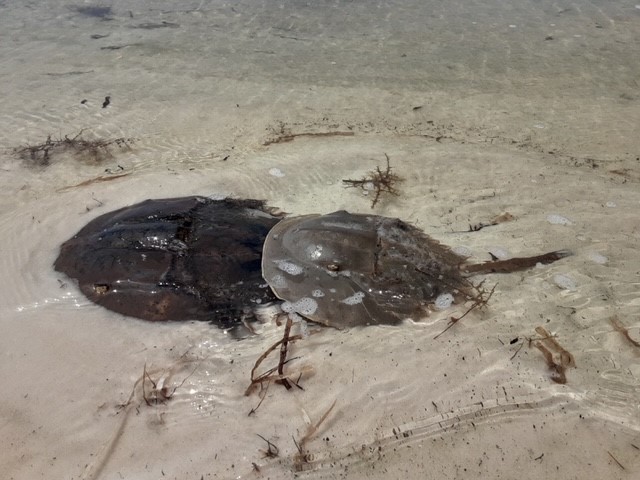
Photo: Bob Pitts
The larger female horseshoe crabs will approach the beach to dig a depression and deposit her eggs. Often the smaller male will use a modified claw to hold to the female and ride her back to shore. Additional small males, known as satellites, will follow the pair and attempt to fertilize the eggs as well. Horseshoe crabs usually nest in large numbers near the same location and at the same time. Whether nesting is observed or not, our volunteers will record the number of horseshoe crabs seen in the area. Like all arthropods, horseshoe crabs will molt their external shell to grow a new one as they grow. The number of molts found is also recorded.
In addition to the data sheets completed by our volunteers, other residents aware of the project will also contact us with sightings. Below is the 2025 report for the spring and fall nesting season.
Spring Surveys
| Location | # of surveys | # of molts | # males | # females | # satellites |
| Bayou Grande | 4 | 0 | 0 | 0 | 0 |
| Redfish Pt. Gulf Breeze | 1 | 0 | 0 | 0 | 0 |
| Redfish Pt. Big Lagoon | 2 | 0 | 0 | 0 | 0 |
| Naval Live Oaks North shore | 46 | 13 | 2 | 0 | 0 |
| Naval Live Oaks South shore | 5 | 1 | 0 | 0 | 0 |
| Little Sabine | 5 | 0 | 0 | 0 | 0 |
| Ft. Pickens | 46 | 12 | 0 | 0 | 0 |
| Big Sabine | 12 | 3 | 0 | 0 | 0 |
| Range Point | 3 | 4 | 0 | 0 | 0 |
| Baby Beach | 1 | 0 | 0 | 0 | 0 |
| Johnson’s Beach | 2 | 0 | 0 | 0 | 0 |
| Park West | 8 | 0 | 0 | 0 | 0 |
| Morgan Park | 1 | 0 | 0 | 0 | 0 |
| Santa Rosa Villas | 2 | 0 | 0 | 0 | 0 |
| TOTAL | 138 | 32 | 2 | 0 | 0 |
Notes:
Three deceased horseshoe crabs were reported. One at Big Sabine, one at Ft. Pickens, and one at Naval Live Oaks south shore.
Fall Surveys
| Location | # of surveys | # of molts | # males | # females | # satellites |
| Naval Live Oaks North shore | 10 | 0 | 0 | 0 | 0 |
| Naval Live Oaks South shore | 1 | 0 | 0 | 0 | 0 |
| Ft. Pickens | 1 | 0 | 0 | 0 | 0 |
| Park West | 11 | 0 | 0 | 0 | 0 |
| Big Sabine | 4 | 0 | 0 | 0 | 0 |
| Park East Dog Park | 1 | 0 | 0 | 0 | 0 |
| TOTAL | 28 | 0 | 0 | 0 | 0 |
Notes:
Though there were no encounters by the volunteer team during the fall, numerous reports were given by residents of dead horseshoe crabs during the months of October and November. These reports were mostly from the Gulf Breeze/Pensacola Beach area, but there were reports from the north shore of Pensacola Bay. The cause is unknown.
Overall
22 volunteers conducted 166 surveys.
102 (61%) of the surveys were conducted at Naval Live Oaks north shore and Ft. Pickens.
23 (14%) were conducted at Park West and Big Sabine.
Only 2 live horseshoe crabs were reported – both males – both alone – both at Naval Live Oaks north shore.
32 molts were found, and all of these were in the spring.
Numerous dead horseshoe crabs were reported across Santa Rosa Sound and Pensacola Bay during October and November. The cause is unknown.
Since this project began in 2019, we have not been able to witness a nesting event. However, we do know that horseshoe crabs do exist in the Pensacola Bay system with most encounters occurring in Santa Rosa Sound.
 2
2