I have never come across the brilliantly colored rough green snake (Opheodrys aestivus) in the wild before, but our Master Naturalist class was introduced to a member of this species during the fight of its life yesterday. We took a trip out to the Weeks Bay National Estuarine Resource Reserve (NERR), and walked through a boardwalked pitcher plant bog to a pier on the Fish River. We were discussing wildlife, land conservation and management, and data collection while admiring the diving pelicans nearby. Someone noticed movement at the surface of the water near a pelican and pointed it out, and we realized it was a bright green/yellow snake. The pelicans noticed the snake about the same time we did and made a beeline to snag it. Three different pelicans made an attempt, with two successfully picking it up and trying to swallow it. The snake had other plans, though, wriggling to freedom each time. All the books say the rough green snake is a good swimmer. I can confirm this firsthand, as we watched the snake undulate quickly past a fourth pelican and make its way quickly to the riverbank. Watching this interaction will remain one of the more memorable things I’ve seen in the field!
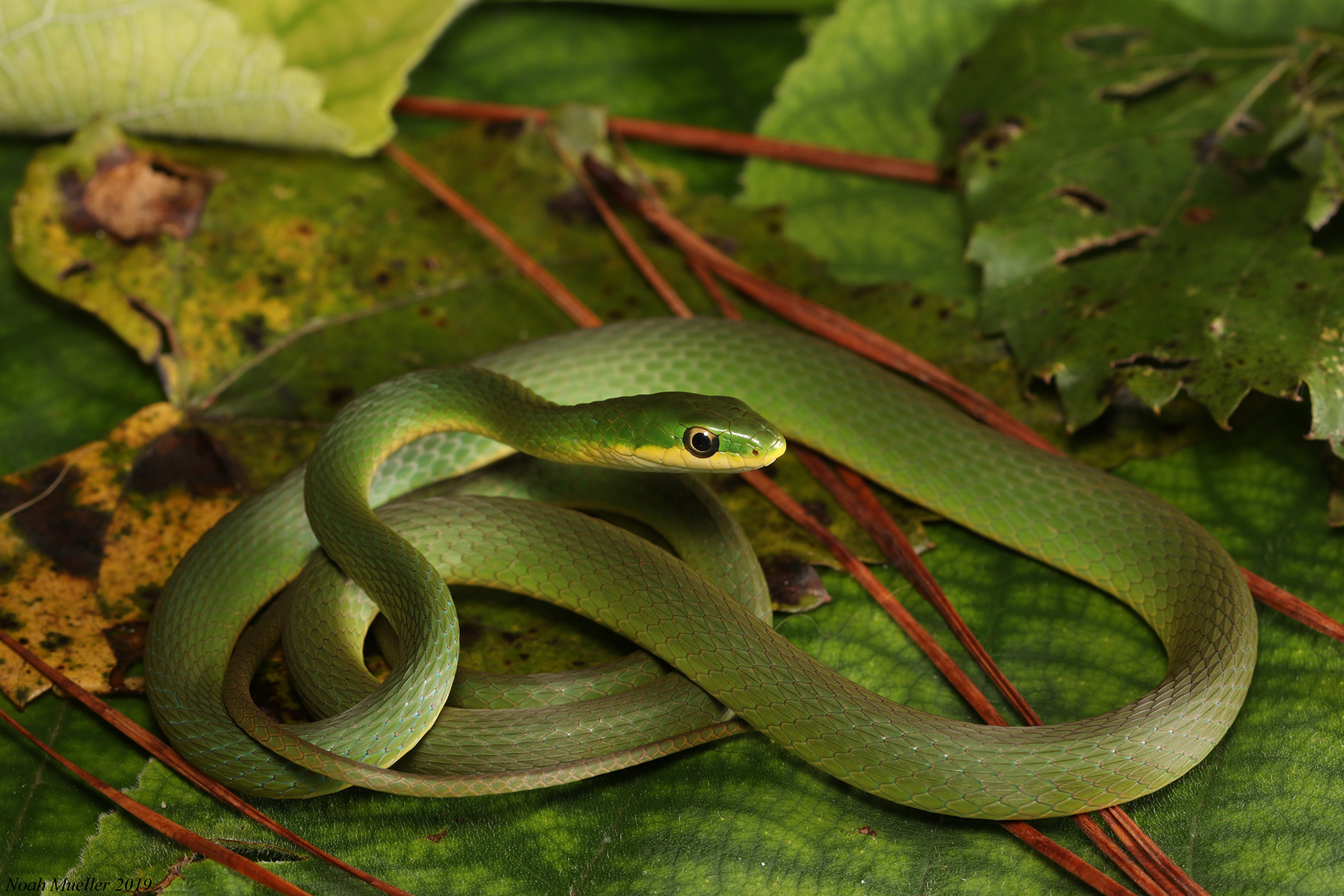
As for the nonvenomous and determined rough green snake, we saw it in exactly the habitat one might expect. They are commonly found in mixed and hardwood bottomland forests/floodplains, and along the edges of rivers and wetlands. They are arboreal snakes, spending most of their time in trees and thick shrubs. This likely accounts for the brilliant–almost tropical–coloration, which makes for easy camouflage in the leaves. If threatened, they even act like leaves, gently swaying like branches in the wind! Rough green snakes feed primarily on insects and spiders, stalking them then swallowing whole. They are active during the day but rarely seen due to their camouflage and presence high in the trees.

This species lives in every Florida county and is also common throughout the southeastern United States and lower Midwest. So, seeing one along an Alabama river was rare, but not unexpected. They are docile snakes and rarely bite even when disturbed. The snake’s scientific name, Opheodrys aestivus, comes from the Greek ‘ophis’ (serpent) and ‘drys’ (tree), and Latin ‘aestivus’ (summer) for the bright green and yellow (underbelly) coloration. A name like the “rough” green snake begs the question of whether a “smooth” green snake exists. The answer to that is yes; the lighter green and yellow smooth green snake Opheodrys vernalis is native to colder climates, and particularly populous along the border of the United States with Canada.
 8
8