https://planthardiness.ars.usda.gov/
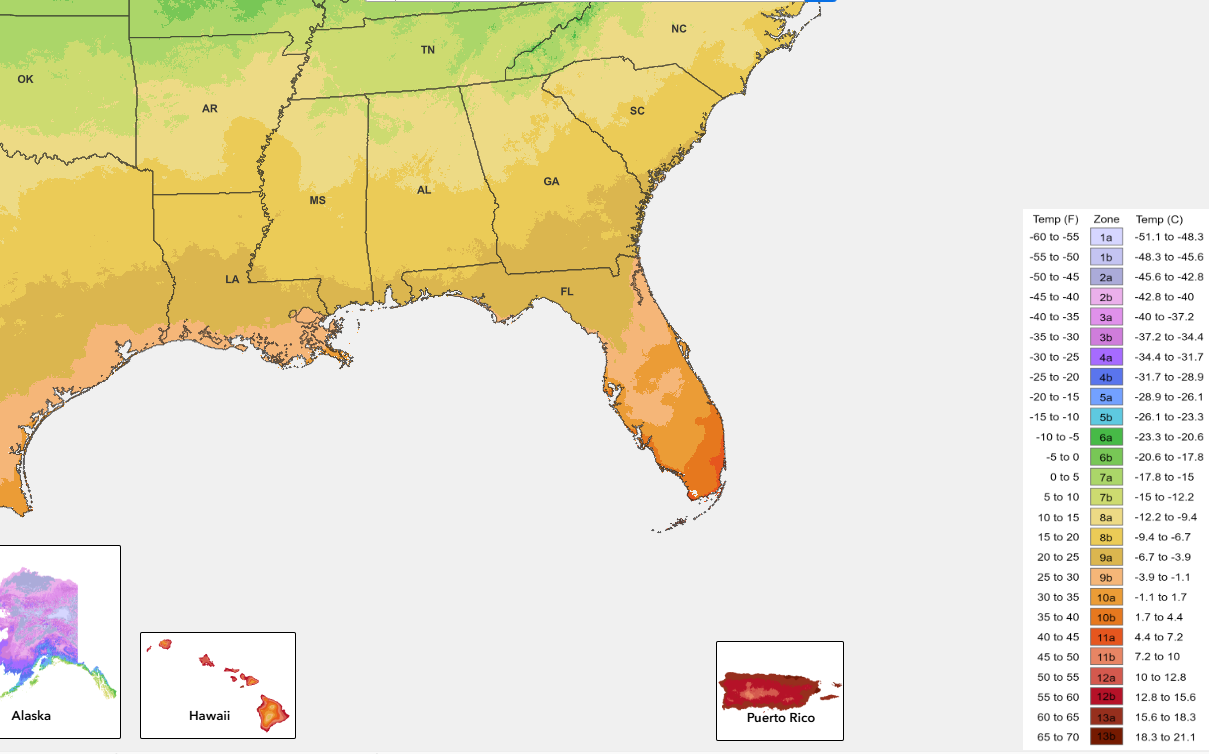
Many people are still unaware that the USDA (U.S. Department of Agriculture) released an updated Plant Hardiness Zone Map in 2023.
The most recent edition of the map until now was published in 2012 and put Duval County in Zone 9A. The average annual extreme low temperature for 9A is 20 to 25 degrees Fahrenheit. In the 2023 edition of the map, half of Duval has been bumped up to Zone 9B. This zone has an average expected extreme low temperature of 25 to 30 degrees Fahrenheit. The area of the county inside the I-295 loop and nearly all areas to the east of the loop are now in 9B. The rest of the county remains in zone 9A. Duval County is not the only area to see a zone shift. About half of the country is now placed a half zone warmer than they were in the 2012 map.
What caused this shift in the new map?
Mainly more accurate data collected over a long time. The 2012 map used temperatures from 7,983 weather stations, and the update used data from 13,412 weather stations. It is easy to understand how almost twice the data can give much more accurate results. The 2023 and 2012 versions of the map were based on 30 years of data, while an earlier version from 1990 used only 12 years of data. This 30-year period smooths out year-to-year fluctuations in temperatures and lines up with the time period that climatologists use to describe baseline “normal” climate in the U.S.
Why would only half of Duval County have a change?
There are a couple of reasons. The first is the urban heat island effect. Urban areas with a lot of concrete and asphalt covering the land have higher temperatures than the rural areas that surround them. The second reason would be the buffering effects of the Atlantic Ocean and the St. John’s River. Areas near large bodies of water tend to create a microclimate with slightly warmer temperatures. Even before the release of this map, serious gardeners in Duval already knew that they could “cheat the zone” and get slightly more tropical plants to survive the winter if they lived near downtown or out at the beach.
This information is most useful as you decide what you want to plant in your landscape and whether it can survive the winter
One important thing to note is that the map uses the average expected low temperature. That means that half the winters will not get to that lowest extreme temperature and the other half of our winters will get even colder than 20 to 25 degrees. Plant researchers assign a hardiness zone range to plants based on this USDA map. For some of us in Duval, a whole new world of possibilities just opened to our landscapes. Some notable zone 9B and warmer plants include avocado, jacaranda, jatropha, banana, tabebuia, ixora, bougainvillea, mandevilla, leatherleaf fern, and cardboard palm. Unfortunately, there are some favorites that are zoned 9A and cooler. Expect Eastern redbud, flowering dogwood, saucer magnolia, and mahonia to struggle if you live inside the loop or east towards the beach.
To check out the updated map for yourself, go to: https://planthardiness.ars.usda.gov/
Article written by Tonya Ashworth, Environmental Horticulture Agent, February 2024
 1
1