When we think of fall fruit, often we think about apples, pumpkins, and cranberries
This year why not add persimmons to the list. Fall is when their ripening, orange fruits are very noticeable. Not only are they available in the produce section, but it is also a fruit that is very low maintenance and easy to grow in our yards. If you want to grow something in your back yard and are discouraged from trying citrus because of citrus greening, persimmons are a good alternative.
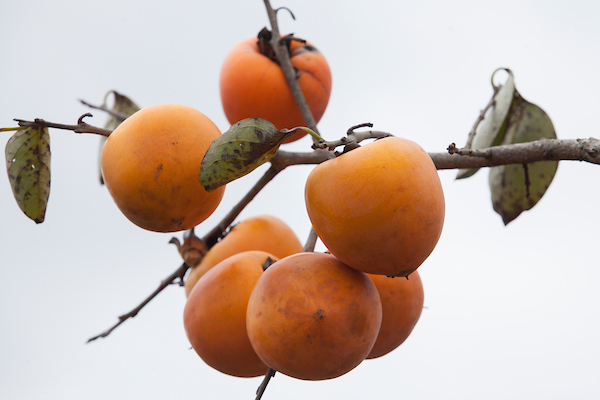
There are two options to choose from when deciding what to grow
There is the native common persimmon and the more productive oriental persimmon. First, let’s talk about oriental persimmons.
The first oriental persimmons were grown in Florida in the mid 1800’s although they have been cultivated in the orient for hundreds of years
An oriental persimmon needs about the same amount of space as a citrus tree. It can achieve a height of 25-30 feet but that is rare. Typically, they top out at 10-15 feet. Oriental persimmon cultivars are typically grafted onto common persimmon rootstocks. This is because the native persimmon rootstocks are readily adapted to our sandy acidic soil.
Oriental persimmons are grouped into two categories, astringent and non-astringent
The fruit of astringent types must ripen completely, or they will be very tart whereas the fruit from non-astringent types can be eaten sooner when the flesh is firm. Astringent types include: ‘Hachiya’, ‘Saijo’, ‘Ramopan’, ‘Tanenashi’, and ‘Gailey’. Non-astringent types include ‘Fuyu’, ‘Hanafuyu’, ‘Izu’, ‘Matsumoto Wase Fuyu’, ‘O’Gosho’, ‘Jiro’, and ‘Motsumoto’. Persimmons will set a heavier crop if a pollinator variety is used. However, they will still produce well even without a pollinator. Both ‘Hachiya’ and ‘Gailey’ are pollinator varieties.
Oriental persimmons do well when planted in full sun
Don’t plant them in low, or poorly drained areas. They need well drained soil. Most Florida soils are slightly acidic which is what persimmons prefer, so no pH adjustment is usually needed.
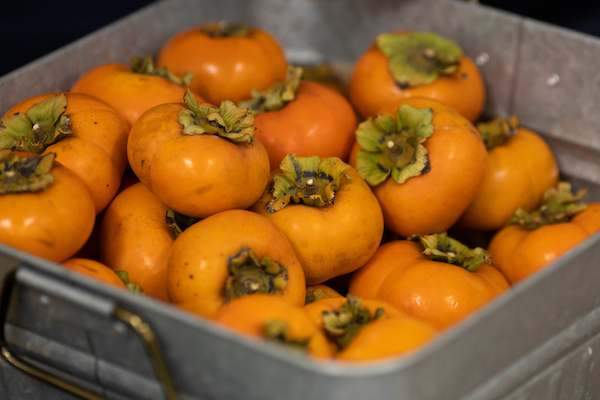
Image credit: UF/IFAS
Oriental persimmons are very durable
They can withstand short periods of drought. However, to grow the best, they need to be watered regularly especially during the spring drought season. This is done by hand watering, or with a drip irrigation system. Irrigating with sprinklers that wet the tree canopy can promote fruit and foliage diseases.
As stated above persimmons are fairly low maintenance
The only pruning that is needed is nominal to allow even light penetration, and to reduce rubbing and crossing branches. They need minimal fertilization as well. Too much fertilization will promote growth at the expense of fruit. Additionally, don’t be alarmed if you notice a lot of fruit dropping in the spring. This is normal as the tree is only keeping the amount of fruit that it can carry through to ripeness. For more information on oriental persimmons go to: https://edis.ifas.ufl.edu/publication/MG242
For those who would rather grow a persimmon as a tree, the native common persimmon is a good option
This medium-sized tree can be an appealing tree to grow in the landscape. In addition to producing small astringent persimmons, the common persimmon leaves can be showy in the fall with orange and red color. When the leaves drop in the fall, the thick bark that forms unique blocky squares can provide interest in winter.
There are some drawbacks to native persimmons
First, the male and female trees are separate. If you purchase one from a nursery, make sure it is a female if you want it to produce fruit. Speaking of fruit, native persimmons can produce a lot. Make sure that you put the tree in a location where this is not a problem. People have been known to slip and fall when the fruit drops on decks or sidewalks.
Not only are persimmons tasty, but they are also good for you as well
According to the University of Florida, persimmons are high in soluble fiber, which reduces the risk of heart disease. They are high in vitamins A and C and supply vitamin B6, manganese, and potassium. Persimmon fruit can be eaten when fully ripe right off the tree. In cooking they can be pureed, dried, and used in preserves, chutneys, quick breads, puddings, pies, and sweet and savory dishes. If you need a little color in your landscape, consider trying a persimmon. For more information on persimmons from the University of Florida go to https://edis.ifas.ufl.edu/topics/persimmon
Article written by Larry Figart, Urban Forestry Agent, December 2023
 1
1