Why Resident Participation is Key to Successful Turfgrass Pest Management
Are you constantly switching turfgrass pest management companies, because you just can’t seem to find the right one to solve your problem?
Before you switch again, make sure you are not inadvertently contributing to the problem yourself. It may not be all your fault, as you could have been misinformed about what to expect out of the relationship. But I have good news! Here is how you can improve your future relationships with companies by better understanding everyone’s roles in residential turfgrass management. A company’s ability to spray pesticides and fertilizers is not a cure-all for all turfgrass health issues. Switching from company to company will not solve your problems. You have a big role to play in healthy turfgrass!
Client’s Role (Most of the below are not common responsibilities of Pest Management Companies, except for fertilization):
- Manage your expectations, because some turfgrass issue solutions are not an overnight fix. One example is the regrowth of bare areas caused by chinch bugs or disease. If small enough, and causes of the bare spot are managed, the turfgrass may be able to grow back in during the growing season (May- October in North Florida). If the areas are too large (bigger than 1 ft by 1 ft square), you may need to resod so that weeds do not encroach. We understand sometimes your HOA’s may be pressing on you with unrealistic expectations. Let us know if we can help educate them as well!
- Educate yourself on proper irrigation, fertilization, mowing practices, and the identification of common pests and disease for the different types of turfgrass. Each turfgrass type has different pro’s, con’s, mowing heights, fertilization needs, common pests and diseases. You can’t treat them all the same. If you don’t know what the proper practices and issues are, how can you communicate with your company?
- Inspecting, Calibrating, and Scheduling of Irrigation Systems:

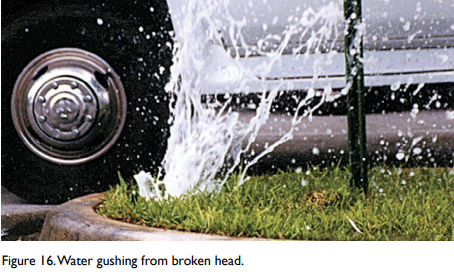
Water Gushing from Broken Head– GI-BMP Manual 2025 Unless the company manages the irrigation system in all facets, they are not responsible for this. Do not just set it and forget it. It is crucial to pay attention to weather patterns, water output, potential system issues and local irrigation ordinances. See the resources area for that ordinance. The two biggest issues I see are related to watering. I constantly see over-irrigated turf in times of heavy rain and under irrigated turf in times of drought as some of the main stressors for our turfgrass. This leads to disease and pest issues.
-
A man mowing a lawn in front of a suburban home. Photo taken on 03-31-17. UF/IFAS Photo by Camila Guillen Mowing: Most of the time there is a third party involved. It is your responsibility to coordinate between your companies. Mowing frequency and height are incredibly important in turfgrass health, weed, pest and disease management. One of the biggest issues I see is mowing companies or residents mowing too low for turfgrass type and too infrequently.

-
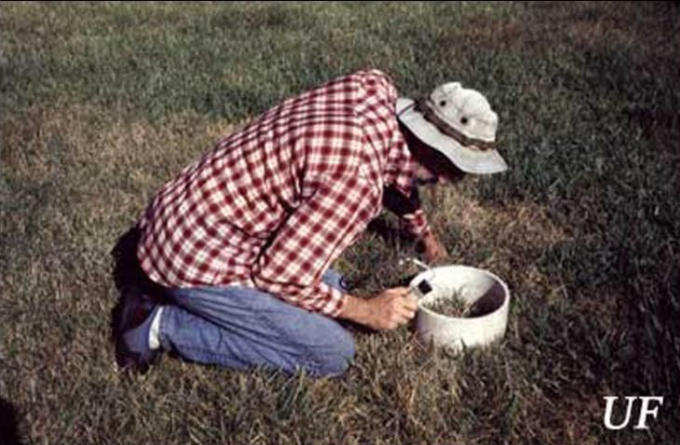
Inspecting for chinch bugs using the flotation method. Credit: R.H. Cherry, University of Florida Monitoring for issues: It is your responsibility to monitor for pests and disease, just as it is your responsibility to monitor for irrigation issues. The companies are traditionally only there eight times a year, unless you call them out. Some are there even less. They do not have the ability to drive by every one of their customers’ yards to look for issues. Take a walk through the yard a few times per week. Notify the company as soon as possible with clear notes of what you think the problem may be and the location in the yard. The sooner the problems are caught, the better chance of success there is for the treatment.
-
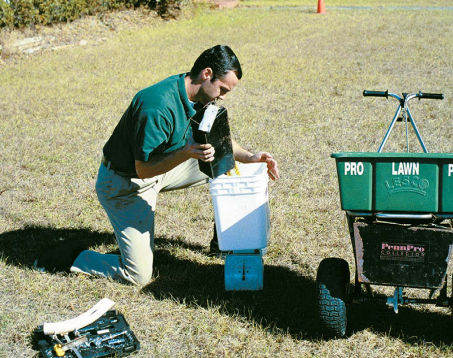
Credit: GI-BMP Manual Fertilization: If you or a third party are handling this, make sure not to over-fertilize and follow best management practices. Read the Green
Credit: GI-BMP Manual Industries Best Management Practices resource below. If your fertilizer applicator is your landscaper (people involved in pruning, mowing, weed-pulling, leaf-blowing) and they charge to apply fertilizer without a Limited Urban Turf Fertilizer Certificate, they are breaking the law. Not only illegal, they also likely do not know how to properly apply fertilizer without damaging your lawn or the environment. Educate them on the Green Industries Best Management Practices Course so that they can perform this legally and responsibly. Additionally, be aware of the issues with Weed-n-Feed applications. This is not an appropriate product for Northeast Florida. The product contains pre-emergent herbicides and fertilizers. The first pre-emergent herbicide applications need to be around early February (or when air and soil temperatures are appropriate) and the first fertilizer application doesn’t need to be until the turf has been actively growing for a time period in April/ May (once again weather dependent). If Weed-n-feed products are applied in February, leaching of fertilizers can occur, if it is applied in April/ May it could be too late as the first application of pre-emergent.
- Read post-treatment reports and follow instructions: They may have applied a product that needs to be watered in, or maybe it is not supposed to be irrigated for a period of time to let the product work. The company may suspect physical and chemical issues with the soil such as compaction or pH issues. They may recommend soil testing or offer additional services such as aeration or top-soil applications.
Company’s Role:
- Clear communication of contract, treatments, realistic expectations of turfgrass response, and scheduling follow-ups if needed
- Timely response: Communicate with your company to see what their realistic response time is in peak seasons. The labor market is extremely difficult, and they may have a lot of clients to service in a small period of time with very few employees.
- Monitoring and notifying the customer of issues when they are on site, whether in person or through post-treatment reports
- Treating issues if included in the contract when on site.
The Grass is Greener When We Work Together!
Here are some resources to educate yourself on turfgrass best management practices and common issues. If the links are not active, search the following link or contact your local extension office for assistance: Ask IFAS: Search
Turfgrass Management Practices:
Pests:
Diseases:
Licensing and Professional Education:
- Fertilizer Certification – Florida-Friendly Landscaping™ Program – University of Florida, Institute of Food and Agricultural Sciences – UF/IFAS
- Green Industries Best Management Practices Manual https://ffl.ifas.ufl.edu/media/fflifasufledu/docs/GIBMP_Manual_Web_English.pdf
 4
4