By: Marilyn Young, Horticulture Program Assistant, UF/IFAS Extension Clay County Extension
Snails in the Garden: Friends or Foes?
By: Marilyn Young, Horticulture Program Assistant, Clay County Extension
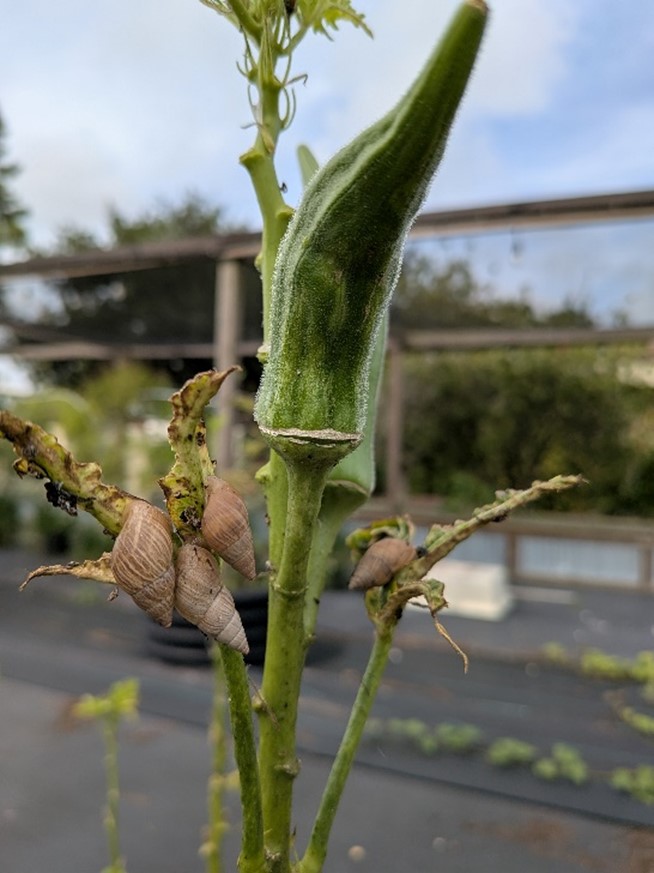
As you walk through the garden in the morning during the mid-Summer months, you may notice skinny mucus trails shining in the sun and large holes in the leaves of leafy plants -especially okra. Look closer and you may see the producer of these slimy “foot steps,” a member of the Gastropoda class commonly known as a terrestrial snail, happily sliding along seeking shelter from the sun.
Background
Florida is home to over 140 terrestrial species of snails and slugs. They are in the phylum of mollusks and are related to conch, oysters, clams and scallops. Snails rely on moist environments to form the protective mucus that enables their movement. Warm, rainy months with lush gardens make a perfect environment for their survival. They are omnivores and will consume fungi, decomposing plant material and organic soils along with green leafy plants for nutrients.
Terrestrial mollusks are mostly nocturnal and are hermaphrodites with both male and female organs. They are capable of self-reproducing and mature adults can lay up to 1000 eggs per year. Many species are harmless, but a few can become garden pests and cause significant damage to plants and vegetable crops.
Control Options
Keeping their numbers low in light of their impressive reproductive abilities can be a challenge. One approach is to change the environment to make it less hospitable by reducing unnecessary irrigation and removing debris from around plant bases. Mechanical removal is also an option using traps. Damp squares of cardboard placed in a shady spot or a steep sided cup filled with beer will attract snails and slugs for physical removal. Molluscicides are another option using baits containing the mineral iron phosphate. More information on use of iron phosphates baits is available at https://ccmedia.fdacs.gov/content/download/105080/file/FAQsIronPhosphateforControllingSnails01991.pdf.
Invasive Varieties
Florida has become a destination for a few invasive snail species including the Giant African Land Snail, Achatina, lissachatina, fulica capturing media attention for eating stucco off houses. The stucco provides the snail with calcium needed to develop its large shell that can reach lengths up to 8 inches. If you have concerns of whether the snails in your garden are of the invasive variety, pictures or specimens can be brought to local extension offices for identification. In the meantime, a few snails in the garden can be beneficial as decomposers of plant material for soil enhancement or serve as a food source for other wildlife especially ducks, rodents, reptiles, birds and amphibians. Finding ways to coexist with these slow-moving creatures can help create a garden that is both beautiful and ecologically sustainable.
References:
https://gardeningsolutions.ifas.ufl.edu/care/pests-and-diseases/pests/snails-and-slugs/
https://edis.ifas.ufl.edu/publication/IN904
https://edis.ifas.ufl.edu/publication/IN893
 1
1