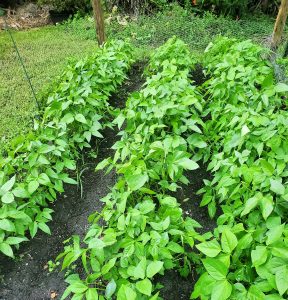
If life gives you long, hot summers, grow southern peas! Sometimes called cowpeas, southern peas should not be taken for granted – not only do they provide a tasty vegetable, but also add nitrogen to your soil doing double duty now and for the fall garden to come. As familiar as black-eyed peas, southern peas also come in an assortment of other varieties sure to please.
Southern peas are made for hot summers, so plan ahead to take advantage of a vegetable that not only tolerates our warm weather but thrives in the heat. As such, southern peas are not true peas, but more closely related to beans. While many people are fairly familiar with black-eyed peas, there are a number of other types – eleven classification units in total which include black-eyes, crowders, creams, purple hull, etc. Southern peas also can also grow either in a bush form, as a vine or even semi-vining types with pod colors ranging from purple to sliver to green. The seeds are also varied including blackeye, pinkeye, cream, or browneye. Crowder peas – as per their name – are in fact tightly packed in the pod and tend to have a rich flavor. At the opposite end of the taste scale, Cream peas have the mildest taste. Black-eyes peas are in the middle with mid-range flavor.
Southern peas are incredibly easy to grow in our area. Select a full-sun site with well-drained soil. Keep in mind that southern peas are not fussy about the soil and will often produce less in very fertile soil with an abundant flush of foliage at the expense of pods, so do not over-fertilize. Also remember that these leguminous plants will fix nitrogen from the air with the help of nodule-forming bacteria on the roots – a helpful byproduct. Plant seeds about two to three inches apart covered with a half inch to an inch of soil, in rows three to four feet apart. Once established, thin the plants to about six inches apart for best results. Southern peas take from fifty to seventy-five days until the pods are ready to harvest.
Attractive white and lavender pea flowers are followed by rapidly developing pods which can reach up to thirteen inches in length. The finished southern pea pods are ready to pick when they are swollen and have filled out – use these as fresh green shelled peas. Some people like to pick them immature as snaps – use only tender young pods for this string bean substitute. Southern peas may also be left on the plant to dry and are harvested for storage and later usage.
The main pests that I have encountered some years are aphids and the cowpea curculio. The aphids can be controlled with spot treatments of commercial insecticidal soap as per label directions late in the day. Cowpea curculios are small weevils that can be very damaging to the pods. Crop rotation from year to year can be helpful to break up cowpea curculio populations.
When all of the southern pea harvest is finished, you still have one more benefit from the southern pea. The remaining plants can be incorporated into the soil as a green manure to add organic matter for the next crop – not to mention the nitrogen fixing benefits.
Southern peas are an easy summer crop that can provide a tasty meal and a cover crop worthy as green manure. You can turn your vegetable garden into a year-round opportunity and southern peas will help you pave the way! For more information on summer vegetables suitable for our area, or to ask a question, you can also call the Master Gardener Volunteer Helpdesk on Mondays, Wednesdays, and Fridays from 1 to 4 pm at 764-4340 for gardening help and insight into their role as an Extension volunteer. Ralph E. Mitchell is the Director/Horticulture Agent for UF/IFAS Extension Charlotte County. He can be reached at 941-764-4344 or ralph.mitchell@charlottecountyfl.gov. Connect with us on social media. Like us on Facebook @CharlotteCountyExtension and follow us on Instagram @ifascharco.
Resources:
UF/IFAS Gardening Solutions (2025) Southern Peas – Crowders, cream, and black-eyed peas. The University of Florida Extension Service, IFAS.
Williams, L. (2024) Confusion Over Classification of Southern Peas. The University of Florida Extension Service, IFAS – Okaloosa County.
UF/IFAS Extension Master Gardener Volunteer Program (2024) Plant Identification Learning Module: Vegetables. The University of Florida Extension Service, IFAS.
Smith, P. & Shaughnessy, D. (2023) Southern Peas. Clemson Cooperative Extension Home and Garden Information Center.
Grant, G. & Stein, L. (2023) EASY GARDENING: Southern Peas. Texas A&M AgriLife Extension.
Fontenot, K. (2005) Southern Peas Thrive in Summer Gardens. The LSU AgCenter and the LSU College of Agriculture.
Growing Southern Peas in a Home Garden (2023) College of Agriculture and Natural Resources, University of Maryland Extension.
Andersen, C. R. (2020) Home Gardening Series – Southern Peas. University of Arkansas Division of Agriculture, Cooperative Extension Service, Fayetteville.
Trull, R. (2025) Southern Peas. The National Gardening Association – Learning Library.
Capinera, J. L. (2023) Cowpea Curculio, Chalcodermus aeneus Boheman (Insecta: Coleoptera: Curculionidae). The University of Florida Extension Service, IFAS.
 2
2