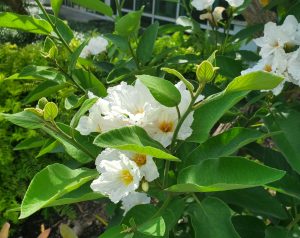
Several orange Geiger trees planted at our office site here in Centennial Park in 2019 were subsequently damaged or frozen to the ground in a January 2022 freeze. Orange Geiger trees or Cordia sebestena are very sensitive to the cold and were marginal at our site – best kept closer to the coast. However, if a cold-hardy relative – the Texas olive – Cordia boissieri – had been planted instead, all would have been well – “Right Plant, Right Place” – right? The Texas olive has white flowers which are just as nice as its orange cousin, but certainly more sustainable when we have that occasional test winter. The Texas olive is a great flowering woody plant for our area especially when your landscape is a distance from the coast which often experiences cooler winter temperatures.
Growing no more than twenty-feet tall and fifteen-feet wide, the Texas olive is a small, slow-growing, evergreen tree with five-inch long, velvety gray-green leaves and clusters of relatively large, three-inch wide white flowers with yellow throats. The deeply fissured bark shows off the trunk known for its break-resistant wood. Highly drought-tolerant – and moderate in salt-tolerance – the Texas olive is native to southern Texas and nearby northern Mexico. Also known as the Mexican Olive, Texas Wild Olive, White Geiger or Anacahuita, this woody plant is not a true olive, but does have one inch long, yellow green fruit. While the fruit is reported to be edible, it is not tasty and eating them should be discouraged – especially in large quantities. The “olives” are better left for consumption by wildlife which relish these fruits.
Texas olives can flower sporadically year-round – most occurring from late winter through summer – with blooms that attract butterflies, bees, and hummingbirds. Plant your Texas olive in a full sun area with well-drained soil in your yard as a specimen or even for a number of years in a large container as a pruned shrub. While multi-trunked in nature, it can be trained to one central trunk giving it a more tree-like appearance. It is cold hardy and will resist temperatures down to twenty degrees F.
The Texas olive is so resilient that it is a true Florida-Friendly Landscaping™ recommended small tree characterized by its hardiness and relatively carefree nature. Rarely seen in its native habitat these days, Texas olive is widely grown in nurseries. While not readily available at the local box stores, you can find them at local family-run nurseries and online – you can also propagate your own using seed. The Texas olive is a must-have plant for the yard, patio, or in a large planter – hardy and able to give you a usefully ornamental specimen for many years to come! For more information on all types of Florida-Friendly Landscaping™ approved plants suitable for planting in our area, or to ask a question, you can also call the Master Gardener Volunteer Helpdesk on Mondays, Wednesdays, and Fridays from 1 to 4 pm at 764-4340 for gardening help and insight into their role as an Extension volunteer. Ralph E. Mitchell is the Director/Horticulture Agent for UF/IFAS Extension Charlotte County. He can be reached at 941-764-4344 or ralph.mitchell@charlottecountyfl.gov. Connect with us on social media. Like us on Facebook @CharlotteCountyExtension and follow us on Instagram @ifascharco.
Resources:
The Florida-Friendly Landscaping™ Guide to Plant Selection & Landscape Design (2022) The University of Florida Extension Services, IFAS.
Gilman, E. F., Watson, D. G., Klein, R. W., Koeser, A. K., Hilbert, D. R. & McLean, D. C. (2018) Cordia boissieri: Texas Olive. The University of Florida Extension Service, IFAS.
Rodriguez, D. (2007) Plant of the Week- Texas Olive Tree. Texas A & M Agrilife Extension – Bexar County.
Neumeyer, C. (2018) IN CONSTANT BLOOM: Mexican Olive is subtropical tree worth growing risk. Texas A & M Agrilife Extension – Victoria County.
 1
1