Understanding the complexity of nature is not an easy task. Ecologists examine interactions among plants, animals, and the surrounding environment. We had the exciting opportunity to host a workshop, “Explore Biodiversity: Become an Ecologist”, for 16 youth, ages 14-18, as part of the recent Florida 4-H University held on the UF campus in late July.
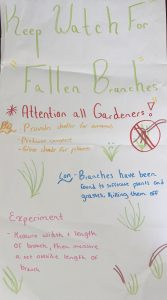
In this hands-on workshop, we reviewed ecological concepts, discussed the diversity of ecosystems and species in Florida, and explored a habitat web. We examined the steps of the Scientific Method, and then it was time for the students to become investigators and conduct their own ecological study. We headed outside to a nearby conservation area, where the students worked in pairs to explore the environment. They made their own observations and followed the Scientific Method to investigate anything that piqued their curiosity. At the end of the workshop, these newfound eco-sleuths shared their passion for discovering Florida’s unique environment by presenting their work in a poster session.
Even if these youth decide that ecology is not their career path, the Scientific Method is important to understand as it applies to all fields of study and many aspects of our lives.

What is the Scientific Method?
The Scientific Method is a systematic way of learning about the world through observation, experimentation, and evidence-based reasoning. It provides the framework scientists use to ask questions, develop explanations, and test ideas.
The Scientific Method is important because it, 1) ensures objectivity and repeatability in experiments, 2) helps distinguish fact from opinion or belief, 3) forms the foundation for scientific discovery and technological advancement, 4) empowers students and researchers to think critically and solve problems effectively.
The steps of the Scientific Method are:
- Observation: What do you notice about the natural world around you? An observation is something you sense with sight, touch, smell, hearing, or taste.
- Ask a question: What do you wonder about your observation? Turn your observation into a question.
- Research your topic: Gather existing knowledge about your topic; read books or prior studies.
- Form a hypothesis: A hypothesis is an educated guess or prediction that answers the question.
- Conduct an experiment: Create an experiment to test your hypothesis. This experiment should be controlled and repeatable with independent, dependent, and controlled variables.
- Analyze your results: Organize the data collected from your experiment to look for patterns or differences. Charts and graphs can help you visualize trends; statistics will show the significance of results.
- Accept or reject hypothesis: Decide if your data supports or rejects your original hypothesis. If your data does not support your hypothesis, return to step 4 to retest a new hypothesis.
- Communicate your results: Share your results so that others can learn from your work, evaluate it, and replicate it in the future.
What You Can Do
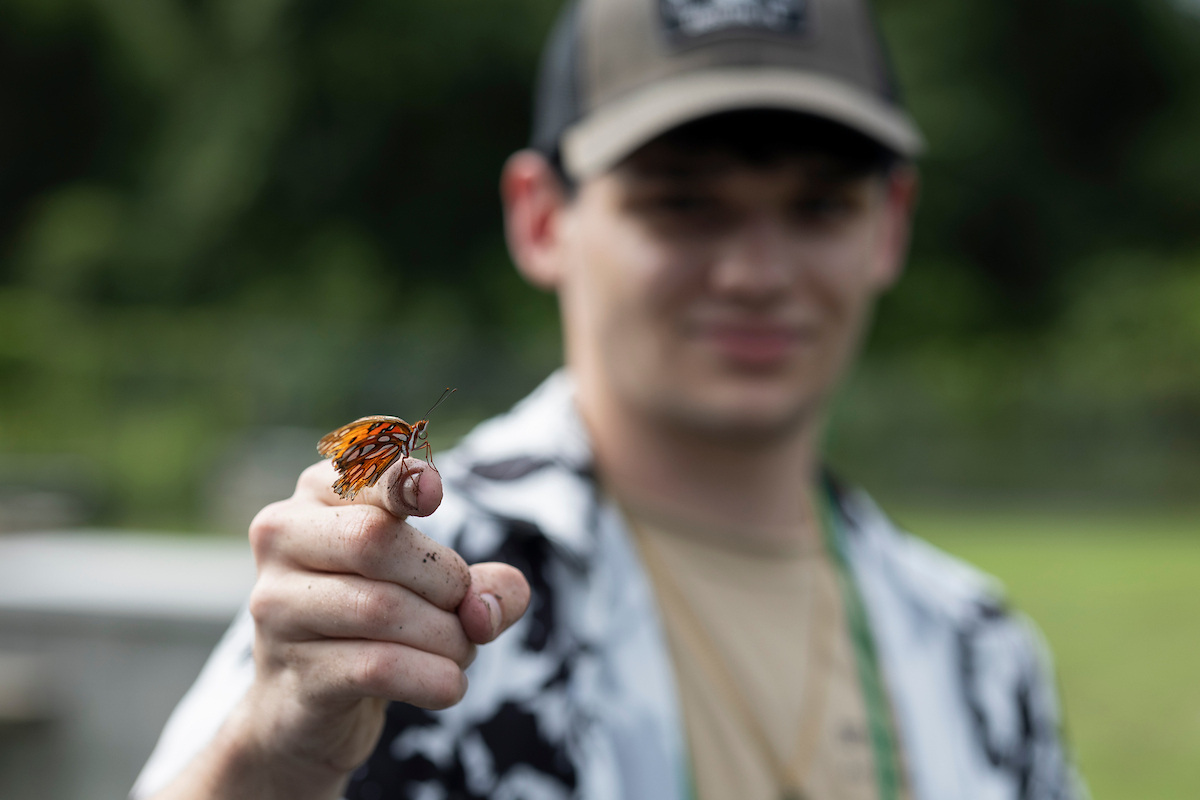
Whether you are investigating a complex ecological issue or simply curious which toy your dog likes best, or which foods your baby will eat, applications for the scientific method are all around us every day. Apply the Scientific Method to various aspects of your life; be observant and remain curious about the world around you! There are many new ways to accessibly apply the Scientific Method – including apps like iNaturalist, that allow you to record your observation, share with other naturalists, and verify your observations through peer-reviewed discussions.
Try out iNaturalist for yourself: https://www.inaturalist.org/
The Florida Youth Naturalist Program offers a curriculum to promote awareness, understanding, and respect of Florida’s natural world among youth. Through a learn-by-doing approach, FYNP provides opportunities for young people to contribute to the environment and world around them. https://programs.ifas.ufl.edu/florida-youth-naturalist-program/
Learn more about 4-H programs near you: https://4-h.org/about/find/
 0
0