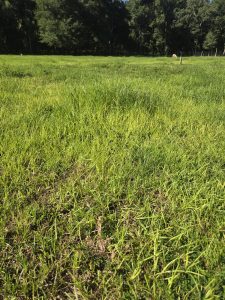
 Maintaining healthy pastures is essential for livestock nutrition and overall farm productivity. In Central Florida, where sandy soils and high rainfall present unique challenges, proper soil management and fertilization are crucial for sustaining lush, nutrient-rich forage. This guide will help you optimize soil health and improve pasture fertility for a thriving grazing system.
The predominant soil type in Central Florida is sandy, which has low water retention and is prone to nutrient leaching. This makes it essential to regularly test soil and apply amendments to maintain a balanced nutrient profile. Ideal pasture soil for Bahia grass should have a pH between 5.5 and 6.5, adequate organic matter, and a good balance of macronutrients like nitrogen (N), phosphorus (P), and potassium (K).
Best Practices Before Fertilizing
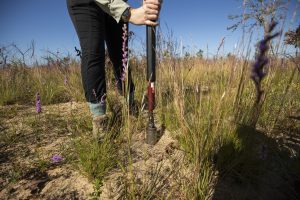
1.Conduct Regular Soil Tests
- Testing soil at least every 2-3 years helps determine nutrient deficiencies and guides fertilization efforts.
- Local extension offices can get you the nutrient/soil form and how to send it off for affordable soil testing services.

Soil core sampling. Photo taken 10-24-23.
2. Apply Fertilizers Based on Soil Needs
- Use soil test results to select the right fertilizer blend. Pastures typically require nitrogen for growth, phosphorus for root development, and potassium for overall plant health.
- For sandy soil, slow-release or split applications of nitrogen help prevent leaching.
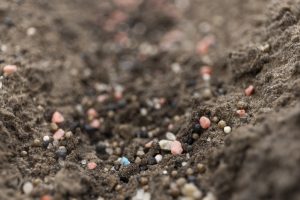
Fertilizer in a trough of plowed soil. Photo taken 03-06-24.
3. Apply Lime or Sulfur as Needed
- If soil tests indicate a low pH (acidic soil), apply lime to raise pH levels and improve nutrient availability.
- If the soil pH is too high (alkaline soil), sulfur can be applied to lower it gradually…this is much harder to do and often a different grass may be suggested such as Bermuda, work with your extension agent to determine your best option.
- These amendments should be applied well in advance of the growing season, ideally in late fall or early winter, to allow time for pH adjustments before fertilization.
4. Time Fertilizer Applications Strategically
- Apply fertilizer during active growing seasons (spring and early fall) to maximize uptake and minimize runoff.
- Avoid fertilizing before heavy rains to prevent nutrient loss through leaching.
- The best practice is to spray for weeds at least two weeks before applying fertilizer. If you plan to spray, timing is important—make sure there’s adequate moisture in the soil. Avoid spraying during dry conditions or in the heat of the day for the best results.
5. Ensure Proper Water Availability
- Water is essential for fertilizer to be absorbed by plants. Without adequate moisture, nutrients remain unavailable in the soil.
- Light irrigation after fertilization can help nutrients penetrate the soil if rainfall is insufficient.
- Monitor rainfall patterns and adjust fertilization timing to align with expected precipitation, typically without the use of irrigation June 1st is the target date.
Improving Soil Structure and Avoid Common Pitfalls
- Incorporate Organic Matter: Adding compost, manure, or cover crops helps improve soil structure, water retention, and microbial activity.
- Use Rotational Grazing: Rotating livestock between pasture sections prevents overgrazing, reduces soil compaction, and promotes even manure distribution for natural fertilization.
- Over-Fertilization: Excess nutrients can lead to runoff and water contamination. Stick to soil test recommendations.
- Ignoring Soil pH: Imbalanced pH reduces nutrient availability. Lime can be applied to raise pH, while sulfur can lower it if needed.
By focusing on soil health and smart fertilization strategies, Central Florida livestock owners can ensure productive, sustainable pastures. Regular monitoring and adapting to changing soil conditions will lead to long-term success in forage management.
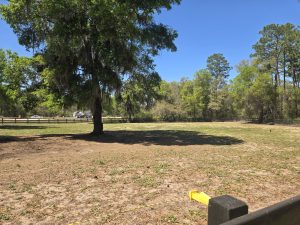
For more information on pasture management please contact your local extension office and visit these resources listed below.
Resources:
2. Bahiagrass Fertilization Recommendations
 0
0