Florida citrus growers continue to battle declining yields, citrus greening disease, and increasingly nutrient-poor soils. As a result, they are taking a closer look at soil-building practices such as cover crops. But how and when the cover cropping benefits citrus orchards is unclear. A new study from the UF/IFAS Department of Soil, Water, and Ecosystem Sciences (SWES) offers new insights—especially for younger orchards.
“Tree cropping systems don’t behave like annual systems,” explains Yaslin Gonzalez, SWES Ph.D. alumna and lead researcher. “We wanted to understand not only whether cover crops impact citrus production—but when and why.”
The research team evaluated two commercial citrus orchards differing in age and management history, but both impacted by citrus greening:
- A younger orchard (approximately 10-years old) with no prior cover crop use
- An older orchard (approximately 30-years old) with previous cover crop use
Both orchards were planted on the coarse, sandy soils typical of southwest Florida. These soils are known for rapid nutrient loss and low organic matter.
Soil Fertility and Soil Health
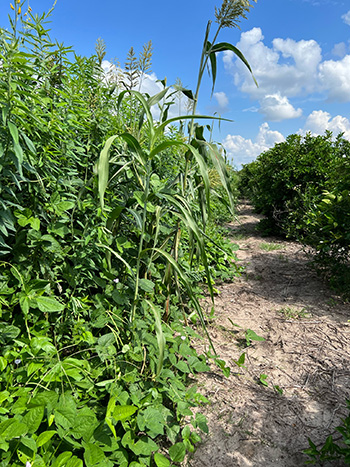
Scientists would expect higher soil nutrient concentrations under cover crops. Instead, nutrient levels in cover-cropped alleys between tree rows were often like those in the weedy control treatment. In some cases, the cover-cropped nutrient levels were lower than the weed-covered alleys. There are a few possible explanations:
“Cover crops were actively taking up nutrients when we collected the soil samples, so that could have reduced soil concentrations,” Gonzalez said. “The ‘grower standard,’ consisting of weeds and planted bahiagrass, already provided some ecological benefits as well.” And finally, “citrus alleys are not fertilized, so we would expect more subtle impacts on nutrients than in a fertilized field.” As a result, major shifts in soil nutrient levels did not occur within the first two years. This was more evident in the older orchard where soil conditions were stable.
Indicators of soil health, such as soil organic matter (SOM), permanganate-oxidizable carbon (POXC), soil protein, and mineralizable carbon (Cmin) capture broader soil functions. In the younger orchard, mixtures containing legumes improved some of these biochemical indicators compared to non-legume mixtures. However, soil health values were similar to the bahiagrass and weeds control. While in the older orchard, cover crops had no significant effect on soil health indicators.
“Young systems responded more quickly,” Gonzalez notes. “Older orchards—especially on sandy soils—might need more time and biomass inputs before major changes appear.”
How Citrus Trees Benefited the Most
In this study, cover crops made the biggest difference in the younger orchard. By Year 2 and 3, the benefits became clear:
- Higher fruit yield
- Higher Brix (sweetness)
- Improved Brix:acid ratio—key for marketable juice
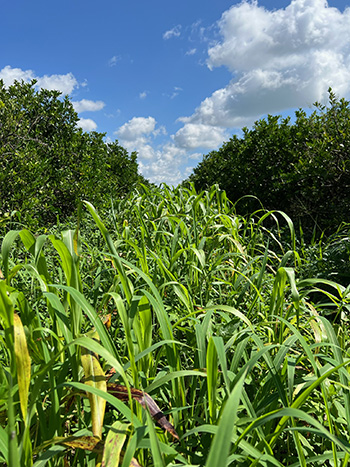
“Seeing yield improvements by the third year was one of the most notable outcomes,” said Gabriel Maltais-Landry, SWES associate professor and co-author. “It suggests that cover crops help young trees develop —and that shows up in the fruit.”
Another important finding is that three soil health indicators—soil protein, Cmin, and POXC—were strong predictors of fruit yield and juice quality. On the other hand, traditional soil fertility measurements (N, P, K) the team took from the alleys were not reliable predictors.
“Most nutrient uptake happens under the tree canopy where fertilizer is applied, even though the roots can extend into the alleys,” Maltais-Landry explained. “Our measurements, in between rows where the cover crops grew, did not capture the area where tree roots take up most of their nutrients.” He added that future studies should measure both in the alleys as well as under the tree canopies.
“For producers, introducing cover crops in young orchards as soon as possible could offer the biggest benefits,” said Dr. Sarah Strauss, SWES associate professor and co-author.
She adds that because perennial systems respond slowly, multi-year monitoring is essential.
“Cover cropping isn’t an immediate fix,” Gonzalez noted, “but it’s a long-term investment in orchard health and resilience.”
For Florida’s citrus industry, cover crops may become an increasingly valuable tool in the fight to maintain productivity and fruit quality under challenging conditions. Read the full article, Cover crops enhance tree fruit production on sandy soils despite minimal impact on bio-chemical soil health indicators and fertility, at the journal Plant and Soil website.
Feature image from Dr. Sarah Strauss, SWES and the UF/IFAS Southwest Florida Research and Education Center, Immokalee, FL.
 5
5