Mycorrhizal fungi play an often unseen but vital role in maintaining healthy ecosystems. These small, subterranean powerhouses sustain both agricultural productivity and forest resilience through their partnerships with plants. Two recent UF/IFAS Extension publications bring new attention to how this component of soil microbiology directly informs land management. Additionally, these EDIS documents detail how mycorrhizal fungi can enhance nutrient use efficiency, build soil structure, and strengthen plants’ responses to environmental stressors. The authors are UF/IFAS Department of Soil, Water, and Ecosystem Sciences (SWES) alumna Holly Andres (M.S. 2024), Sunny Liao, her thesis advisor and SWES associate professor of soil microbial ecology, and postdoctoral associate Kaile Zhang.
Microscopic Partnership with Global Impact
Mycorrhizal fungi form mutualistic relationships with plant roots, exchanging nutrients and water for carbon the plant provides. These associations influence nearly every aspect of soil function and plant health.
“Mycorrhizal fungi are highly sensitive to management practices such as tillage, fertilizer use, and fungicide applications,” said Holly Andres. “Increasing awareness among growers and land managers is key to protecting these natural systems that sustain productivity and soil health.”
Both EDIS documents emphasize that the stability and resilience of agricultural and forest ecosystems depend on these fungal partnerships. Equally important, human management choices can either enhance or degrade them.
Biology, Ecology, and Benefits of Arbuscular Mycorrhizal Fungi in Agricultural Ecosystems
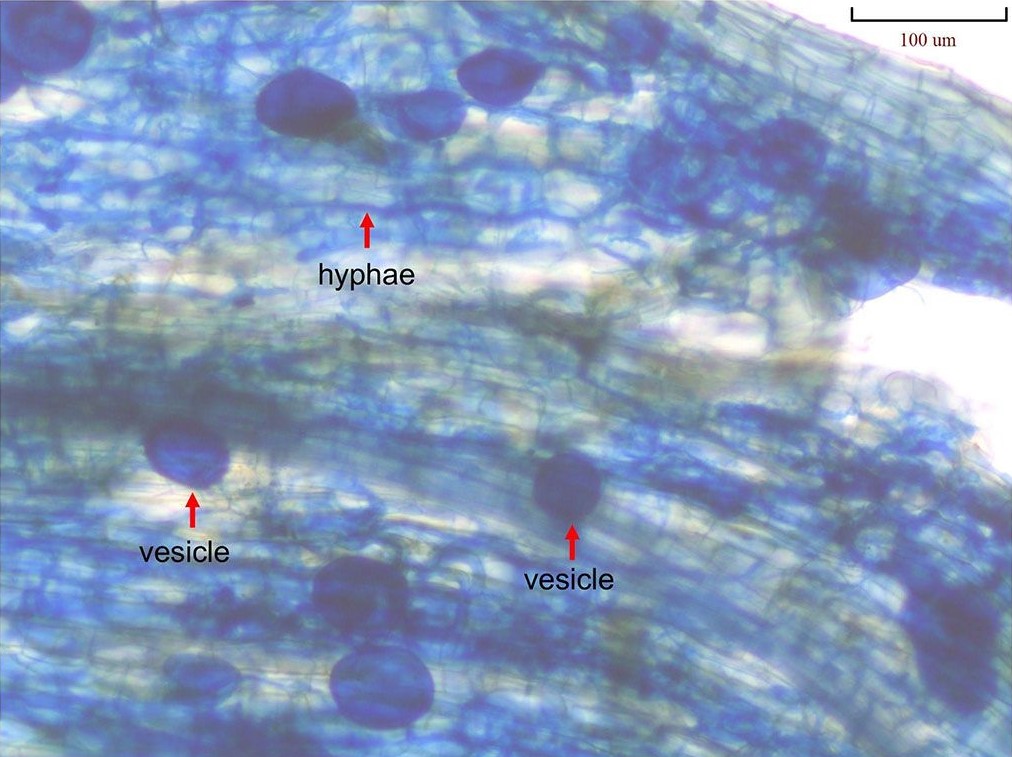
(Photo by Kaile Zhang, UF/IFAS)
The first publication describes how arbuscular mycorrhizal fungi (AMF) form internal structures called intraradical hyphae, arbuscules and vesicles within plant roots. These serve as exchange sites where nitrogen, phosphorus, and other nutrients move from soil to plant. At the same time, plants supply carbohydrates to fungi.
AMF associations occur in about 80–90% of all vascular plant families, including most agricultural crops. Their benefits are wide-ranging: improved nutrient uptake, enhanced drought and salt tolerance, and better resistance to soil-borne pathogens and parasitic nematodes. AMF also secrete glomalin, a glue-like compound that binds soil particles into aggregates, improving soil structure and water infiltration.
The publication highlights how sustainable agricultural practices—such as reduced tillage, crop rotation, and organic amendments—can improve AMF populations. It warns that excessive synthetic inputs or soil disturbance can diminish fungal diversity and long-term soil fertility.
“By connecting fungal biology with management practices, we hope growers make decisions that conserve and utilize these natural soil partners,” said Dr. Liao. “Healthy fungal networks translate into healthier, more resilient crops and soils.”
Biology, Ecology, and Benefits of Ectomycorrhizal Fungi in Natural and Managed Forest Ecosystems
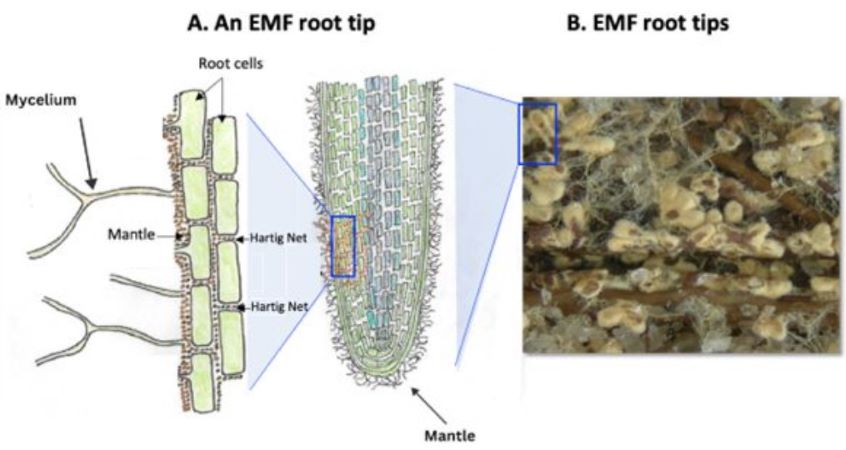
(B) EMF (Suillus decipiens) colonization on pine roots (Pinus taeda).
(Illustration A by Holly Andres; Image B by Sunny Liao, UF/IFAS)
The companion publication shifts focus to ectomycorrhizal fungi (EMF) that are associated with roughly 60% of tree and woody species worldwide. These fungi form a sheath around root tips and a complex network between root cells known as the Hartig net.
EMF play key roles in carbon and nutrient cycling, particularly nitrogen and phosphorus turnover, and in soil stabilization. They help trees withstand drought, heavy metals, and other stressors while improving water and nutrient absorption. In Florida’s pine-dominated forests, EMF associations support reforestation, pollution remediation, and carbon sequestration.
“This shows forest managers, nursery operators, and timber producers that EMF can enhance tree survival and growth while reducing reliance on chemical fertilizers,” said Dr. Zhang.
Sustainable Land Stewardship
Together, these publications offer a comprehensive view of how fungal symbioses function across terrestrial ecosystems. AMF are dominant in agricultural soils, enhancing short-term productivity and long-term soil health. EMF are dominant in forested systems, where they drive long-term nutrient cycling and carbon storage. Both underscore a central message: fostering natural microbial partnerships can reduce chemical inputs, improve ecosystem resilience, and promote responsible resource use efficiency.
“My hope is that readers realize just how much is happening in the root zone,” said Andres. “That they’ll consider how everyday management decisions can support, rather than disrupt, those underground networks.”
“By understanding and managing mycorrhizal relationships, stakeholders can cultivate more resilient ecosystems for future generations,” Dr. Liao added. “Mycorrhizal fungi are allies that are vital for sustainable management.”
Featured photo from UF/IFAS Department of Soil, Water, and Ecosystem Sciences.
 2
2