The Guana Tolomato Matanzas National Estuarine Research Reserve, or GTMNERR, is a vital part of Florida’s northeast coast. It is home to rich ecosystems, diverse wildlife, and a community deeply invested in protecting its future. But like many estuarine systems, the Guana Estuary faces growing pressure from nutrient pollution, development, and environmental change.
To address these challenges, the “Guana Nutrients: Budgets and Bivalves” project brought together researchers, resource managers and local partners. Their mission was to investigate how nitrogen moves through the estuary and explore how shellfish, like oysters and mussels, could help clean the water. Now, after five years of fieldwork, data collection and public engagement, the team is sharing what it’s learned—and what it means for Guana’s future.
“We set out to understand where nitrogen was coming from and how it was moving through the system,” said Dr. Ashley Smyth, assistant professor of biogeochemistry with the University of Florida Institute of Food and Agricultural Sciences Department of Soil, Water, and Ecosystem Sciences and the project’s lead. “But we also wanted to figure out what we could do about it. How we could use nature, like oysters and mussels, as part of the solution.”
Nature-Based Solutions
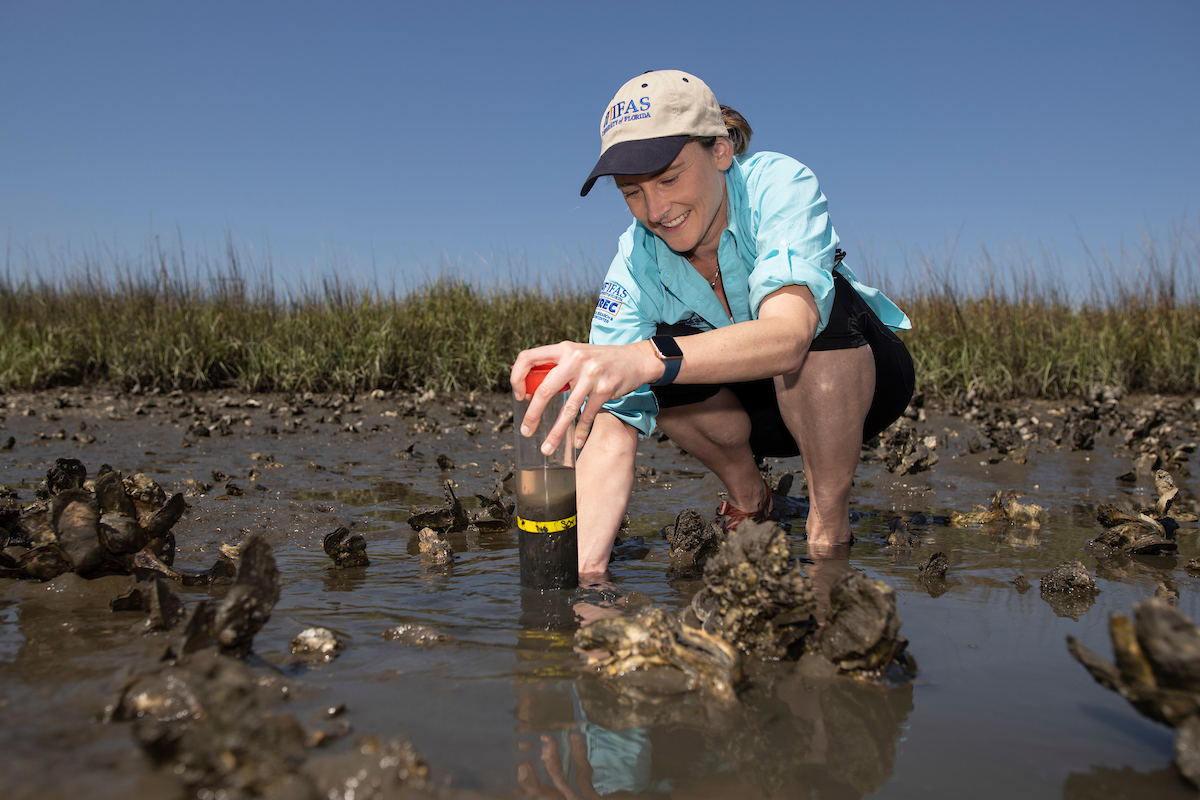
The team found that shellfish play a major role in improving water quality. Together, oysters and mussels remove about 7 percent of nitrogen in the water column annually, with most of that work being done by oysters in the upper estuary. Mussels filter more efficiently by weight but are exposed to water for shorter periods due to tides.
“These organisms are filtering water whenever they can,” Smyth said. “They’re not just providing habitat. They’re actively improving water quality. It’s like having a free water treatment system, and we’re just starting to tap into its full potential.”
Sediment samples and isotope analyses revealed that nutrient sources vary by season and weather patterns also influence them. Much of the nitrogen entering the estuary is in organic form, coming from plant decay and stormwater runoff.
“We learned that the form of nitrogen matters,” said Dr. Nikki Dix, research coordinator at GTMNERR. “Phytoplankton responded most strongly to urea and phosphate, which tells us that organic nitrogen—something often overlooked—needs to be considered in our management strategies.”
Managing Nutrients
Controlling nutrients at their source remains a top priority. The upper watershed, or headwaters, of the Guana Estuary is approximately 80 percent developed. Urban areas and golf courses contribute to nitrogen loading, especially north of Mickler’s Weir. As development expands in areas like Ponte Vedra, nitrogen inputs could rise by 60 to 80 percent.
To reduce those risks, the project team developed science-backed recommendations. These include stormwater controls, invasive hog management, targeted vegetation harvesting and restoring bivalve populations through aquaculture. One major challenge was the lack of discharge data, which made it difficult to model how nutrients move through the system. The team is now partnering with hydrodynamic modelers to improve future scenario testing.
“Every piece of the system matters,” Dix said. “From marsh grasses to sediment microbes to shellfish, they’re all part of how nutrients move—and how we can control them.”
A Connected Community Creates Change
Aside from the data, the Guana Nutrients project created something equally important: community connection. Stakeholders took part in field visits, workshops and discussions that brought people from different backgrounds together around a shared concern—water quality.
“Science doesn’t matter if it doesn’t leave the lab,” said Kaitlyn Dietz, coastal training program coordinator at GTMNERR. “This project gave us the chance to bring people into the process—not just at the beginning or the end, but throughout. And that was powerful.”
Dietz said open communication helped build trust and made the science more usable. “We didn’t just share the results. We listened to values, revealed what surprised us, and brainstormed opportunities to rethink,” she said. “I think that transparency helped people connect to the work in a meaningful way.”
The collaborative approach has already sparked spin-off projects, new partnerships and a stronger foundation for future water quality planning. It also gave local advocates data they can use to push for change. Stakeholders described the findings as “advocacy ammunition”—clear, credible evidence they could bring to meetings and decision-makers.
Looking ahead, the team hopes to build on this momentum. There is still more to learn about nutrient cycling, shellfish restoration and the role of invasive species. But this project laid the groundwork to support future action.
“What started as a research question turned into a community movement,” Smyth said. “Studying this unique ecosystem will help people protect it.”
To learn more about the project and explore resources, visit its website.
Support from several partners made the project possible, including the Florida Fish and Wildlife Conservation Commission, St. Johns River Water Management District, Matanzas Riverkeeper, Friends of GTM Research Reserve, St. Johns Regional Audubon and Florida Sea Grant. Funding for the project totaled nearly $595,000 and was provided by the National Oceanic and Atmospheric Administration through the National Estuarine Research Reserve System Science Collaborative.
 4
4