Button Bush (Cephalanthus occidentalis) is an amazing plant for both natural area restorations and landscapes.
Found naturally throughout Florida and much of the US and Eastern Canada (zones 4-10A) in various wetland environments such as swamps, sloughs, river banks, marshes, and pond/lake edges. This makes it a great plant for a waterfront or rain garden. This plant can be used as a large shrub or small tree with heights reaching up to 12 feet and a width of up t0 10 feet. The reddish brown bark offers an interesting color addition to your garden. The leaves are arranged in an opposite leaf pattern, though they may also present whorled characteristics.
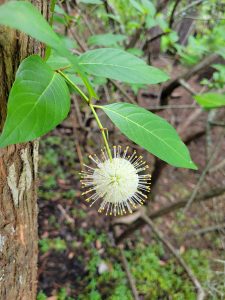
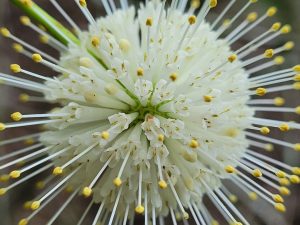
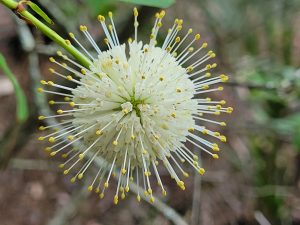
Flowers emerge from April through August allowing for months or enjoyment. Like all powder puff style flowers the male filament and anther extend beyond the main flower body. These nectar rich flower attract both bees and butterflies. The resulting seeds attract numerous bird species.
When selecting the planting site, aim for location with part sun, part shade, as it is an understory plant. Ensure the location is moist and well drained, they have a low tolerance to drought.
Care and Maintenance:
It is important to not that all part of this plant are toxic to humans if injected with leaves being toxic to some animals, including horses.
There are no major pests or diseases of concern for this plant, making it relevantly low maintenance once established.
Resources:
Explore more Florida-Friendly plants at ffl.ifas.ufl.edu/plants.
https://gardeningsolutions.ifas.ufl.edu/plants/trees-and-shrubs/shrubs/buttonbush/
https://edis.ifas.ufl.edu/publication/FP117
https://gardeningsolutions.ifas.ufl.edu/pdf/articles/buttonbush-stephen-brown.pdf
https://blogs.ifas.ufl.edu/charlotteco/2025/05/21/buttonbush-a-native-plant-on-the-fringe/
 0
0