The nursery industry stands out above the crowd when we take a look at Sumter County’s agricultural producers. More than 75% of all crop sales came from the nursery sector, according to the 2022 USDA Census of Agriculture. Among the many commodities grown here are trees, everything from liners to finished landscape material.
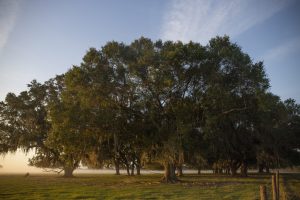
Recently, during a visit to one of our local producers, Rice Family Trees and Shrubs, I learned something fascinating about how trees are propagated to meet different goals. One of the species this farm grows in large numbers is live oaks. Whether it is a younger oak planted in a roadside median, or a mature oak in a pasture, live oaks are a hallmark of Florida’s landscape. But how do they get their start?
Cutting vs. Seedling: Two Different Starts, Two Different Trees
When it comes to propagating new plants, growers have lots of options. Two of the most common propagation methods are cuttings and seeds. Both methods have advantages, and both result in trees with different traits, especially when we think long-term about the tree’s future.
Propagation by Cutting
Growing trees from cuttings offers several benefits, with genetic uniformity at the top of the list. A cutting is genetically identical to the mother plant, which is important when a grower is producing patented or named cultivars. If you need consistency, cuttings deliver it.
However, this method does influence the tree’s future root system. Cuttings develop adventitious roots, a network of fibrous, lateral roots that form around the base of the cutting. While this produces a dense, outward-branching root system, it may not be ideal for mature tree stability.
In container production, this becomes even more challenging. Lateral roots tend to hit the pot wall and begin circling, creating the potential for girdling, where roots wrap around the trunk or each other. Because so much of a plant’s biomass is below ground, the structure of those roots matters a lot more than we might think when the tree is young.
Propagation by Seed
Trees grown from seed, on the other hand, begin life with a strong taproot. This single, deep anchoring root can be a major advantage for long-term stability, especially here in Florida where tropical storms, tornadoes, and hurricanes are part of the landscape. A deep, sturdy foundation below ground can mean a healthier, more resilient tree decades later.
Seed-grown trees also bring genetic diversity. Every acorn represents two parents, which means natural variation, sometimes producing excellent form and vigor, other times producing less desirable traits. This variability is both the charm and the challenge of seed propagation.
Growers can manage this variability by collecting acorns from known, high-quality parent trees. A common example is the Cathedral Live Oak, a sought-after cultivar of Quercus virginiana. Acorns collected from a Cathedral live oak still contain 50% of the genetics from that cultivar, but they tend to produce seedlings that share many of its desirable characteristics, often with just a few quirks of their own.
Why It All Matters
It’s easy for all of us, even those of us in the industry, to overlook the basic foundations of horticulture. With new technology emerging every day, it can be easy to look past the importance of high quality foundational practices. But those foundations matter! Propagation methods, substrate, container type, irrigation practices- these very early decisions shape a plant’s entire lifespan. Oftentimes, tree growers are making decisions for their product, hoping that it will outlive them.
By continuing to refine these basics, we can improve the strength, reliability, and overall quality of Florida’s horticultural products. And sometimes, as I was reminded during my visit, it all starts with something as simple as how an oak tree begins its life.
 6
6