Understanding how plant diseases work can really equip growers to protect their plants to the best of their ability. So today, I want to provide a basic rundown of one of the keystones of plant pathology: the disease triangle.
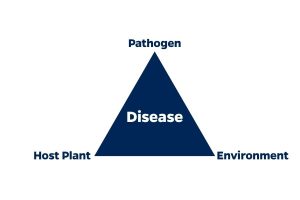
The Disease Triangle
The Disease Triangle is a model which educators use to explain how plant diseases develop. Very broadly speaking, plant pathogens need three things:
- A pathogen,
- A susceptible host, and
- The right environmental conditions.
The triangle illustrates how these three factors interact, and importantly, how disrupting any one of them can slow or prevent disease.
Understanding the Pathogen
Lets use Phytophthora as an example. Species of Phytophthora are oomycetes, meaning they produce swimming spores with little tails called flagella. Because of their mobility in water and their tendency to cause rot, oomycetes are often called water molds.
Plants infected with Phytophthora can show a variety of symptoms, but one hallmark sign is rapid decline where the plant dies so quickly that the leaves don’t even fall off. This is unusual. Most pathogens cause leaf drop as disease progresses, so this symptom often raises a red flag.
Piecing it Together
Now enter our disease triangle!
Let’s say an ornamental grower is dealing with recurring Phytophthora issues in a low-lying section of their nursery. In this scenario, we can see how the three sides of the triangle come together:
-
The host (the plant) is susceptible. That’s not easy to change.
-
The pathogen (Phytophthora) is likely already present in the soil. Also not easy to eliminate entirely.
-
The environment—a low spot where water collects—is the factor we can influence.
Since plants can’t get up and walk away when conditions become harmful, it’s up to us to alter the environment. By relocating those plants or regrading and raising that area of matting, we can prevent waterlogged soils that create a perfect breeding ground for this pathogen.
Even a small environmental adjustment can break the disease triangle and stop the problem in its tracks.
Putting the Triangle to Work
The next time you’re dealing with a plant disease in your operation, think back to the disease triangle and identify where you might be able to break the cycle.
- Maybe you can disrupt the pathogen with a fungicide or bactericide.
- Maybe you can disrupt the host by choosing more resistant plant material.
- Or, maybe you can disrupt the environment with a simple change in irrigation or site conditions.
However you approach it, understanding these three pieces sets you up to make targeted, effective decisions to protect your plants.
 1
1