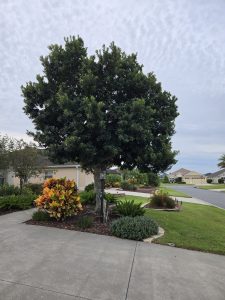
Are you looking to attract wildlife to your yard? Consider the Japanese Blueberry (Elaeocarpus dentatus).

Although relatively new to the industry, this evergreen tree makes an excellent choice for wildlife-friendly yards throughout USDA Hardiness Zones 8B–10B, covering much of the state.
In spring, the tree produces white blooms that attract bees, butterflies, and other beneficial insects. Following bloom season, it produces dark berries that serve as a food source for local birds and other wildlife.
When selecting a planting location, you need a full sun location with room for growth as this plant grows between 30-40 feet wide. Ensure the soil is well-drained. Water regularly until established. Once established, this tree is drought tolerant.
While this is a low maintenance evergreen tree, basic maintenance is needed starting about one year after planting. Focus on structural pruning:
- A strong central leader
- Separation of crossing branches
- An open and balanced canopy
Its broad canopy and seasonal interest make it suitable as a specimen tree, shade provider, or a pollinator centerpiece in diverse garden
designs.

More Resources:
https://hort.ifas.ufl.edu/treesandpowerlines/elaeocarpus_decipens.shtml
https://hort.ifas.ufl.edu/woody/Pages/eladen/eladen.shtml
https://blogs.ifas.ufl.edu/charlotteco/2023/05/24/a-newer-plant-on-the-block-japanese-blueberry/
 0
0