So the search begins…
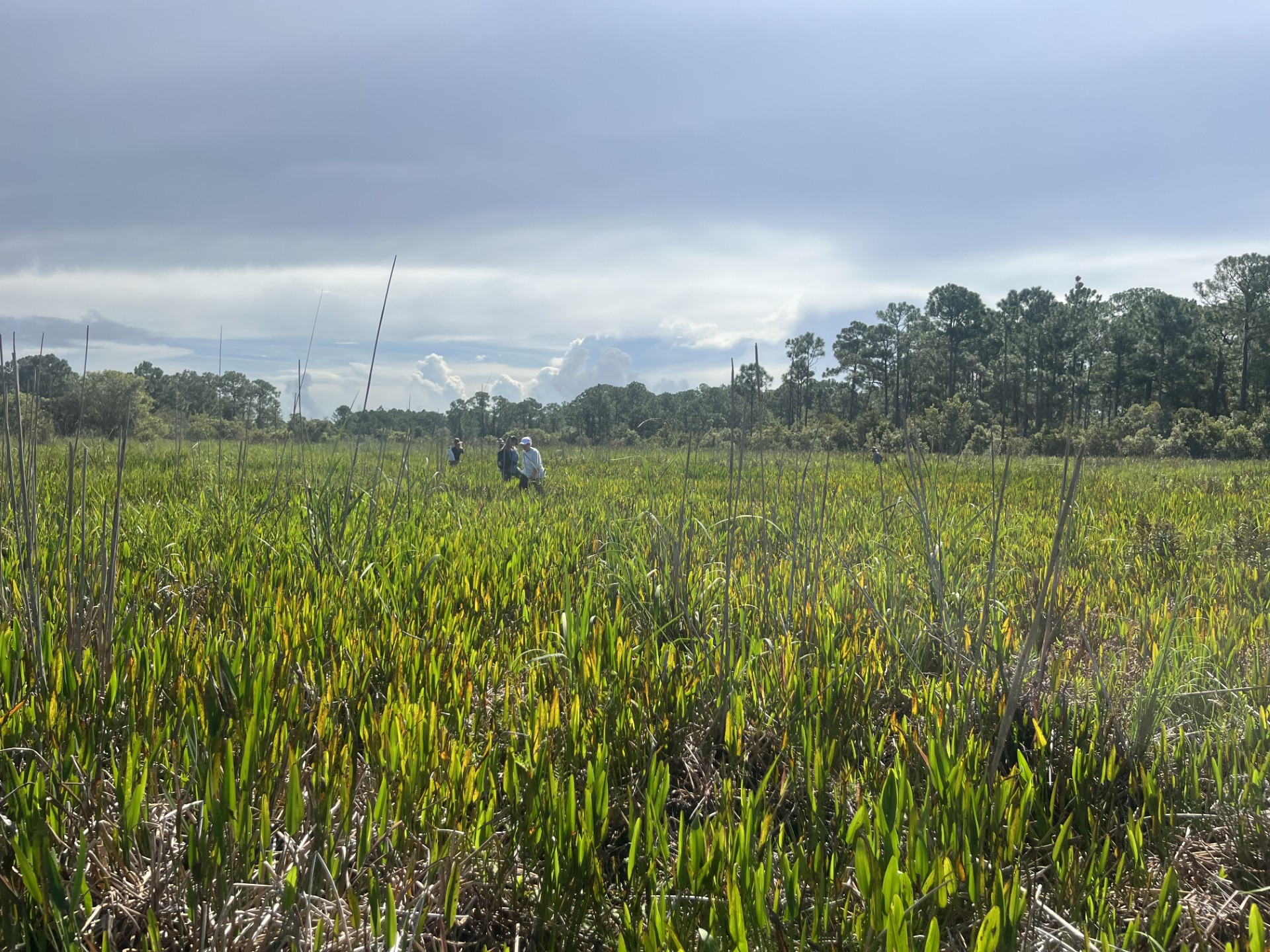
This week, I got the opportunity to participate in my very first python survey and potential removal! This started due to a potential sighting within a preserve so we were tasked with trying to confirm this identification (or in a best case scenario, prove the absence of this individual). We drove about 30 minutes into the far edge of the preserve to begin this investigation. We went straight to where the initial spotting occurred. Before us was a large mud hole with some disturbed vegetation around it. While pythons themselves are not known to den, they will take advantage of good hiding spots! Land managers tried to thoroughly investigate this hole to see what organism may call it home but turns out the spot was vacate at the moment.

We then tried to follow potential “tracks”, meaning areas that looked like a large snake may have slithered through. Due to the tall vegetation, this was a difficult task to accomplish but we all spread out and did our best to try and find evidence suggesting the presence of a python. By the end of the survey period, we walked away with no evidence to suggest there is or is not a python within this area. For now, land managers have left game cameras on site in the hopes this creature may slide by.
This whole day had me testing my knowledge about this Florida invader, so I did some digging and thought I would share!
Meet the Invader
Burmese pythons, or Python bivittatus, are considered to be one of the largest snakes in the world. Burmese pythons can grow up to 20 ft long with the largest recorded individual in Florida measured over 17ft at the Florida Museum. These reptiles can be identified by their tan coloration with dark blotches along the top and sides. A great comparison is to think of them as blotches found on a giraffe! According to the Florida Fish and Wildlife Conservation Commission (FWC), this species is semi-aquatic meaning they are often found in are near water.

Which means, yes, pythons can swim!
Burmese pythons are considered to be generalist carnivores meaning they will eat anything they can get to. This includes various mammals, birds, and even other reptiles. Burmese pythons are considered constrictors using their long bodies to coil around their prey and squeeze. They also have a unique jaw system with six rows of teeth and flexible ligaments that allow them to eat their prey whole.
While normally solitary, during mating season you may encounter multiple pythons. Individual females on average will lay approximately 40 eggs but can lay as many as 100 in one clutch. Females will keep their eggs warm for about 2 months and once hatched, babies tend to be about 18inches in length.
Habitat Expansion
While native to Asia, Burmese pythons were likely released in Florida via the pet trade. The first report of a Burmese python in Florida occurred in 1979 but it wasn’t until 2000 that the species was considered established in Everglades National Park. While predominately found in the Florida Everglades, reports have shown that they are now considered established from south of Lake Okeechobee to Key Largo.

There are concerns regarding the distribution of the species is likely to grow, due to the individuals searching for food. This could mean reports of Burmese pythons in areas outside of the Everglades could grow, including here in St. Lucie County.
So, What makes them invasive?
An invasive species means they are:
- An introduced species (non-native) –
 Remember, Burmese pythons are originally from Asia
 - Introduced by humans- Burmese pythons were brought to the US via the pet trade
- Causes harm to the environment, economy, and/or human health- More information on that below

Additionally, these pythons have no known predators within the Florida landscape making them even more successful!
A 2012 study compared roadkill surveys from starting from 1993 up to 2011 within Everglades National Park (Dorcas et al., 2012). The study showed a decrease in Virginia opossums, rabbits, white-tailed deer, and bobcats during the 2003 to 2011 surveys. The authors suggest that the Burmese pythons play role in these declines due to the correlation of where the animals are and the spread of the pythons. The timing of the pythons within the Everglades also coincides with the decline of the organisms listed earlier (Dorcas et al., 2012). This is a large concern particularly for Florida’s most vulnerable species, including but not limited to the Great Egret, Key Deer, and Lower Keys Rabbit to name a few.
What do you do if you find one?
It is important that you report any and all sightings of the Burmese python to the FWC. You can report a sighting by:
- Calling the Exotic Species Hotline at 888-Ive-Got1 (888-483-4681)
- Report your sighting online at IveGot1.org
- Downloading the free IveGot1 app
All reports should include a picture of the individual and where it was located.
References and More Information
Florida Fish and Wildlife Conservation Commission. (2019). Invasive Burmese python. In Florida Fish And Wildlife Conservation Commission. https://myfwc.com/wildlifehabitats/profiles/reptiles/snakes/burmese-python/
M.E. Dorcas, J.D. Willson, R.N. Reed, R.W. Snow, M.R. Rochford, M.A. Miller, W.E. Meshaka, P.T. Andreadis, F.J. Mazzotti, C.M. Romagosa, & K.M. Hart, Severe mammal declines coincide with proliferation of invasive Burmese pythons in Everglades National Park, Proc. Natl. Acad. Sci. U.S.A. 109 (7) 2418-2422, https://doi.org/10.1073/pnas.1115226109 (2012).
National Geographic. (2010). Burmese python | National Geographic. In National Geographic. https://www.nationalgeographic.com/animals/reptiles/facts/burmese-python
Reed, R., and Rodda, G.H., 2009, Giant Constrictors: Biological and Management Profiles and an Establishment Risk Assessment for Nine Large Species of Pythons, Anacondas, and the Boa Constrictor: U.S. Geological Survey Open-File Report 2009-1202, Report: xviii, 302 p.; Available online and on CD-ROM, https://doi.org/10.3133/ofr20091202.
Robins, R. (2012). Burmese python. In Rare, Beautiful & Fascinating: 100 Years @FloridaMuseum. https://www.floridamuseum.ufl.edu/100-years/object/burmese-python/
Is there a certain organism that you want to know more about that is here in Florida? Let me know, I would love to research it and share! You can connect with me via email at bgerovac@ufl.edu.
 3
3