What is ‘Reclaimed Water’?
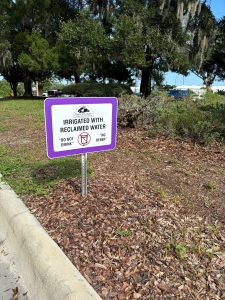
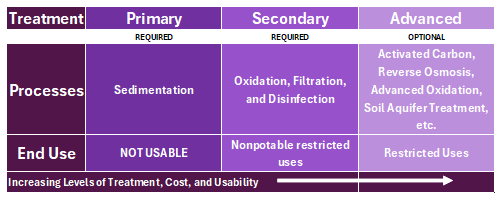
According to the USEPA and UF/IFAS, reclaimed water is recycled wastewater that has been thoroughly treated, at least to the secondary level, for reuse. This treatment removes harmful organisms and substances, such as bacteria and viruses. Reclaimed water is treated at the wastewater treatment facility and undergoes processes such as sedimentation, oxidation, filtration, disinfection, and more (Table 1). Each of these steps increases the acceptable exposure to the public, which means cleaner water and more uses. The level of treatment can also impact the cost of the resource, depending on the utility provider. Supplied through separate infrastructure, reclaimed water is signified by purple pipes and signage (Image 1) to indicate specific use. Reclaimed water offsets our use of finite potable water from our aquifer, yielding major benefits to Florida’s water conservation initiatives. Although reclaimed water is treated, it is not potable and should not be consumed by humans or animals.
Why is it needed?
Population pressure, resource availability, and environmental health require intuitive solutions for future water security. Florida’s population is growing at an average rate of 1,000 people per day. According to the St. Johns River Water Management District in 2024, Floridian households use an average of 123 gallons of potable water per day. Here in Florida, several water management districts have
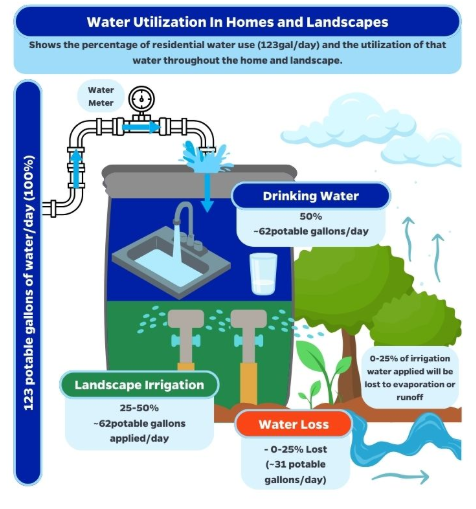
implemented irrigation restrictions on both potable and reclaimed due to the limited availability of water in our aquifer, the evaporation that takes place in the heat of the day, and pressures on availability throughout the delivery. It is recommended to water between 4-10 a.m. and 4-10 p.m. to avoid water loss from evaporation. In Florida, we can lose up to 25% of the water applied at the wrong time (Image 2). Here in Central Florida, about 50% of potable water goes to household use; the other 50% goes onto the landscape via irrigation. This makes the maximization of our landscape irrigation systems a crucial concern for Florida’s water supply. Florida has used reclaimed water to offset potable water use for over 40 years, safely.
Understanding how water is used in Florida allows us to better see the entire water scenario. Reclaimed water helps Florida address urban water scarcity, resource maximization, and environmental and public health. After secondary treatment, reclaimed water can be used to enhance current water supplies through surface and groundwater recharge, protecting our future water resources. However, even with high levels of treatment, reclaimed water still contains some constituents outside of the drinking quality range. This includes the nutrients nitrogen and phosphorus, which can reduce the need for fertilizer applications, when used in excess can also pollute local waterways. It can also contain bacteria and salts, so care should be given to the frequency of irrigation and how the reclaimed water is distributed to edible plants.
How CAN reclaimed water be used?
Reclaimed water has strict use restrictions in Florida—enforced through the EPA and FDEP:
- Public Use Irrigation, such as private residential and commercial landscapes.
- Non-food Crop Irrigation, such as florals and trees are primary non-food crops irrigated in Florida.
- Restricted Landscape Impoundments, such as manmade lake, pond, or body of water where swimming, wading, boating, fishing, etc. are prohibited.
- Groundwater Recharge; FDEP currently has 13,000 Class V Injection Wells across Florida for the purpose of groundwater recharge.
- Wetland, Wildlife, Stream Augmentation, such as surface water discharge post wastewater treatment.
- Industrial Cooling, such as large facilities using reclaimed water in infrastructure cooling systems.
- Peeled or Thermally Processed Crops: any vegetable that must be peeled or cooked before consumption—most common are potatoes and oranges.
Reclaimed water CANNOT be used for any of the following:
- Drinking
- Filling pools or hot tubs
- Using for household plumbing (e.g., toilets)
- Connecting to drinking water pipes
- Skin contact activities (e.g., sprinklers)
- Washing pets, vehicles, or surfaces
- Connecting to an outdoor hose bibb
Reclaiming Water Program Information:
FREE Irrigation Conservation Kits – Attend a workshop, participate, and enter for the potential to win 1 of 35 kits valued at $50!
Great news, all workshops and webinars are approved for Florida Nursery, Growers, and Landscapers Association (FNGLA), Florida Department of Agriculture and Consumer Services (FDACS), and FL Water Star Accredited Professionals Continuing Educational Units (CEUs)!
Stay tuned for more workshop dates and sign-ups.
Have questions? Reach out to Jacob Burris (Jacob.Burris@ufl.edu)
Reclaiming Water Series:
Reclaiming Water: A Series on Smart and Sustainable Choices, Part 1
References:
Borisova, T., Warner, L. A., Weng, W., Searcy, J., Chaudhary, A. K., & Dukes, M. (2017, February). Estimating benefits of residential outdoor water conservation: A step‑by‑step guide (FE1009). UF/IFAS Extension, Food and Resource Economics Department. https://edis.ifas.ufl.edu/fe1009
Burris, J., & McIntyre, T. (2025, April 29). Reclaiming water: A series on smart and sustainable choices. UF/IFAS Extension Seminole County. https://gardeningsolutions.ifas.ufl.edu/pdf/infographics/landscape-water-conservation.pdf
Hochmuth, G., Rainey, D., Trenholm, L., Momol, E., Lewis, C., & Niemann, B. (2022, April). Maximizing the benefits of reclaimed water for irrigating the landscape and protecting the environment (SL385/SS587). UF/IFAS Extension, Department of Soil and Water Sciences. https://edis.ifas.ufl.edu/ss587
Lusk, M. (2017, June 20). Reclaimed water: Frequently asked questions. UF/IFAS Extension. https://blogs.ifas.ufl.edu/extension/2017/06/20/reclaimed-water-frequently-asked-questions/
Trenholm, L. E., Unruh, J. B., & Cisar, J. L. (2013, April). Watering your Florida lawn (ENH-9). UF/IFAS Extension. https://edis.ifas.ufl.edu/LH025
UF/IFAS Extension Sarasota County. (2020, December 9). Reclaimed water and landscape management. https://blogs.ifas.ufl.edu/sarasotaco/2020/12/09/reclaimed-water-and-landscape-management/
UF/IFAS Extension Sarasota County. (2025, July). Reclaimed water. https://sfyl.ifas.ufl.edu/sarasota/natural-resources/water-resources/reclaimed-water/
 2
2