The latest Cattle on Feed report summarized December placements, marketings, and total cattle on feed for the month of December. As of January 1, there were 11.45 million head of cattle on feed, a 3.2 decline from January 1, 2024. Placements in December were down 5.4 percent with marketings up 1.8 percent. The increase in marketings was expected since there was one more slaughter day in December 2025 compared to 2024. Total cattle placements for 2025 were down 6.7 percent year over year.
Supplies Expected to Continue Tightening
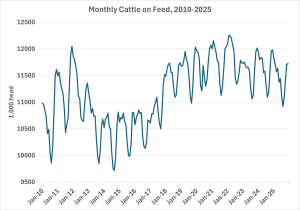
Looking at the last cycle (graph 1), we saw the lowest number of cattle on feed in September 2014 at 9.7 million head (border was open with about 1 million head being placed that year). The number of cattle on feed started to climb after that until the peak of 12.2 million head in February 2022. As of January 2026, there were 11.45 million head on feed (border was closed for most of the year with 228,000 Mexican cattle being placed). The point being, the border closure has certainly influenced already tight supplies (specifically in Southwest feedlots), but domestic supplies are expected to continue tightening. Domestic cattle placements were down 2.3 percent (488,000 head) from 2024 to 2025 compared to being down by 12.9 percent (2.87 million head) from 2014 to 2015. The decline in domestic placements, specifically heifers, is expected to be slower in this cycle as the cost of expanding is higher and forage availability remains a concern.
Heifers on Feed
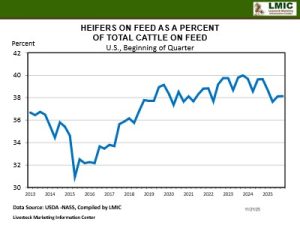
Steer placements were down 3.2 percent year over year with heifer placements down 3.1 percent. The percentage of heifers on feed was 38.7 percent, up 0.6 percent from October and unchanged from last January. Zero heifers from Mexico were placed in the fall months leading up to January 1, 2026, compared to the 145,585 head of Mexican heifers placed in the fall of 2024 before the closure in December 2024. The takeaway here is that even though the total number of heifers on feed has declined, that can likely be attributed to the lack of heifer placements from Mexico in 2025. The percentage of heifers on feed indicates that domestic heifers are not being largely retained as of now. The inventory report that will be released on the 30th will provide a clearer picture of how many heifers have been held back as replacements, overall cow numbers, and the supply of feeder cattle for 2026.
Questions, contact Hannah at h.baker@ufl.edu
See this update and other helpful resources online at https://rcrec-ona.ifas.ufl.edu/about/directory/staff/hannah-baker/
Written January 2026
 0
0