Preparing for Fall, Dormant Forages, & Drought
Fall is officially here! At the time of writing this in late September, temperatures are starting to cool off in the mornings and evenings as we head into the fall months. With this means that warm season perennials will begin heading into their dormant stages if they have not already. Thoughts about providing winter supplementation, grazing cool-season forages, and feeding hay are and should be on the forefront of producers’ minds in an effort to maintain body condition of cows. In the current market, an open cow means missing the opportunity of selling a high-priced calf.
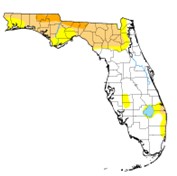
While most of the state has experienced plentiful rainfall, all of the Panhandle is experiencing abnormal and moderate drought conditions with some areas experiencing severe drought conditions on the FL/AL line (https://droughtmonitor.unl.edu/). This is no doubt forcing producers to start feeding hay earlier and maybe even cull cows and sell calves early. While now is a great time to sell cattle with cull cows bringing around $1.50/lb and calves bringing well over $4.00/lb, I believe the industry would like to start rebuilding at some point. So, this spell of drought in the Southeast is certainly not helping or encouraging expansion efforts.
Prices just keep climbing…
Another circumstance that is not yet encouraging expansion is high prices, incentivizing producers to sell heifers rather than retaining and to wean/sell calves earlier. At this time of year, we typically see a dip in prices as the majority of spring-born calves are being sold. Across the country, calves have been sold earlier this year due to everyone anticipating that seasonal decline and trying to get ahead of it. In Florida, historical price data shows that we usually start experiencing that seasonal decline in July when weaning starts, lasting until November or December.
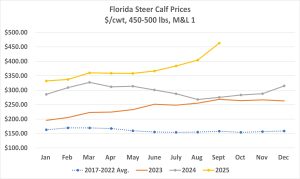
However, that has not been the case this year. Prices for calves have steadily increased since July, rather than decreasing. Florida prices in September for 450-500-pound steer calves were 68% higher year-over-year. It is safe to say that this fall-run is unlike in previous years. This is not to say that there will not be a seasonal decline going into October or later in the year. There could or could not be. We are in uncharted waters with this market. With that said, if there is a decline, it may not be as large as we have seen before. Demand is still very strong across the board, which is now the key driver of these prices. Feedlots still need calves, and low corn prices with high fed cattle prices are helping to reduce cost of gain. Packers still need carcasses, and high boxed beef prices are helping to mitigate some loss. Most importantly, consumers still very much want beef which is driving higher prices across all sectors.
Questions, contact Hannah at h.baker@ufl.edu
See this update and other helpful resources online at https://rcrec-ona.ifas.ufl.edu/about/directory/staff/hannah-baker/
Written September 2025
 1
1