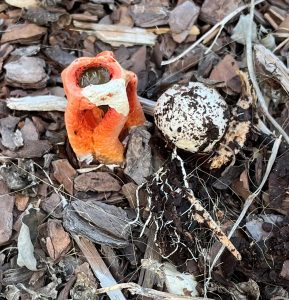
Mushrooms are creating a stink in Northwest Florida lately. A foul-smelling mushroom from the stinkhorn fungus is popping up in many of our landscapes. It is their odor that normally gets the
attention of a homeowner out in their landscape. The homeowner then tries to find what has died nearby and discovers the culprit, brightly colored, odd-shaped mushrooms, which are usually growing in wood mulch.
Stinkhorns, which belong to an order of fungi that include puffballs, earthstars and the bird’s nest fungi, produce mushrooms that smell like rotted meat. Their putrid odor motivates people to seek advice on control measures. Apart from the objectionable smell, stinkhorns are not a problem.
There are hundreds of different types of mushrooms in Florida. Even though many of the mushrooms are very visible, they are only the reproductive parts of a fungus. The mushrooms grow from fine thread-like or root-like structures called mycelia (singular mycelium), which normally go unseen. Mycelia can live for years in wood, living tissue or the soil.
The stinkhorn fungus is a decomposer. From this view point it is considered beneficial because it helps break down decaying plant material. Dr. Gary Simone, former UF/IFAS Extension Plant Pathologist, said, “Their ecological niche is one of composting grass, straw, wood chips or similar organic matter on the soil surface.”
The wet, warm environment of the southeastern United States provides a perfect home for these mushroom-producing fungi. Mushrooms are natural residents of Florida. Northwest Florida
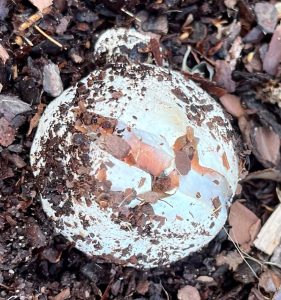
Credit: Larry Williams
receives 60 to 65 inches of rain per year, we have high humidity and warm, mild temperatures most of the year, plus we have a wealth of decaying plant material. This all adds up to fungi heaven.
Stinkhorn fungi start as white, egglike structures that are anchored to the soil by a root-like network (Mycelia). Only the top portion of the egg-like structure can be seen. Most of the “egg” is underground.
Simone said, “The egg-like structure contains a fully formed, miniature adult that is ready to expand to adult size upon availability of water.” It may only take an hour or so from the egg-rupturing stage to the mature stinkhorn mushroom.
Based on the type of stinkhorn, the fruiting structure (mushroom) will be either column, stalk-like, globular or lattice-like in shape. The mature mushroom varies in color, but most are pink to orange. They also vary from two to a little over six inches in height and from one-half to three inches in width.
All stinkhorn mushrooms possess foul odors.
Various insects, including flies, are attracted to the scent of stinkhorn mushrooms. Flies feed on the spore slime. After dining, they depart and transport spores for this fungus to other locations.
Simone said, “Stinkhorn fungi do not cause disease, in spite of their occurrence near declining trees and shrubs.” He said that their colonies may extend in all directions around the visible mushroom and that they persist for several years until their food source is exhausted. Most people I talk to about stinkhorns tell me the mushrooms are growing in an area where they have wood mulch. This fungus helps decompose the wood mulch.
Mushrooms from the stinkhorn fungus occur fall through spring.
The following are stinkhorn management options offered by Simone.
- Tolerance: Learn to live with them as they do represent beneficial organisms to the soil ecology in Florida. Keep windows closed during periods of mushroom production to minimize the odor problem indoors.
- Eradication: Hand-pick the “egg” stage before it ruptures and put it in a zipper bag in the garbage. Inverting the bag over your hand, like a glove, allows picking the mushroom without touching it. Then, simply fold the bag over the mushroom and close the bag. Small or new colonies may be eradicated through the complete removal of an area of mulch to the depth of the native soil. No guarantees with this method, though.
- Environment alteration: Use of ground covers, such as ivy, jasmine, liriope, mondo grass, etc., will serve to reduce stinkhorn incidence in a landscape. Distance large, mulched areas away from the house.
There are no legal, effective or practical chemical control options.
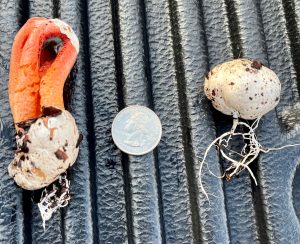
compared to quarter
Credit: Larry Williams
 1
1